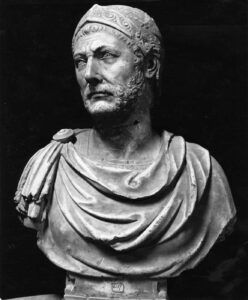
Hannibal Barca
Hannibal Barca (247–183 BC)
- Assumed command of Carthage's army at twenty-six, crossed the Alps with forty thousand infantry, eight thousand cavalry and thirty-eight war elephants, losing almost half his force to terrain and cold,1Wikipedia — Hannibal then destroyed three Roman armies in eighteen months — at the Trebia, Lake Trasimene, and Cannae — killing or capturing over a hundred thousand Roman troops in less than three years.2Wikipedia — Second Punic War
- At Cannae in 216 BC, surrounded and annihilated a Roman force of seventy thousand with an army of inferior numbers through a double envelopment that required every component of his multinational force to execute precisely on schedule without a common language — a tactical achievement that remains in military academy curricula two thousand years later.1Wikipedia — Hannibal
- Spent fifteen years campaigning in Italy without reinforcement, was denied the resources he needed by the Carthaginian peace faction throughout,3World History Encyclopedia — Hannibal was ultimately defeated at Zama, exiled, and continued advising Rome's enemies until Prusias of Bithynia was pressured into betraying him — dying by his own hand to deny Rome the satisfaction.4Britannica — Hannibal
Hannibal Barca is the dataset's most complete illustration of what happens when exceptional personal variables operate against a system that will not support them. The tactical genius is documented beyond dispute — Cannae remains in military academy curricula two thousand years after it was fought, the double envelopment studied by every generation of commanders from Scipio to Schlieffen.1Wikipedia — Hannibal The equations record that genius honestly. They also record, with equal honesty, the system behind the genius — the Carthaginian Council of Nobles, the peace party of Hanno II, the repeatedly denied reinforcements, the political opposition that valued its trade relationships with Rome more than it valued the general who had destroyed three Roman armies in eighteen months. Maharbal's verdict after Cannae — "you know how to gain a victory but not how to use one" — is the most quoted military criticism in ancient history. The equations suggest it was directed at the wrong man.
The Iberian command and Alpine crossing period establishes the variable profile at its most coherent. Hannibal assumed command at twenty-six, confirmed by the army before the Carthaginian government had formally ratified the appointment — which is itself a People score operating independently of institutional sanction.4Britannica — Hannibal The consolidation of Hispania south of the Ebro, the storming of Althaea, the tactical success at the River Tagus against a coalition of Spanish tribes that outnumbered his force — these are Ability and Process documented before the Italian campaign began.4Britannica — Hannibal The Alpine crossing is Conviction operating at maximum against an Environment that would have stopped any leader with a lower score. He calculated from the beginning that he would have to operate without aid from Hispania. He crossed the Alps anyway.
The Italian peak campaign is the profile's analytical centrepiece. Trebia, Lake Trasimene, Cannae — three successive battles in which Hannibal identified his opponent's psychology as precisely as he identified their tactical dispositions, and used both against them. The account of Lake Trasimene is analytically precise: he calculated that Flaminius, partly for fear of popular reproach and partly of personal irritation, would be unable to endure watching the devastation of the region he had been sent to protect, and would follow into the defile regardless of tactical risk. He was correct.3World History Encyclopedia — Hannibal Cannae is the Ability variable at its documented maximum — surrounding and destroying a force of seventy thousand with an army of inferior numbers through a double envelopment that required every component of his multinational force to execute precisely on schedule without a common language. That is Process and People operating at their highest recorded level in the Military domain.
The Maharbal question requires specific analytical attention because it has been misread for two millennia. The criticism assumes that Hannibal had the operational capacity to march on Rome after Cannae and chose not to. The equations ask a different question: what were his Resources at that point? He had no siege engines. Rome was fortified. His army had just fought one of the bloodiest battles in ancient history and was operating deep in hostile territory without a supply line.3World History Encyclopedia — Hannibal The Carthaginian government — which had denied him reinforcements following Cannae, had been blocking his requests for supplies and equipment since the campaign began, and was dominated by a peace faction that actively resented the war he was fighting on their behalf — was not going to provide the material required to besiege the capital. Maharbal was criticising Hannibal for not exploiting a victory that the system behind him had already made unexploitable. The Resource and Corporate Drag limitations the equations record in the Italian stalemate period belong primarily in those variables, not in Hannibal's personal variable profile.
The stalemate and Zama period is the most analytically precise record of institutional abandonment in the dataset. Fifteen years in Italy, operating without reinforcement, watching his veterans die without replacement, increasingly dependent on local mercenaries whose loyalty lasted only until there was no plunder to earn — and still winning battles.5EBSCO Research Starters — Hannibal The Romans eventually adopted the Fabian strategy not because it was their natural instinct — it was considered cowardice by many Romans — but because it was the only response to a general they could not defeat in open battle. That is a precise measurement of Ability operating against maximum adverse Environment.2Wikipedia — Second Punic War
Zama is the one tactical failure in his record. He faced Scipio with cavalry at a structural disadvantage following Masinissa's defection, and was defeated by the one Roman general who had studied him closely enough to counter his methods.3World History Encyclopedia — Hannibal The defeat does not revise the variable profile downward. It records what happens when exceptional Ability operates against genuinely superior operational conditions for the first time in a career defined by operating against inferior ones.
The post-war period is the dataset's clearest illustration of Conviction surviving total institutional defeat. Elected suffete of Carthage at forty-six, he enacted financial reforms eliminating aristocratic corruption. The reforms generated sufficient opposition from the oligarchs who had denied him reinforcements throughout the Italian campaign that they collaborated with Rome to force his exile.4Britannica — Hannibal He fled to the Seleucid court, advised Antiochus III, fought naval battles in the Aegean at the age of fifty-seven, and continued as a military asset to Rome's enemies until Prusias of Bithynia was pressured into betraying him. His final letter — "let us relieve the Romans from the anxiety they have so long experienced, since they think it tries their patience too much to wait for an old man's death" — is Conviction and Humility in a single sentence.
Polybius records that in seventeen years in the field, passing through barbarous countries and employing men of different nations and languages in desperate enterprises, no one ever conspired against Hannibal and no one who had once joined him ever deserted him.6Dickinson College Commentaries — Hannibal That is the People and Trust variables measured across the longest sustained operational period in the ancient world dataset. The Romans, who feared and hated him sufficiently to use his name as a byword for catastrophe for generations, built statues of him in the streets of Rome. The equations record why.
Score Comparison
Add up to 10 leaders. Click a name to visit their profile.
The 13 Equations
Scores for: Iberian Command — Alpine CrossingThe 22 Variables
Canonical scoresSources & Bibliography
The scores assigned to this leader are derived from publicly available sources. Variable inputs reflect documented behaviour, structural conditions, and historical record at the time of each snapshot.