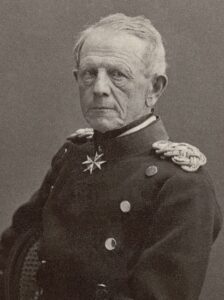
Helmuth von Moltke
Helmuth von Moltke (1800–1891)
- Served as Chief of the Prussian Great General Staff for thirty-one years from 1857 to 1888 — directing the planning and execution of three decisive wars in Schleswig (1864), Königgrätz (1866) and Sedan (1870) that unified Germany under Prussian leadership, defeated Austria in seven weeks and France in six, and established Prussia as the dominant land power in Europe.1Wikipedia — Moltke the Elder ↗
- Built the Prussian General Staff system into the operational template that every modern Western military would later copy — establishing the principles of Auftragstaktik (mission-type tactics), the systematic integration of railways and telegraph into military operations, and the doctrine that subordinate commanders should be told the objective and trusted to determine the method, producing a command culture whose tempo and adaptability his opponents could not match.2Britannica — Moltke the Elder ↗
- Wrote the maxim "no plan of operations extends with certainty beyond the first encounter with the enemy's main forces" — a statement of epistemic humility built into the doctrine of his Staff that has been repeatedly cited as the founding principle of modern strategic thinking, and that captures in seventeen words the philosophical core of the institutional system he constructed.3US Army CGSC — Moltke Operational Studies ↗
Helmuth Karl Bernhard Graf von Moltke was born on 26 October 1800 in Parchim, in the Duchy of Mecklenburg-Schwerin, the son of a Danish-Prussian soldier of declining means.1Wikipedia — Moltke the Elder ↗ He attended the Royal Cadet School in Copenhagen, served briefly in the Danish army, and transferred to Prussian service in 1822. The early decades of his career were spent on the periphery of Prussian military life: an extended assignment to the Ottoman army from 1835 to 1839 produced a topographical and ethnographic study of Asia Minor that established his reputation as a military scholar; subsequent assignments to the staff of Crown Prince Friedrich and to the Berlin General Staff provided the institutional foundation for what would later become his life's work. He spoke seven languages fluently. He published a study of Rome that was still cited a century later. He married Marie Burt, the English-born stepdaughter of his sister, in 1842; the marriage was childless and lasted until her death in 1868. His appointment as Chief of the Prussian Great General Staff in 1857, at the age of fifty-six, was the moment when the institutional system the framework reads in this profile begins. He held the position for thirty-one years, until 1888.2Britannica — Moltke the Elder ↗ During that period the Staff he built directed three wars to decisive victory: against Denmark in 1864 over Schleswig-Holstein, against Austria in 1866 in seven weeks of campaigning that culminated at Königgrätz, and against France in 1870 in six weeks that culminated at Sedan and the capture of Napoleon III. By the Treaty of Frankfurt in May 1871, the German Empire was proclaimed at Versailles, Prussia was unchallenged as the dominant land power in continental Europe, and the institutional system Moltke had built was the global standard for military command. The analytical profile of Moltke during the Wars of Unification reads as outstanding across most variables, with two genuinely distinctive readings on the personal-rigidity axis. The Defined Output variable scores high: three wars, three specific objectives, three decisive outcomes delivered on time and within the operational logic that Moltke had specified in advance. The Process variable scores at the same level. The Staff system he built — the selection, education, war-gaming, mobilisation tables, the integration of railways and telegraph into operational planning, the formalised practice of after-action analysis — was the most sophisticated operational machinery any military had produced to that point. Every Staff structure in every Western military since derives from Moltke's institutional design. The Intent variable Moltke essentially developed in its modern operational form. Auftragstaktik — the doctrine of mission-type orders — required that every officer in the chain understand the commander's intent clearly enough to act without further instruction when contact disrupted the plan. The shared mental mapping across the Staff was disciplined enough that subordinate commanders separated by hundreds of kilometres could converge on the same operational solution without communicating. This is one of the framework's worked examples of high Intent in a leadership system, achieved through institutional design rather than personal charisma. The Confidence and Conviction variables read as strong without reaching the framework's extreme upper bands. Moltke's confidence was calibrated, not grandiose. He was rigorously prepared and confident in his preparation. He was equally rigorous about the limits of preparation: the maxim that no plan extends with certainty beyond first contact with the enemy is itself a statement of disciplined humility, and it was built into the doctrine of his Staff. The combination of strong Confidence, strong Humility, and the framework floor on Ego is unusual at this level of professional achievement and is what makes Moltke a particularly clean example of the framework's reading. He was the most successful commander of his era and one of the most personally restrained. The Ego and Pride variables run at the framework floor of 3, and these are the two most distinctive readings in the profile. Moltke published almost nothing under his own name during his active service. He refused public celebration. He attributed victories to the Staff and to his subordinates. He continued to live modestly even after being ennobled as a Count and granted a personal estate after Sedan. His own writings about the wars he had directed were detached, analytical, and conspicuously free of self-praise. The Pride variable runs at the same floor: he revised his operational plans repeatedly when conditions changed (his rail-deployment plans for 1870 were revised six times in four years as the political situation evolved), and treated revision as routine rather than as concession. The framework's reading of low-Ego, low-Pride leadership at the apex of military command is one of the cleanest in the dataset, and it is what produces the Virtue and Trust readings the equations register downstream — high Congruence, high Humility, low Pride combine to produce a Virtue score that distinguishes Moltke from most of his contemporaries. The Recognition variable scores in the upper-mid band. Wilhelm I's confidence in him was substantial. Bismarck's respect was grudging but real, and survived the genuine tensions over political objectives in 1866 and 1870. The Reichstag elected him as a deputy repeatedly from 1867 until his death in 1891. Foreign militaries sent observers to learn from his Staff. The Visibility variable is moderate but lower than the standard for a commander of his stature, because Moltke was famously reticent about himself: the Staff was visible across Europe, but Moltke personally was a more private figure than his achievements would have predicted. The k variable for the Wars of Unification snapshot scores moderate positive. The strategic environment was favourable but largely foreseen — Austria distracted by Italian affairs, Russia recovering from Crimea, France under Napoleon III isolating itself. The unforeseen events that did arise mostly worked in Moltke's favour: Benedek's tactical errors at Königgrätz exceeded reasonable expectation, and the speed of the French collapse in 1870 exceeded reasonable expectation. The Imperial Decades snapshot, covering 1871 to 1888, reads differently. The strategic environment darkened as France recovered and Russia repositioned. The two-front war that Moltke had not had to fight in the Wars of Unification became increasingly foreseeable, and his Memorandum on the Risk of a Two-Front War from this period is one of the more prescient strategic documents of the nineteenth century. Ambition steps down because the goal had been achieved; the new task was institutional maintenance and the training of successors. The Defined Output variable drops because peacetime preparation has less defined output than wartime victory. He retired in 1888 at the age of eighty-eight, was elected to the Reichstag again, and died of a stroke at his Berlin home on 24 April 1891 in his ninety-first year. The institutional system he built outlasted him by decades, was copied by every Western military, and was inherited by his nephew Helmuth von Moltke the Younger when he became Chief of the General Staff in 1906 — a succession that did not go well, and that is treated separately in this dataset.
Score Comparison
Add up to 10 leaders. Click a name to visit their profile.
The 13 Equations
Scores for: Imperial Decades — 1871 to 1888The 22 Variables
Canonical scoresWhat changed: Wars of Unification — 1857 to 1871 → Imperial Decades — 1871 to 1888
Sources & Bibliography
The scores assigned to this leader are derived from publicly available sources. Variable inputs reflect documented behaviour, structural conditions, and historical record at the time of each snapshot.
- Wikipedia — Helmuth von Moltke the Elder
- Britannica — Helmuth von Moltke the Elder
- US Army CGSC — Moltke Operational Studies
- Hughes, D.J. — Moltke on the Art of War: Selected Writings (1993)
- Bucholz, A. — Moltke and the German Wars 1864-1871 (2001)
- Showalter, D. — The Wars of German Unification (2004)