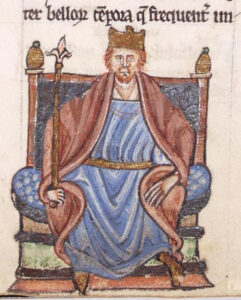
Henry II
Henry II (1133–1189)
- Born on 5 March 1133 at Le Mans in Maine — the eldest son of Empress Matilda and Geoffrey Plantagenet, Count of Anjou — entered the struggle for the English throne at fourteen, was made Duke of Normandy at seventeen, inherited Anjou on his father's death in 1151, married Eleanor of Aquitaine in 1152 acquiring her vast duchy, and in 1153 invaded England and forced Stephen to recognise him as heir1Wikipedia — Henry II — becoming at twenty-one the ruler of a domain stretching from the Scottish border to the Pyrenees, the largest concentration of territory under a single medieval ruler since the Carolingians.
- Inherited an England prostrated by twenty years of civil war — the Anarchy of Stephen's reign had allowed barons to seize royal lands, erect unlicensed castles, and displace royal justice with feudal authority — and spent his first decade systematically reversing it: recovering castles, restoring the Exchequer, establishing itinerant royal judges, and through the Assizes of Clarendon (1166) and Northampton (1176) creating the jury system and common law framework that remains the foundation of English and much of world jurisprudence today2Britannica — Henry II — while simultaneously appointing his chancellor Thomas Becket as Archbishop of Canterbury in 1162, expecting to control the Church through loyalty, and watching Becket transform overnight into its most determined defender.
- Survived the murder of Becket in Canterbury Cathedral on 29 December 1170 — his outburst of rage that inspired four knights to act recorded variously as "Will no one rid me of this turbulent priest?" — did public penance at Canterbury in 1174, crushed the Great Revolt of 1173–74 in which Eleanor, his eldest son Young Henry, Richard and Geoffrey all joined against him, imprisoned Eleanor for the remaining fifteen years of her life2Britannica — Henry II — and died at Chinon on 6 July 1189, defeated by his son Richard in alliance with Philip II of France, having learned two days before his death that his youngest and most beloved son John had joined the rebellion against him.
Henry II ruled England from 1154 to 1189 and built more of the institutional architecture of the modern British state than any monarch before him. He did it under conditions of constant personal turbulence — against the Church, against his barons, against his own family — that would have destroyed most leaders of his era. The equations capture both the extraordinary output and the mechanism of its partial undoing.
The restoration period is the most undervalued phase of his career and the one that sets everything else up. England in 1154 was a country whose institutional fabric had been systematically destroyed during nineteen years of civil war. Barons held castles they had no right to. The Exchequer had ceased to function. Justice was local, arbitrary, and feudal. Henry's first decade was an administrative reconstruction of unprecedented ambition: recovering royal lands, demolishing unlicensed castles, restoring financial machinery, and beginning the legal reforms that would eventually produce common law. The Process variable at this period is among the highest of any medieval ruler in the dataset — not because the tools were dramatic but because the method was systematic and the execution was consistent.3EBSCO Research Starters — Henry II
The canonical snapshot is the most analytically complex in the profile — not because the peak and the moral failure coincide in the same period, which they do, but because the same variable drives both. Pride at 7 explains why Henry appointed Becket as Archbishop: he could not accept that his closest ally would refuse him anything. It also explains why he could not manage the subsequent conflict without escalating it to the point where four knights believed they were doing his will by murdering the Archbishop in his own cathedral. The outburst that preceded the murder — however it was actually worded — is the Pride variable at its most operationally destructive, producing the single most politically costly unintended consequence in the Medieval Political domain dataset.4Ancient War History — Henry II and Becket
What redeems the canonical snapshot analytically is that Henry then corrected. The public penance at Canterbury in 1174 — walking barefoot through the city, being flogged by monks — was politically humiliating and personally courageous. It stabilised his relationship with the papacy, defused the Becket crisis, and freed him to continue the legal reforms. The Assize of Northampton in 1176 — institutionalising trial by jury and standardising royal justice across the kingdom — was passed after the Becket crisis rather than before it. The Humility variable records this: a leader who could absorb catastrophic personal defeat and continue to build.5Histories and Castles — Henry II
The Great Revolt of 1173–74 is the most analytically unusual event of his reign. His wife, his three eldest sons, and the kings of France and Scotland all rose against him simultaneously — a coalition that any objective assessment would have judged overwhelming. Henry won. His management of the crisis — rapid military response, strategic use of mercenaries, diplomatic isolation of the rebels, and ultimately an offer of reconciliation that avoided the mass executions his opponents had expected — is the People and Process variables operating at their ceiling under maximum competitive pressure. The k variable score at this period remains moderate despite the revolt, because Henry's institutional base — the common law courts, the Exchequer, the loyalty of England's middle-ranked landowners who had benefited from his legal reforms — held.
The late period is defined by the succession crisis that consumed him. He imprisoned Eleanor, managed his sons through a combination of concession and manipulation, and watched the coalition against him reassemble under Richard with Philip II's support. His last campaign failed. He died at Chinon having been told that John, his youngest and most beloved, had joined the rebellion. The People variable at the late period is the lowest in the profile — not because Henry's selection declined but because the system he had designed to succeed him was built around dynastic loyalty that was structurally incompatible with the strength of will he had also transmitted to his sons.
Britannica records that contemporaries agreed on his outstanding ability while also recording "errors and aspects of his character that appear contradictory." The equations do not require contradiction to be resolved — they record the Ego and Pride variables that produced both the Becket crisis and the Great Revolt's defeat, and the Process and Value variables that produced common law. Both are true. The number that matters most across all four snapshots is Value: the jury system, the principle of royal justice available to all subjects, and the institutional architecture of the English state are still running in modified form today. That is the definition of maximum Value.
Score Comparison
Add up to 10 leaders. Click a name to visit their profile.
The 13 Equations
Scores for: Great Revolt and Final Years — Victory and DefeatThe 22 Variables
Canonical scoresWhat changed: Becket Crisis and Legal Consolidation — Peak and Fracture → Great Revolt and Final Years — Victory and Defeat
Sources & Bibliography
The scores assigned to this leader are derived from publicly available sources. Variable inputs reflect documented behaviour, structural conditions, and historical record at the time of each snapshot.