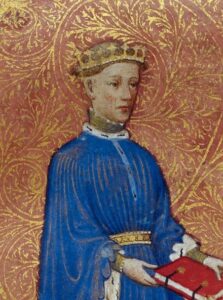
Henry V
Henry V (1386–1422)
- Born on 16 September 1386 in Monmouth — eldest son of Henry Bolingbroke who seized the throne as Henry IV in 1399, leaving the young prince heir to a crown of contested legitimacy — gained his first military command at sixteen at the Battle of Shrewsbury in 1403 where he took an arrow to the face and remained on the field1Wikipedia — Henry V — spent the next decade commanding in Wales against Owain Glyndŵr's rebellion and pressing for a role in his ailing father's council, becoming the first English king who could both read and write with ease in the vernacular tongue.2Britannica — Henry V
- Ascended the throne in March 1413 at twenty-five, spent two years in methodical preparation, crossed to France in August 1415 with approximately 11,000 men, besieged Harfleur for five weeks at the cost of a third of his army to dysentery, then marched 200 miles toward Calais in sixteen days — exhausted, filthy, and seriously weakened — before meeting a French army of between 12,000 and 36,000 at Agincourt on 25 October 1415 and defeating it in under three hours, killing approximately 6,000 Frenchmen at a cost of under 400 English dead.3Britannica — Battle of Agincourt
- Returned to France in 1417, conquered Normandy systematically by 1419, entered Paris, and by the Treaty of Troyes in May 1420 was recognised as regent of France and heir to the French throne — the largest holding of French territory by an English king since the Angevin Empire1Wikipedia — Henry V — before dying of dysentery at Vincennes on 31 August 1422 at thirty-five, nine weeks before the French king he was due to succeed, leaving a nine-month-old heir and a French empire that would be entirely lost within thirty years.
Henry V ruled England from 1413 to 1422. In nine years he restored English military credibility after half a century of failure, came closer than any English king since the Angevin period to realising the claim to the French throne, and died before he could consolidate any of it. The arc is a compressed version of the most characteristic pattern in this dataset: exceptional variables producing exceptional results, destroyed not by failure of leadership but by the one variable the equations cannot control — biology.
The pre-king period is the most analytically undervalued phase of his record. The prince who fought at Shrewsbury at sixteen was not performing courage — he took an arrow to the face and remained in command. The prince who spent a decade suppressing Glyndŵr's rebellion in Wales was learning, at the most granular operational level, what it took to reduce a fortified position, sustain a campaign over years, and manage men under sustained adversity.2Britannica — Henry V Britannica's assessment — that his military strategy stands in marked contrast with the haphazard operations of the previous century — is the Process variable at its formation stage. He did not arrive at Agincourt as an inspired amateur. He arrived as the product of fifteen years of operational learning.
The Agincourt campaign is the canonical snapshot and the Codex's most straightforward military profile. The Defined Output was precise: take Harfleur, demonstrate English martial credibility, return to Calais. The decision to march overland after losing a third of his army — against his council's advice — is where Conviction and Humility operated simultaneously in a combination the equations reward: he consulted commanders, heard the arguments against, then made a decision grounded in strategic rather than personal logic. The terrain selection at Agincourt — a recently ploughed field between two woods that neutralised French numerical advantage — is the Process variable at its ceiling.4World History Encyclopedia — Battle of Agincourt
The Congruence variable at this period requires direct acknowledgement. Henry ordered the execution of French prisoners at Agincourt — potentially 2,200 men, some burned alive in a farmhouse — and refused passage to civilian women and children expelled from Rouen during the siege, leaving them to starve in the ditches. He framed both decisions in military necessity rather than chivalric principle.1Wikipedia — Henry V The gap between his stated chivalric code and these documented actions is real and the equations record it. It does not collapse his scores because the gap is less pervasive than in profiles where Congruence failure runs through the entire record — these are specific, documented decisions under operational pressure rather than a systematic pattern. But it prevents the profile from presenting an uncomplicated hero.
The Treaty of Troyes snapshot reflects a leader at the maximum extent of his achievement — regent of France, heir to the French throne, married to Catherine of Valois — operating against a k variable that had been almost maximally favourable throughout his campaigns. France was paralysed by the Burgundian-Armagnac civil war; Charles VI was incapacitated; the political architecture of French opposition had been destroyed by Agincourt and the subsequent campaigns. What the equations also record at this snapshot is the beginning of Resource depletion: seven years of continuous campaigning had exhausted the financial base he had assembled, the currency debasing pressure that would follow his death was already building, and the system had no succession plan that could sustain what he had built.5World History Encyclopedia — Henry VIII
He died on 31 August 1422, thirty-five years old, of dysentery — the disease that had been killing his men since Harfleur. The French king he was due to succeed died nine weeks later. His heir was nine months old. Everything he had built depended on him personally, and he was gone. The Defined Output variable at maximum cannot compensate for a succession architecture that requires the leader to remain alive.
Shakespeare immortalised him in the St Crispin's Day speech — a leader who could make men want to fight when they were outnumbered and exhausted. The Codex records something adjacent but more precise: a leader with the highest Conviction score in the Military domain dataset, a Process architecture that was genuinely ahead of its time, and an Environment so favourable that the same qualities in a less hospitable context might have produced a very different result. Henry V at Agincourt was the right leader at the right moment with the right method. That the moment lasted nine years and he died before it resolved is not a leadership failure. It is the k variable operating at its most unforgiving.
Score Comparison
Add up to 10 leaders. Click a name to visit their profile.
The 13 Equations
Scores for: Prince of Wales — Military FormationThe 22 Variables
Canonical scoresSources & Bibliography
The scores assigned to this leader are derived from publicly available sources. Variable inputs reflect documented behaviour, structural conditions, and historical record at the time of each snapshot.