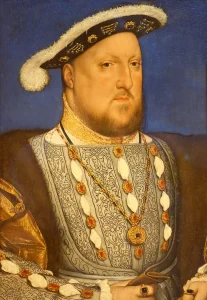
Henry VIII
Henry VIII (1491–1547)
- Born on 28 June 1491 in Greenwich, the second son of Henry VII — his elder brother Arthur died in 1502 leaving him heir at ten, his mother Elizabeth of York died the following year, and he ascended the throne at seventeen in April 1509 having been educated for the Church before being redirected to kingship1Wikipedia — Henry VIII — greeted by Thomas More and Erasmus as the embodiment of the Renaissance prince: learned, athletic, musical, fluent in Latin, physically magnificent, and genuinely charismatic in a way that his careful, suspicious father had never been.
- When Pope Clement VII refused to annul his marriage to Catherine of Aragon, Henry did not accept defeat — he passed legislation severing England and Ireland from Rome, declared himself Supreme Head of the Church of England through the Act of Supremacy in 1534, dissolved 800 monasteries between 1536 and 1540 transferring a fifth of England's landed wealth to the Crown and its allies2Wikipedia — Dissolution of the Monasteries — executed Thomas More, John Fisher, Thomas Cromwell, Anne Boleyn, Catherine Howard, and thousands for treason — and in doing so created the constitutional and religious architecture of modern England, though he left it impoverished, religiously fractured, and with a nine-year-old heir.
- Died on 28 January 1547 at fifty-five, having married six times in pursuit of a male heir and produced one sickly boy, two daughters both declared illegitimate at various points, and a succession so unstable it produced three monarchs in six years3The Royal Family — Henry VIII — his treasury spent, his currency debased, his kingdom divided between Catholic and Protestant factions he had personally created, and his greatest minister executed on his orders.
Henry VIII ruled England from 1509 to 1547, transforming a stable, orthodox Catholic kingdom into the constitutional and religious architecture of early modern Britain. The transformation was real, consequential and lasting. So was the mechanism: the systematic subordination of every institution, relationship and value to a single man's will.
He ascended the throne as the most admired young king in Europe. Thomas More and Erasmus both wrote of the new reign with genuine excitement — here was a prince who could read Aquinas and Erasmus in Latin, compose music, joust, and charm ambassadors simultaneously. His father had left him a full treasury and a unified kingdom. Henry VII had been careful and defensive; his son arrived as the opposite of all that.4Britannica — Henry VIII Legacy
The early reign's variable profile reflects the reality behind that reputation. His Conviction and Ambition were very high but his Defined Output in this period was diffuse — wars with France that cost more than they gained, an alliance system managed primarily by Wolsey rather than Henry. The Charisma variable at its peak in this period is among the highest in the Political domain dataset. The Humility variable is not. From the beginning, Henry ruled as if disagreement were treachery — a disposition that cost him Thomas Wolsey, Thomas More, John Fisher, and eventually every significant minister of his reign.
The Break with Rome is the canonical snapshot and the analytically decisive one. The driver was personal: he wanted an annulment, the Pope would not grant it, the Holy Roman Emperor Charles V controlled the Pope, and Henry's will was not accustomed to obstruction. What followed was not a principled Reformation — he executed Protestant reformers as well as Catholic loyalists, maintained the doctrine of transubstantiation, and continued to regard himself as a faithful Catholic who had simply removed a foreign usurper from authority over the English Church.5History Hit — Key Changes Under Henry VIII
The Congruence variable at this period records that gap precisely. The stated justification — that the Pope had no legitimate authority over the English Church — was theologically constructed after the fact to support a conclusion Henry had already reached for personal reasons. The methods — the Act of Supremacy, the Dissolution, the executions of More and Fisher — were instrumentally coherent but morally disconnected from any stated principle beyond royal will. The equations record high Autonomy, high Defined Output, high Resources — and a Congruence score that reflects a leader who had stopped distinguishing between what he wanted and what was right.
The Dissolution of the Monasteries is the period's most consequential administrative act. 800 religious houses dissolved, a fifth of England's landed wealth transferred to the Crown and distributed to loyal nobles, the social infrastructure of Catholic England dismantled at a rate of fifty institutions per month by the end.2Wikipedia — Dissolution of the Monasteries The Pilgrimage of Grace — 40,000 people in arms in the North — was suppressed and its leaders executed. The equations record this as maximum Autonomy operating against minimum Competition: the institutional opposition had been eliminated and the popular opposition was crushed.
The late reign is where the variable profile collapses. Cromwell executed in 1540 on trumped-up charges, currency debased to fund French wars that produced only Boulogne, health deteriorating into the obesity and leg ulcers that made movement painful, paranoia deepening. Where the early reign had ministers of genuine ability functioning with reasonable latitude, the late reign had a court of flatterers operating in a climate of terror. The process variable falls because no coherent administrative architecture survived Cromwell's removal. The Defined Output variable falls because the succession — the single objective that had driven everything — remained insecure. One legitimate male heir, aged nine, and a Protestant minority government-in-waiting.
What the equations capture — and what the popular narrative centred on the six wives tends to obscure — is that Henry VIII was a genuinely extraordinary leader in the technical sense for a specific period, and a catastrophically destructive one across his full reign. The peak snapshot produces a high score because the variables that drive effective power were, for a window, genuinely exceptional. The arc from that peak to the late reign is one of the steepest declines in the dataset — driven not by external reversal but by the progressive elimination of every corrective mechanism the system contained.
Herodian's verdict on Marcus Aurelius was that he proved his quality by blameless character. Henry VIII proved his quality by will alone. That is a different equation — and it produces a different result.
Score Comparison
Add up to 10 leaders. Click a name to visit their profile.
The 13 Equations
Scores for: The Caged Prince — FormationThe 22 Variables
Canonical scoresSources & Bibliography
The scores assigned to this leader are derived from publicly available sources. Variable inputs reflect documented behaviour, structural conditions, and historical record at the time of each snapshot.