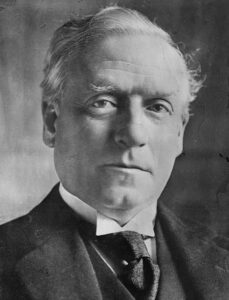
Herbert Asquith
Herbert Asquith (1852–1928)
- Herbert Henry Asquith — son of a Yorkshire wool merchant, Balliol scholar, barrister, MP from 1886, Home Secretary under Gladstone, Chancellor of the Exchequer under Campbell-Bannerman, and Prime Minister from April 1908 to December 1916 — led the most legislatively productive Liberal government in British history, took Britain into the First World War, introduced the Parliament Act stripping the Lords of their veto, laid the foundations of the welfare state through the People's Budget and National Insurance, and was removed from office in December 1916 by a coalition of Conservative ministers and his own Chancellor in a political manoeuvre that ended his premiership, destroyed the Liberal Party as a governing force, and made Lloyd George Prime Minister — a sequence whose consequences for British politics outlasted both men.1Britannica — H.H. Asquith
- The pre-war legislative record — the Parliament Act of 1911, the National Insurance Act, the People's Budget, Irish Home Rule, Welsh Disestablishment, and the payment of MPs — represents the most concentrated burst of constitutional and social reform since the Grey administration of 1830 to 1834, achieved against the most sustained institutional resistance of any peacetime government of the twentieth century, with a House of Lords veto that required two general elections and a constitutional crisis to overcome.2UK Parliament — Parliament Act 1911
- The wartime record from August 1914 to December 1916 — managing coalition government, the shell crisis, Gallipoli, conscription, the Easter Rising, and the Somme — is the most analytically contested period of the premiership: a leader of genuine intellectual distinction and exceptional peacetime capability operating in a crisis environment that demanded variables he did not possess in sufficient quantity, and whose removal, however it was engineered, produced a more effective war leadership in Lloyd George at a cost to the Liberal Party from which it never recovered.3Britannica — H.H. Asquith
Herbert Asquith is the most precisely calibrated illustration in the British Political domain of the difference between peacetime and wartime leadership variables. He was among the most capable peacetime Prime Ministers of the twentieth century — intellectually exceptional, legislatively productive, constitutionally courageous — and among the least equipped for the specific demands that industrial warfare placed on an executive. The equations capture both assessments without requiring either to cancel the other.
The formation period establishes the intellectual baseline with unusual clarity. Asquith's Balliol career — first class in Greats, the Craven Scholarship, the reputation as the most formidable mind of his generation at Oxford — produced a Process and Ability variable baseline that the subsequent career consistently reflected.1Britannica — H.H. Asquith The barrister career that followed gave him a Communication variable built on forensic precision rather than rhetorical flourish — he could dismantle an argument with a completeness that parliamentary opponents found difficult to counter, and construct a legislative case with a logical architecture that the Commons found persuasive. The Humility variable in this period is analytically higher than the subsequent career suggests — the young Asquith was genuinely open to intellectual correction in a way that the long years in office eventually narrowed.
The Home Secretary period under Gladstone from 1892 to 1895 established the operational baseline. Asquith managed the Featherstone Massacre — in which troops fired on striking miners in Yorkshire, killing two — with a combination of legal correctness and political tin ear that prefigured the wartime communication failures.4Oxford DNB — H.H. Asquith The decision was legally defensible. The communication of it was not. The Communication variable at this snapshot records a pattern that runs through the entire career — Asquith could articulate a position with forensic precision and fail to understand why the precision was insufficient for the political context.
The Chancellor of the Exchequer period under Campbell-Bannerman from 1905 to 1908 is where the People variable reaches its highest pre-premiership expression. Asquith's management of the relationship with Lloyd George — whom he identified as the most politically creative mind in the Liberal Party and whose People's Budget he subsequently championed against Lords opposition — reflects a leader who could recognise capability that was radically different from his own and give it institutional space to operate.1Britannica — H.H. Asquith The irony embedded in this assessment is that the same People variable that identified Lloyd George as the most useful instrument available eventually failed to manage Lloyd George as a political threat — the same capability that made the pre-war government productive made the wartime government vulnerable.
The constitutional crisis of 1909 to 1911 is the canonical snapshot and the most analytically precise expression of the Decisiveness and Conviction variables in the profile. The Lords' rejection of the People's Budget in November 1909 — constitutionally unprecedented, since the Lords had not rejected a finance bill in two centuries — required Asquith to call two general elections in a single year, secure a royal guarantee of the creation of sufficient Liberal peers to pass the Parliament Bill if the Lords rejected it, and manage the internal Liberal coalition through a constitutional crisis that lasted two years.2UK Parliament — Parliament Act 1911 The Decisiveness variable at this moment is the highest in the profile — Asquith identified the constitutional mechanism required, secured the royal guarantee through sustained and precise negotiation with George V, and deployed the threat of peer creation with sufficient credibility to produce enough Lords abstentions to pass the Bill without its actual use. That is the same mechanism Grey had used in 1832, and Asquith deployed it with the same analytical precision.
The National Insurance Act of 1911 — passed in the same parliamentary session as the Parliament Act — reflects the Process and Defined Output variables operating at their ceiling simultaneously across two legislative tracks of transformative consequence.5UK Parliament — National Insurance Act 1911 The management of the cabinet through the Lords crisis while simultaneously driving the welfare state legislation through the Commons reflects a Process variable operating at a level of institutional complexity that most Prime Ministers do not face in peacetime. The People variable at this snapshot is strong — Lloyd George at the Treasury, Churchill at the Board of Trade and then Home Office, Grey at the Foreign Office represent a cabinet of genuine collective capability whose management Asquith handled with a judicial authority that the peacetime environment rewarded.
The Irish Home Rule crisis of 1912 to 1914 is the most analytically complex domestic challenge of the pre-war period and the one that most directly captures the limits of the Adaptability variable. Asquith had introduced Home Rule as a legislative commitment, was navigating the Ulster crisis that Bonar Law was systematically intensifying, and was managing a cabinet divided between those who considered coercion of Ulster acceptable and those who did not.6Britannica — Home Rule Bills The Curragh Incident of March 1914 — in which British Army officers indicated they would resign rather than enforce Home Rule against Ulster — was the most severe challenge to civilian control of the military in British political history, and Asquith's management of it reflected the Communication and Decisiveness variables under maximum institutional pressure. He resolved it without the government collapsing, which was the minimum required outcome and was achieved, but the Ulster question remained unresolved when the war began four months later.
The wartime period from August 1914 is where the variable profile diverges most sharply from the peacetime record. Asquith's management style — deliberate, judicial, consensual, reliant on cabinet collective decision-making — was precisely suited to the legislative complexity of the pre-war period and precisely unsuited to the executive speed that industrial warfare demanded.3Britannica — H.H. Asquith The shell crisis of 1915 — in which the British Expeditionary Force was reported to be losing battles for lack of artillery ammunition — was as much a Communication and Process failure as a supply failure: Asquith had not constructed the executive machinery to identify and resolve industrial bottlenecks at the speed the military situation required. The Adaptability variable at this snapshot is the lowest in the profile — he could not shift from the judicial cabinet style to the executive command style that the war demanded, and he could not acknowledge that the shift was necessary without undermining the constitutional framework he had spent his career constructing.
The December 1916 removal is the terminal variable failure and the one that most precisely captures the People variable at its most consequential low point. Asquith failed to read the political manoeuvre that Lloyd George and the Conservative ministers were constructing against him — not because the information was unavailable but because his model of how political relationships operated did not include the possibility that Lloyd George would move against him directly.4Oxford DNB — H.H. Asquith The People variable that had correctly identified Lloyd George as the most useful instrument available had failed to maintain sufficient awareness of how that instrument was being directed. The removal itself — and Asquith's subsequent refusal to serve under Lloyd George — reflects a Pride variable that the profile had not previously required to be tested at this level, and which failed the test.
The post-premiership period from 1916 to 1926 is defined by the destruction of the Liberal Party as a governing force — partly through the Asquith-Lloyd George split, partly through the structural changes in the British electorate that the 1918 franchise extension produced, and partly through Asquith's inability to construct a political strategy that addressed either.1Britannica — H.H. Asquith The Adaptability variable at this snapshot is the lowest in the profile — a leader who had demonstrated exceptional Adaptability within the constitutional framework he understood, operating without the capacity to adapt to a political landscape that had changed structurally beyond the framework's boundaries.
The number that matters most across all four snapshots is the Process variable — specifically the gap between its peacetime and wartime expression. Asquith built the most effective legislative process of any Liberal government in British history, managing multiple simultaneous constitutional and social reform tracks with a judicial precision that the Commons and cabinet machinery rewarded. The same variable profile — consensual, deliberate, constitutionally rigorous — could not construct the executive war machine that industrial conflict required. That gap is not a failure of character. It is the record of a variable profile optimised for one environment encountering a different one without the Adaptability to bridge them. That is the Leaderment profile of Herbert Asquith.
Score Comparison
Add up to 10 leaders. Click a name to visit their profile.
The 13 Equations
Scores for: Removal and Liberal DeclineThe 22 Variables
Canonical scoresWhat changed: Wartime Premier — Shell Crisis and Coalition → Removal and Liberal Decline
Sources & Bibliography
The scores assigned to this leader are derived from publicly available sources. Variable inputs reflect documented behaviour, structural conditions, and historical record at the time of each snapshot.