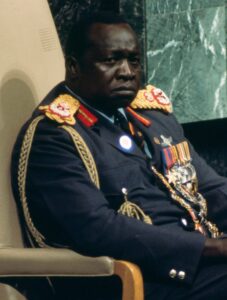
Idi Amin
Idi Amin (c.1924–2003)
- Seized power in a military coup on 25 January 1971 while President Obote was attending the Commonwealth summit in Singapore, with the assistance of Israeli government agents and to the evident satisfaction of Western powers who considered Obote's leftward drift a threat to their interests1Wikipedia — Idi Amin — then in August 1972 ordered the expulsion of Uganda's entire Asian community within ninety days, expropriated their businesses and properties, and handed them to supporters who lacked the expertise to run them, destroying an estimated ninety percent of the country's tax revenue base in a single decision.2House of Lords Library — Ugandan Asian Expulsion
- Chaired the Organisation of African Unity in 1975, facilitated the Entebbe hijacking in 1976 — allowing Palestinian and German hijackers to hold hostages at his airport, then watching Israeli commandos fly in, kill his soldiers and free them in an operation broadcast globally1Wikipedia — Idi Amin — had the Anglican Archbishop of Uganda murdered in 1977, survived eight coup attempts, and ordered the invasion of Tanzania's Kagera region in November 1978 in a military adventure that precipitated the war that ended his rule.3History.com — Idi Amin
- Fled by helicopter on 11 April 1979 when Kampala fell to Tanzanian and Ugandan exile forces, lived in exile in Libya, then Iraq, then Saudi Arabia, never expressed remorse, maintained in interviews that Uganda needed him, and died in Jeddah in August 20034Britannica — Idi Amin — having been responsible for between 100,000 and 500,000 deaths and leaving Uganda requiring decades of recovery.
Idi Amin presents the Codex with its most analytically uncomfortable profile in the Political domain. The discomfort is not analytical — the framework handles the variable configuration without difficulty. The discomfort is that the framework must record, without moral adjudication, that a leader responsible for between 100,000 and 500,000 deaths, the destruction of a functioning economy, and eight years of systematic ethnic persecution held genuine operational power for the entirety of his rule. Powerless is not a rating the Codex can honestly apply to a man who chaired the Organisation of African Unity, survived eight coup attempts, expelled 80,000 people from a country in ninety days, and held the presidency of Uganda from 1971 to 1979. The Codex records what the variables produced. What they produced for Amin is a trajectory of declining but real operational power consuming itself from within.
The coup and early rule period is where the structural conditions were most favourable. Amin seized power in January 1971 while President Obote was attending the Commonwealth summit in Singapore, with the assistance of Israeli government agents and to the evident satisfaction of Western powers who considered Obote's leftward drift a threat to their interests.1Wikipedia — Idi Amin Crowds cheered in the streets of Kampala. He received immediate military and financial support from the United Kingdom and Israel. He held the full apparatus of state — the army, the intelligence services, the civil administration — and rapidly replaced all of it with structures loyal to himself personally rather than to any institutional principle. The State Research Bureau became the operational centre of torture and extrajudicial killing. Military tribunals were placed above civil law. Soldiers were appointed to government positions. He ruled by decree.
The Autonomy variable at its ceiling in this period is not a rhetorical claim. He answered to nobody. The Bureaucracy and Corporate Drag variables at their floor reflect that he had systematically dismantled every institutional constraint that might have generated friction — surrounding himself with ethnic loyalists drawn from the Kakwa, Lugbara and South Sudanese communities who constituted the dominant majority of his top generals and cabinet by 1977.5EBSCO Research Starters — Idi Amin The violence was a structural feature of the administration, not an aberration from it.
The expulsion of Uganda's Asian community in August 1972 is the single most consequential self-inflicted variable event in the profile. Asians accounted for approximately ninety percent of the country's tax revenue and formed the operational backbone of the commercial economy. Amin expelled all 80,000 within ninety days, expropriated their businesses and properties, and handed them to supporters who lacked the operational expertise to run them. Industries collapsed. Government revenue evaporated. The economy entered a terminal decline from which it did not recover during his rule.2House of Lords Library — Ugandan Asian Expulsion The Resources variable begins its descent from this point and does not recover. The Codex records this as the moment where Pride — the conviction that the decision was correct regardless of its consequences — overrode every operational calculation available to him.
The consolidation and international isolation period records the progressive deterioration of every structural variable except Autonomy and Chaos. He pivoted from Israeli and Western support to Libyan and Soviet backing after the break with Israel in 1972, securing military hardware that eventually included tanks, jets and missiles.4Britannica — Idi Amin He chaired the OAU in 1975. He facilitated the Entebbe hijacking in 1976, allowing Palestinian and German hijackers to hold hostages at Entebbe Airport and then watching Israeli commandos fly in, kill his soldiers, and free the hostages in an operation broadcast globally — demonstrating the operational incompetence of his military to the world.1Wikipedia — Idi Amin The United Kingdom broke diplomatic relations. The international isolation that followed was not an external imposition. It was the arithmetic consequence of his own decisions.
The Chaos variable elevated throughout the profile is the Codex recording that Ego and Pride were operationally damaging but had not reached the terminal level that prevents all functional decision-making. He was still making decisions. He backed down from Kenya when their army deployed along the border in 1976. He negotiated rather than fought when the circumstances required it. He managed his ethnic coalition with sufficient political skill to survive eight coup attempts. The decisions were consistently catastrophic for Uganda but they were decisions — analytically different from the complete operational collapse that maximum Chaos would record.
The decline and paranoia period documents the progressive fragmentation of the coalition that had sustained him. The murder of Archbishop Janani Luwum and two cabinet ministers in 1977 accelerated ministerial defections.6EBSCO Research Starters — Idi Amin Flees Uganda By 1978 the split between Amin's supporters and those loyal to his Vice President Adrisi had produced effective factions within the Uganda Army itself. The People variable declining through this period records the erosion of the ethnic patronage network that had been his primary operational mechanism. When the network fragmented, the capacity to govern fragmented with it.
The Tanzania war and exile period ends the profile with a military adventure that historians and his own generals considered irrational. The invasion of Tanzania's Kagera region in November 1978 produced the comprehensive response it predictably generated. Julius Nyerere mobilised the Tanzania People's Defence Force with Ugandan exile forces and drove steadily toward Kampala. Libyan troops sent by Gaddafi to assist retreated. The Uganda Army collapsed.6EBSCO Research Starters — Idi Amin Flees Uganda Amin fled by helicopter on 11 April 1979 when Kampala fell.
He lived in exile in Libya, then Iraq, then Saudi Arabia, where the Saudi royal family provided sanctuary and a subsidy in exchange for political silence. He never expressed remorse. During interviews in Saudi Arabia he maintained that Uganda needed him. He died in Jeddah in August 2003.4Britannica — Idi Amin The Codex records a profile in which Ego and Pride at their elevated levels produced Chaos that consumed every other variable progressively from 1972 onward — not in a single catastrophic event but in a sustained eight-year process of institutional destruction, economic vandalism and human slaughter that left Uganda requiring decades of recovery. The profile's most analytically significant reading is not the scores. It is Trust at its floor and Value at its floor simultaneously with Autonomy at its ceiling. That combination — total operational freedom producing near-zero institutional trust and near-zero value delivered — is the Codex's most precise description of what tyranny looks like in variable form.
Score Comparison
Add up to 10 leaders. Click a name to visit their profile.
The 13 Equations
Scores for: Tanzania War — ExileThe 22 Variables
Canonical scoresWhat changed: Decline — Paranoia → Tanzania War — Exile
Sources & Bibliography
The scores assigned to this leader are derived from publicly available sources. Variable inputs reflect documented behaviour, structural conditions, and historical record at the time of each snapshot.