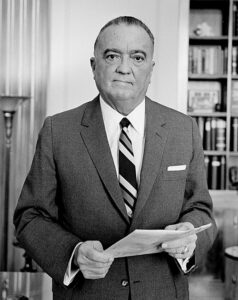
J. Edgar Hoover
J. Edgar Hoover (1895-1972)
- Served as Director of the FBI for forty-eight years across eight presidencies — from Calvin Coolidge to Richard Nixon — transforming what was a modest Bureau of Investigation in 1924 into the world's most technically advanced federal law enforcement agency, establishing centralised fingerprint files, a national forensic laboratory, and a training academy that set the standard for professional policing across America.1Wikipedia — J. Edgar Hoover ↗
- Maintained seventeen thousand pages of secret files across one hundred and sixty-five dossiers on sitting presidents, senators, judges, civil rights leaders, celebrities and journalists — using intelligence gathered through illegal wiretapping, informants and surveillance to blackmail opponents, protect his directorship from removal, neutralise political enemies including Martin Luther King Jr., and accumulate personal power without democratic accountability for nearly five decades.2Daily Beast — Hoover's Secret Files ↗
- Publicly denied the existence of the American Mafia for decades while simultaneously maintaining personal files on Mafia figures that were later shown to include material potentially usable for blackmail — with credible historical evidence suggesting that Meyer Lansky held compromising photographs of Hoover that may have contributed to the FBI's sustained refusal to pursue organised crime until the 1957 Apalachin meeting made denial impossible.3Mob Museum — J. Edgar Hoover ↗
John Edgar Hoover was born on 1 January 1895 in Washington D.C., the son of federal civil servants, and grew up in the shadow of the Capitol building in a household where government service and institutional loyalty were the dominant values.4Study.com — J. Edgar Hoover ↗ He studied law at George Washington University, earned a Master of Law degree in 1917, joined the Department of Justice immediately, and by 1919 was serving as special assistant to Attorney General A. Mitchell Palmer — playing a leading role in the Red Raids, the mass roundup and deportation of suspected Bolsheviks and anarchists, at the age of twenty-four. He was appointed Director of the Bureau of Investigation in 1924 at the age of twenty-nine. The analytical framework for Hoover requires the same dual-register treatment applied to Riefenstahl: the institutional and the moral variables point in opposite directions, and the equations must process both. The institutional achievement is genuine and large. He recruited on merit rather than political patronage, established professional training standards, built the Technical Laboratory that became the world's model for forensic science in law enforcement, created the national fingerprint database, and produced a series of high-profile arrests of gangsters in the 1930s that made the Bureau a household name.5Legends of America — Hoover ↗ The Process and Ability variables in his profile reflect a man who understood, with exceptional clarity, how bureaucratic institutions accumulate power and how that power can be defended against political interference. The Congruence variable is where the profile diverges sharply from the institutional narrative. Hoover's stated values — the rule of law, the impartial administration of justice, the protection of the American public — were systematically contradicted by his actual conduct. He sent an anonymous blackmail letter to Martin Luther King Jr. shortly before King accepted the Nobel Peace Prize, interpreted by King as encouraging him to commit suicide.1Wikipedia — J. Edgar Hoover ↗ He compiled files on the sexual conduct of senators and presidents and used them to signal that he knew what he knew. He denied the existence of the Mafia for thirty years while simultaneously operating COINTELPRO against civil rights organisations. He was, in the analytical vocabulary of the Codex, a faker of the institutional register: his public role as America's top lawman was the platform from which he pursued private power that had nothing to do with law enforcement. The Bureaucracy variable in his profile scores near its ceiling — not because he was subject to bureaucratic constraint but because he weaponised bureaucratic process as a tool of personal power. The distinction matters analytically: most leaders score high on Bureaucracy because it limits them. Hoover scores high because he generated it deliberately, around himself, as protection. The seventeen thousand pages of secret files were the administrative infrastructure of personal sovereignty within a democratic state.6First Amendment Encyclopedia — Hoover ↗ He died at his desk on 2 May 1972, aged seventy-seven, still Director, the only person ever to hold the position for life. The morning after his death, his personal aide destroyed the most sensitive files as instructed. The remaining files were transferred to the National Archives in 2005. President Truman had wanted him fired as early as 1945. Every subsequent president kept him in post. The equations record what forty-eight years of institutional power built on personal blackmail actually produces: high Process, high Bureaucracy, high Ability, near-zero Congruence, and negative Value.
Score Comparison
The 13 Equations
Scores for: Building the FBI — 1924 to 1945The 22 Variables
Canonical scoresSources & Bibliography
The scores assigned to this leader are derived from publicly available sources. Variable inputs reflect documented behaviour, structural conditions, and historical record at the time of each snapshot.