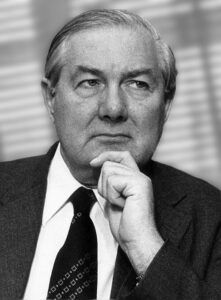
James Callaghan
James Callaghan (1912–2005)
- James Callaghan — son of a Royal Navy chief petty officer, elementary school leaver at fourteen, Inland Revenue tax officer, trade union official, MP from 1945, Parliamentary Secretary to the Ministry of Transport, Chancellor of the Exchequer, Home Secretary, Foreign Secretary, and Prime Minister from April 1976 to May 1979 — is the only person in British political history to have held all four great offices of state, a distinction that reflects not the breadth of his ambition but the sustained confidence of successive Labour prime ministers in a man whose political judgment, institutional loyalty, and human capability consistently exceeded the formal credentials his background might have predicted.1Britannica — James Callaghan
- His premiership from 1976 to 1979 — inherited without a general election mandate, conducted with a parliamentary majority that disappeared within months, sustained through the Lib-Lab pact, the IMF crisis of 1976, the devolution referendums, and the Winter of Discontent of 1978 to 1979 — ended with a vote of no confidence that he lost by a single vote, producing the 1979 general election that brought Margaret Thatcher to power and ended the postwar social democratic consensus that Callaghan had spent his career defending, making his the most consequential single defeat in the history of the Labour Party.2History Extra — James Callaghan
- The man who managed all of this — the IMF negotiations that required accepting spending cuts that his entire political formation opposed, the Lib-Lab pact that kept a minority government alive through parliamentary arithmetic that would have ended most careers, and the Winter of Discontent that his own misjudgment of the trade union relationship had partly produced — was by the assessment of those who worked with him most closely one of the most naturally gifted political operators of the postwar period, a judgment that his historical reputation has consistently underweighted because the outcomes of his premiership were defined by what came after it rather than by what he actually did.3Oxford DNB — James Callaghan
James Callaghan is the most underscored profile in the postwar British Political domain — underscored not because the variable analysis is generous but because the historical assessment has been systematically distorted by the Winter of Discontent narrative and the Thatcher contrast that followed it. The equations separate what Callaghan did from what happened to him, and the separation produces a more defensible profile than the received assessment suggests.
The formation period is analytically significant for the specific combination of working-class formation, trade union experience, and self-education that it produced. Callaghan left school at fourteen with no formal qualifications, worked as a tax inspector, became a trade union official for the Inland Revenue Staff Federation, and entered Parliament in 1945 with a direct knowledge of working-class institutional life that most of his Labour colleagues had encountered through research rather than experience.1Britannica — James Callaghan The People variable in the formation period is built through the specific capability that trade union work develops — the ability to read a room of people with competing interests, to identify the positions that can be moved and those that cannot, and to construct agreements that enough people can accept without feeling they have lost. That capability runs through every subsequent phase of the career and is the most analytically consistent variable in the profile.
The Chancellor of the Exchequer period from 1964 to 1967 is the most analytically difficult phase of the career. Callaghan inherited a balance of payments deficit of 800 million pounds, defended the sterling parity for three years through a combination of deflation, borrowing, and political commitment, and then presided over the devaluation that the defence of sterling had been designed to prevent.1Britannica — James Callaghan The Congruence variable at this snapshot records the gap between Callaghan's public commitment to the parity and the eventual outcome without adjudicating whether the defence was correct — the economic argument for earlier devaluation was strong, and Callaghan's political commitment to sterling reflected the constraints of the Wilson government's electoral positioning rather than his own economic judgment. He resigned as Chancellor following the devaluation — accepting personal responsibility for an outcome that the political framework had partly imposed — which is the Congruence variable operating correctly in the aftermath of a failure it had not produced alone.
The Home Secretary period from 1967 to 1970 is the most politically controversial phase of the pre-premiership career. Callaghan's opposition to Roy Jenkins's liberal legislation — specifically his resistance to the relaxation of immigration controls under the Commonwealth Immigrants Act of 1968 — reflects a People variable reading of Labour's working-class electoral base that was politically accurate and analytically uncomfortable.3Oxford DNB — James Callaghan The Congruence variable at this snapshot is higher than the liberal assessment of Callaghan suggests — he was consistent between his private views and his public positions on immigration in a way that the Wilson government's more equivocal approach was not. The Value variable records the outcome for those affected by the legislation without adjudicating the political calculation that produced it.
The Foreign Secretary period from 1974 to 1976 is analytically the strongest pre-premiership snapshot. Callaghan renegotiated the terms of British EEC membership — producing the changes that allowed Wilson to present the 1975 referendum as a genuine choice rather than a foregone conclusion — with a diplomatic capability that the subsequent assessment has consistently undervalued.1Britannica — James Callaghan The People variable at this snapshot reflects a leader who could manage the European counterparts, the Wilson cabinet, and the Labour Party's anti-EEC faction simultaneously — three audiences with incompatible positions, each requiring a different register, each needing to believe that the outcome served their interests. That is the People variable operating at its most sophisticated pre-premiership expression.
The IMF crisis of 1976 is the canonical snapshot and the most analytically significant single event of the premiership. Callaghan inherited a sterling crisis, a public sector borrowing requirement that the markets considered unsustainable, and an IMF loan negotiation that required accepting spending cuts of a scale that the Labour Party's entire postwar programme had been designed to prevent.4IMF — The 1976 Crisis His management of the cabinet through the IMF negotiations — in which ministers including Tony Benn and Peter Shore argued for alternative economic strategies that would have produced a different and potentially more damaging outcome — reflects the People and Decisiveness variables operating simultaneously at high pressure: holding a cabinet together through a decision that most of its members opposed, while negotiating with an international institution that held the financial leverage.
The Labour Party conference speech of September 1976 — in which Callaghan told the party that the option of spending your way out of recession no longer existed, that it had only worked by injecting inflation into the economy, and that higher inflation had been followed by higher unemployment — is the most analytically precise Communication variable output of the career.5British Political Speech — Callaghan 1976 Conference Speech It was the most honest speech a Labour Prime Minister had delivered to his own party in the postwar period — a direct acknowledgement that the Keynesian framework that the party had built its economic policy around required fundamental revision. The Communication variable at this moment is operating at its highest point in the profile — not because the speech was rhetorically brilliant, but because it said something true and politically costly to an audience that did not want to hear it. That is the Congruence variable and Communication variable operating in alignment at their most consequential.
The Lib-Lab pact from March 1977 to August 1978 is the most analytically precise expression of the Process variable in the profile. Callaghan negotiated a formal agreement with the Liberal Party under David Steel that kept the minority government alive through a parliamentary arithmetic that a vote of confidence would otherwise have ended.2Britannica — James Callaghan The pact required managing Liberal demands for policy concessions, Labour backbench resentment at governing in coalition with a non-socialist party, and the permanent possibility that either side might terminate the arrangement at a politically disadvantageous moment. The Process variable at this snapshot reflects a leader who constructed and maintained a complex institutional arrangement under conditions where most of the participants had incentives to defect, which is the Process variable operating at its most demanding expression.
The Winter of Discontent of 1978 to 1979 is the terminal failure and the one that most precisely captures the limits of the People variable when applied to the trade union movement. Callaghan had gambled on the unions accepting a five percent pay norm — based on a reading of trade union leadership willingness that the subsequent strike wave demonstrated was wrong.2Britannica — James Callaghan The lorry drivers' strike, the public sector strikes, and the images of uncollected rubbish and unburied bodies that the media circulated destroyed the government's central claim — that Labour could manage the trade unions where the Conservatives could not. The People variable at this snapshot records its lowest point in the profile: a leader whose most consistent capability — reading people and constructing agreements they would hold — failed at precisely the moment and with precisely the constituency that the government's survival required it to succeed.
The return from Guadeloupe in January 1979 — and the press conference at which he was reported to have said crisis, what crisis? — is the Communication variable at its most damaging single moment. Callaghan did not use those words, but his actual response — that he did not think other people in the world would share the view that there was mounting chaos — was sufficiently complacent in tone to allow the tabloid paraphrase to stick.3Oxford DNB — James Callaghan The Intent variable at this moment is low — Callaghan did not understand what the communication required, which is analytically unusual for a leader whose People variable had been consistently high throughout the career.
The no confidence vote of 28 March 1979 — lost by 311 votes to 310, the first government to fall on a confidence vote since 1924 — is the terminal k variable expression: a single vote, produced by the Scottish National Party's withdrawal of support following the devolution referendum result, ending a government that had managed a parliamentary minority for three years through sustained political craft.6UK Parliament — Confidence Votes The margin is the most precise illustration in the British dataset of the difference between political skill and political fortune — Callaghan had deployed the former consistently and the latter withdrew at the final moment by one vote.
The number that matters most across all four snapshots is the People variable — and the gap between its expression in the institutional and trade union domains. Callaghan could read cabinet ministers, international negotiators, parliamentary party managers, and Liberal leaders with a precision that produced outcomes against the odds consistently throughout the career. He could not read the trade union shop stewards of 1978 to 1979 with the same accuracy — and the gap between those two expressions of the same variable is the analytical explanation for the Winter of Discontent. The skill was genuine. Its domain specificity was the limit. That is the Leaderment profile of James Callaghan.
Score Comparison
Add up to 10 leaders. Click a name to visit their profile.
The 13 Equations
Scores for: Chancellor and Home Secretary — Devaluation and ImmigrationThe 22 Variables
Canonical scoresSources & Bibliography
The scores assigned to this leader are derived from publicly available sources. Variable inputs reflect documented behaviour, structural conditions, and historical record at the time of each snapshot.