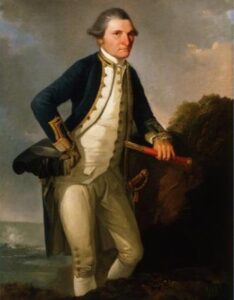
James Cook
James Cook (1727-1799)
- Led the Endeavour voyage of 1768–71, charting New Zealand and the eastern coast of Australia with unprecedented accuracy, observing the transit of Venus from Tahiti, and keeping his crew free from scurvy through diet and sanitation — establishing the principle that scientific inquiry and naval exploration could operate as a single enterprise.1Britannica — James Cook ↗
- Commanded the second Pacific voyage of 1772–75 aboard Resolution, sailing further south than any previous explorer, crossing the Antarctic Circle three times, disproving the existence of the mythical fertile southern continent Terra Australis, and producing the first accurate map of the Pacific Ocean.2Wikipedia — James Cook ↗
- Discovered the Hawaiian Islands on his third voyage in 1778, was killed at Kealakekua Bay on 14 February 1779 during a dispute with the local population over a stolen boat — a death that contrasted sharply with the careful, humane conduct that had characterised his first two voyages and which historians have attributed in part to physical and psychological deterioration on his final expedition.3Biography.com — James Cook ↗
James Cook was born in October 1728 in the village of Marton in Yorkshire, the son of a Scottish farm labourer, and received a modest schooling paid for by his father's employer before spending his teenage years on the farm.1Britannica — James Cook ↗ At eighteen he became a seaman's apprentice with a Whitby shipowner, spent years on coastal coal-haulers learning navigation in the notoriously treacherous waters of the North Sea and the Baltic, taught himself mathematics and cartography in his spare time, was offered command of his own merchant vessel, and turned it down to join the Royal Navy as an ordinary seaman. That decision — to give up a command he had earned in order to start again at the bottom of a different institution — is the first analytical entry point in Cook's profile. It is a Learning and Humility variable in action: he knew that what he needed to become the navigator he intended to be was not a merchant captain's command but the Royal Navy's training, equipment and resources. By 1759 he was charting the approaches to Quebec under fire during the Seven Years' War, producing surveys of such precision that they enabled Wolfe's fleet to navigate the St Lawrence River — work that brought him to the attention of the Admiralty and the Royal Society.4Canadian Encyclopedia — James Cook ↗ By 1768, when the Royal Society needed a commander for its Tahiti transit-of-Venus expedition, Cook was the choice — a forty-year-old lieutenant of relatively obscure background whose navigation record was without peer. The Endeavour voyage of 1768–71 is the most analytically clean first snapshot in the Explorers domain. Cook's Defined Output covered three separate objectives simultaneously — observe the transit of Venus, investigate the southern Pacific for Terra Australis, and chart whatever he found — and he delivered all three.1Britannica — James Cook ↗ His management of crew health was a leadership act in itself: where scurvy routinely killed a third of long-voyage crews in the eighteenth century, Cook returned without a single scurvy death, through a regime of enforced diet that included sauerkraut, cress and citrus preparations. The People variable in his profile reflects this — he understood that the ship's mission was only deliverable if the men who crewed it were alive at the end of it. The second voyage of 1772–75 produced the greatest single act of empirical exploration leadership in the dataset. Cook was personally sceptical of the theoretical southern continent but dutifully made three sweeps of the Antarctic Circle, sailing further south than any previous explorer, demonstrating conclusively that no fertile Terra Australis existed, and producing the first comprehensive map of the Pacific that was accurate enough to serve navigation for the following century.2Wikipedia — James Cook ↗ The Ability and Process variables in this snapshot score at their ceiling — a man who had by this point reduced the margin of error in Pacific cartography to something approaching zero, operating without any of the navigational technology that later explorers would take for granted. The third voyage tells a different story. Contemporary accounts note a change in Cook's behaviour — harsher discipline, less patience with his crew, less of the careful management of relationships with indigenous peoples that had characterised the first two voyages.5EBSCO — James Cook ↗ Whether this represented physical deterioration, the effects of cumulative stress across eleven years of extreme voyaging, or something more specific is disputed. What is not disputed is that the man killed at Kealakekua Bay in February 1779, attempting to take a Hawaiian chief hostage over a stolen boat, was operating differently from the man who had kept his crew alive and his relationships with Pacific peoples intact across the previous two voyages. The Congruence variable drops in the third snapshot — not because his values changed but because his behaviour increasingly diverged from the standards he had set for himself. He died aged 50, the son of a farm labourer, having filled in more of the world map than any other European explorer. He is buried in the Pacific Ocean, which he knew better than anyone alive.1Britannica — James Cook ↗
Score Comparison
Add up to 10 leaders. Click a name to visit their profile.
The 13 Equations
Scores for: Endeavour — First VoyageThe 22 Variables
Canonical scoresSources & Bibliography
The scores assigned to this leader are derived from publicly available sources. Variable inputs reflect documented behaviour, structural conditions, and historical record at the time of each snapshot.