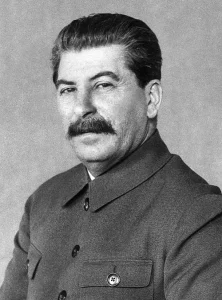
Joseph Stalin
Joseph Stalin (1878–1953)
- Born Iosif Dzhugashvili on 18 December 1878 in Gori, Georgia — scarred by smallpox at seven, his arm deformed in a carriage accident, beaten regularly by an alcoholic father — attended the Tiflis Theological Seminary where he began reading Marx and Darwin, abandoned it at twenty to become a full-time Bolshevik revolutionary: organising workers, editing Pravda, raising funds through bank robberies including the 1907 Tiflis raid that netted 250,000 rubles and several deaths1Wikipedia — Joseph Stalin — arrested and exiled to Siberia seven times before the October Revolution brought the Bolsheviks to power.
- Was appointed General Secretary of the Communist Party in 1922 — a position Lenin's testament warned should be taken from him before his death — and over the following decade eliminated Trotsky, Zinoviev, Kamenev and Bukharin through bureaucratic manipulation, exile and show trials, launched forced collectivisation of Soviet agriculture that caused the Holodomor famine of 1932–33 killing an estimated three to seven million Ukrainians, and between 1936 and 1938 executed hundreds of thousands of real and perceived opponents in the Great Purge — including three of his five marshals and most of his senior military command2Britannica — Joseph Stalin — before signing the Molotov-Ribbentrop Pact with Hitler in August 1939.
- When Germany invaded in June 1941 Stalin retreated to his dacha in apparent paralysis for days while his generals waited for orders — then recovered, managed the evacuation of Soviet industry eastward, presided over Stalingrad and the turning of the war, attended Tehran and Yalta, watched the Red Army take Berlin in May 19453History.com — Joseph Stalin — extended Soviet control across Eastern Europe through installed communist governments — led the Soviet Union into the nuclear age with an atomic test in 1949 — and died of a stroke on 5 March 1953 while planning what appeared to be the opening phase of a new purge, his doctors having been arrested weeks before under the fabricated Doctors' Plot.
During the quarter century preceding his death, Joseph Stalin probably exercised greater political power than any other individual in recorded history. He industrialised the Soviet Union, collectivised its agriculture, organised the defeat of Nazi Germany, extended Soviet control across Eastern Europe, and delivered nuclear capability. He was responsible, through deliberate policy and wilful negligence, for the deaths of between six and twenty million Soviet citizens — the range reflecting genuine historical uncertainty about counts that Stalin's own machinery concealed. The equations do not reconcile these facts. They record both simultaneously and let the variable scores carry the tension.
The rise to power is the most technically accomplished phase of his career in management terms. Lenin had identified him as dangerous and recommended his removal. Stalin suppressed the testament. He used the General Secretary position to control party appointments — a role his rivals regarded as administrative and beneath them — while they competed for ideological prominence. By the time they understood what he had done, the apparatus was his. He eliminated Trotsky through exclusion and eventually assassination in Mexico in 1940. He eliminated Zinoviev and Kamenev through the show trials of 1936. He eliminated Bukharin through the trial of 1938. Each elimination was preceded by years of patient accumulation of leverage, followed by a single decisive move. The Process score at this period is the highest in the profile — ruthless, systematic, and almost entirely without error.4Wikipedia — Stalin's rise to power
The canonical snapshot is the most analytically demanding period and the most analytically important. The Five-Year Plans produced genuine industrialisation: the Soviet Union entered the 1930s as a largely agrarian economy and emerged as the second largest industrial power in the world. The same policies produced the Holodomor — a man-made famine that killed millions of Ukrainians through grain requisitions that continued even as people died in the streets. The Great Purge executed the senior military command on fabricated treason charges, leaving the Red Army leaderless at the precise moment Germany was rearming across the border. Stalin knew what the purge was destroying. He proceeded anyway. The Humility variable at this period records the most consequential failure of self-correction in the dataset: a leader who chose to interpret the gap between his model and reality as a problem with reality, rather than with his model.2Britannica — Joseph Stalin
The Congruence variable across all snapshots is near floor. The stated values of Marxism-Leninism — liberation of the working class, historical progress toward collective human freedom — are the most systematically violated stated values of any profile in the dataset. The workers he claimed to liberate were collectivised into starvation, imprisoned in gulag labour camps, and shot by the millions. This is not a say-do gap of the kind that Blair's Iraq or Nixon's tapes produce. It is a structural inversion — a leader whose stated values were the precise opposite of his operational reality for twenty-five years.
The wartime snapshot is the most analytically contested. The collapse of June 1941 — Stalin's paralysis while German forces advanced hundreds of miles, his apparent breakdown, his withdrawal to the dacha — is the most dramatic single Confidence failure in the political domain dataset. He had ignored warnings from British intelligence, American intelligence, and his own NKVD about the impending invasion, because accepting the warnings would have required acknowledging that his Molotov-Ribbentrop strategy had failed. The Humility variable had already made the warning impossible to receive.3History.com — Joseph Stalin What followed — the recovery, the management of the industrial evacuation, the patience at Stalingrad, the strategic competence at Tehran — demonstrates that the Conviction and Ability variables were genuinely extraordinary once the denial phase collapsed. The wartime Stalin who managed the alliance, played Roosevelt against Churchill, and extracted maximum territorial concessions at Yalta is a different profile from the 1941 Stalin who had nearly destroyed his own army. The equations hold both.
The late period is the paranoia spiral without interruption. Eastern Europe subjugated. The nuclear arsenal built. The Cold War architecture established. And simultaneously, purges resuming, the Doctors' Plot fabricated, new terror building. He died in a room where his security detail was too frightened to check on him for hours after he was found on the floor. The system he had built — in which everyone survived by telling him what he wanted to hear — functioned perfectly as a mechanism for killing him when he needed someone to call a doctor.
Britannica records that during his prime, Stalin was hailed as a universal genius, the shining sun, the staff of life, and was even publicly invoked as "Our Father" by a metropolitan of the Russian Orthodox Church. The Codex records that he was responsible for the deaths of millions and the permanent subjugation of hundreds of millions more. Both are true. The equations hold both simultaneously, which is what they are designed to do.
Score Comparison
Add up to 10 leaders. Click a name to visit their profile.
The 13 Equations
Scores for: Rise — From General Secretary to Sole PowerThe 22 Variables
Canonical scoresSources & Bibliography
The scores assigned to this leader are derived from publicly available sources. Variable inputs reflect documented behaviour, structural conditions, and historical record at the time of each snapshot.