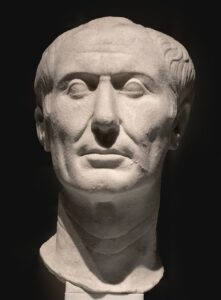
Julius Caesar
Julius Caesar (100–44 BC)
- Spent eight years in continuous campaigning across Gaul, Britain and Germania against opponents the Roman military establishment had feared for a generation, building the double circumvallation at Alesia — twelve miles of fortification facing inward against the besieged Gauls, eleven miles facing outward against the relief army, defeating both simultaneously while outnumbered overall1EBSCO Research Starters — Julius Caesar — and writing the Commentaries that documented each campaign year in real time as both military record and political messaging.2Wikipedia — Julius Caesar
- Crossed the Rubicon in January 49 BC with a single legion, collapsing every political option except victory — drove Pompey from Italy without a major engagement, pacified Spain, won at Pharsalus, pursued Pompey to Egypt, then dispatched Pharnaces of Pontus in a campaign brief enough to produce the most compressed victory announcement in military history: Veni, vidi, vici.3Britannica — Julius Caesar
- Proclaimed dictator for life in February 44 BC, introduced the Julian calendar, extended citizenship to provincial populations and enlarged the Senate — then was assassinated on the Ides of March by some sixty senators who had observed him remain seated when the Senate approached him to bestow honours, and who feared he intended to make himself king.4Wikipedia — Assassination of Julius Caesar
Julius Caesar presents the Codex with a profile that spans the full analytical range of the framework — from Highly Effective to Emergent across four snapshots separated by less than twenty years. The trajectory is not a gradual decline. It is a cliff. The mechanism is not external defeat. It is internal variable inflation consuming the system that produced the peak.
The Gallic Wars period establishes the variable foundation with a specificity the sources support in unusual detail. Caesar wrote his own campaign record — the Commentaries are both primary source and propaganda, which the Congruence variable must account for — but the operational facts they document are corroborated independently.2Wikipedia — Julius Caesar Eight years of continuous campaigning across Gaul, Britain and Germany, against opponents the Roman military establishment had feared for a generation, producing consistent tactical innovation rather than a preferred approach applied repeatedly. The double circumvallation at Alesia — building twelve miles of fortification facing inward against the besieged Gauls, then eleven miles facing outward against the relief army, then defeating both simultaneously with a force outnumbered overall — is Process and Defined Output operating at their documented maximum.1EBSCO Research Starters — Julius Caesar The People variable throughout this period is the most consistently recorded characteristic across all sources. He knew his centurions by name. He trained alongside them. He called them comrades rather than soldiers. His troops retired wealthy. That is not charm. It is a leader who understood that the People variable was the operational foundation of everything else and invested in it accordingly.
The Civil War and Rubicon period is the profile's analytical peak and the most precisely documented Defined Output event in the ancient world dataset. Crossing the Rubicon collapsed every political option except victory — there was no negotiated return, no conditional arrangement, no path that preserved both the mission and his survival other than the one he chose.3Britannica — Julius Caesar What followed was the fastest concentrated campaign sequence in the Roman record: Pompey driven from Italy without a major engagement, Spain pacified, Pharsalus fought and won, Pompey pursued to Egypt, Alexandria managed with a combination of political sophistication and military force, Zela dispatched in a campaign brief enough to produce the most compressed victory announcement in military history. Veni, vidi, vici is Defined Output stated in three words. The equations produce their highest score at this snapshot because the personal variable quality and the structural conditions were in their closest alignment — Chaos still functional, Autonomy expanding but not yet at its ceiling, People and Process both operating at high levels.
The Dictator in Rome period is where the variable profile begins its terminal divergence. The reforms were genuine — the Julian calendar, citizenship extended to provincial populations, land redistribution, senatorial enlargement to make it more representative.2Wikipedia — Julius Caesar These are Defined Output and Value operating at their documented level. The Congruence variable sits below its peak not because the reforms were insincere but because the gap between Caesar's stated commitment to the Roman Republic and his accumulation of permanent dictatorial power cannot be analytically reconciled. He accepted divine honours, remained seated when the Senate approached, appointed loyalists of lower social rank to positions above senators who had served Rome for decades. Each of these is a Pride variable event — an assertion of personal precedence over institutional protocol that the Ego variable required but that the People and Corporate Drag variables recorded as damage.
The specific analytical signal in the Dictator period is the divergence between Ability and Humility. His ability remained high — the administrative reforms were architecturally sound, the military planning for the Parthian campaign was evidently credible given that his successors spent decades attempting what he had designed. His Humility had declined. A leader who retained high Ability while Humility fell had the technical capacity to recognise the political signals that preceded the Ides and the psychological incapacity to act on them. Multiple sources record that Caesar was warned — a seer had cautioned him that his life would be in danger no later than the Ides of March, and his wife Calpurnia begged him not to attend the Senate that day.4Wikipedia — Assassination of Julius Caesar He dismissed the warnings. That is not courage. It is Pride preventing the accurate assessment of risk that a higher Humility score would have enabled.
The Ides of March snapshot records Chaos at its ceiling and the terminal consequence. The senators who killed him justified their action as defence of the Republic. Their actual motivation was a mixture of genuine institutional concern, personal grievance and political calculation that the equations cannot fully disaggregate. What the equations can record is that Caesar's variable profile in the months before the Ides had produced the precise conditions the conspirators needed — a leader whose Ego made delegation difficult, whose Pride made warning dismissible, whose Corporate Drag had risen as senatorial resistance accumulated, and whose People variable had declined as the man who had called his troops comrades became the man who insulted the institutional body that Rome's elite regarded as the embodiment of its identity.4Wikipedia — Assassination of Julius Caesar
He was fifty-five years old. He had planned to leave Rome three days after the Ides for a Parthian campaign that his adopted son would eventually attempt and never complete. The equations record a leader who at his peak was among the most operationally capable in the ancient world dataset, and whose Chaos trajectory — from functional to terminal across four snapshots — produced an outcome that the variable profile had been predicting for years before the senators produced their knives.
Score Comparison
Add up to 10 leaders. Click a name to visit their profile.
The 13 Equations
Scores for: The Ides of MarchThe 22 Variables
Canonical scoresWhat changed: Dictator — Rome → The Ides of March
Sources & Bibliography
The scores assigned to this leader are derived from publicly available sources. Variable inputs reflect documented behaviour, structural conditions, and historical record at the time of each snapshot.