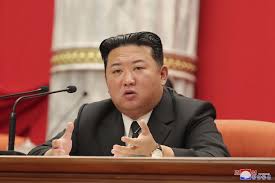
Kim Jong-un
Kim Jong-un (born c.1983)
- Born in Pyongyang, the third son of Kim Jong-il and Ko Yong-hui, educated secretly at the International School of Berne in Switzerland under a pseudonym in the late 1990s before returning to study at Kim Il-sung Military University — spent most of his early adulthood invisible to the outside world, was publicly identified as heir apparent only in 2010 when his father was already visibly ill1Britannica — Kim Jong-un — and in December 2011, at approximately twenty-seven years old, became Supreme Leader of the Democratic People's Republic of Korea upon his father's death, inheriting the world's most totalitarian state, its nascent nuclear programme, and a population in chronic food insecurity.
- Consolidated power by executing his uncle Jang Song-thaek in December 2013 — the most senior official in the regime and his father's effective regent during the transition — then in 2017 ordered the assassination of his half-brother Kim Jong-nam with VX nerve agent at Kuala Lumpur airport2Wikipedia — Kim Jong-un — while simultaneously conducting six nuclear tests in four years, declaring intercontinental ballistic missile capability sufficient to reach the continental United States, meeting Donald Trump in Singapore in 2018 in the first summit between the leaders of the two countries, and deploying North Korean troops to support Russia's invasion of Ukraine from 2024.
- As of April 2026, remains Supreme Leader with no viable internal challenger, has enshrined himself in the North Korean constitution as the supreme leader named while currently holding power — a first in North Korean history — is believed to be grooming his daughter Kim Ju-ae as successor based on her increasingly prominent appearances at weapons tests and military parades1Britannica — Kim Jong-un — and presides over a state that has conducted the only confirmed nuclear weapons tests of the 21st century while maintaining one of the lowest GDP per capita figures on earth.
Kim Jong-un has been Supreme Leader of North Korea since December 2011. The third generation of the Kim dynasty, he inherited a system built by his grandfather and father over six decades and has systematically deepened every structural feature of it — the cult of personality, the prison camp system, the nuclear programme, the isolation — while adding dimensions his predecessors did not have: a credible thermonuclear deterrent, a direct military alliance with Russia, and an international profile achieved through personal summits that his father never sought.
The consolidation period is the most instructive phase of his record. He was twenty-seven, unknown, and had been publicly identified as heir for barely a year. The conventional analysis expected the regime to fracture — too young, too inexperienced, too dependent on his father's old guard. He executed his uncle within two years. The uncle was the most powerful man in North Korea after Kim himself, had been regarded as a stabilising regent during the transition, and had connections to China that made him untouchable in most analysts' assessments. Jang Song-thaek was charged, tried by military tribunal, and shot in December 2013. The message to every other potential rival was precise and unambiguous.3CFR — Kim Jong-un's First Decade
The nuclear programme is the canonical analytical achievement of his tenure and the Defined Output variable at its most operational. He inherited a programme that had conducted two tests. By 2017 he had conducted four more, declared thermonuclear capability, tested an ICBM with estimated range sufficient to reach the continental United States, and created the deterrence architecture that his grandfather had conceived and his father had begun.4EBSCO Research Starters — Kim Jong-un The byungjin policy — parallel development of nuclear capability and economic modernisation — was the stated Defined Output, and the nuclear half of it was delivered. The economic half was not; sanctions and structural dysfunction prevented it. The equations record the asymmetry: maximum delivery on one output, near-zero delivery on the other.
The Trump summits of 2018–2019 are the Confidence variable operating at its most visible. A leader with zero legitimate international standing achieved personal meetings with the sitting US president by threatening the United States with nuclear weapons sufficiently credibly that engagement appeared preferable to escalation. He gained international legitimacy — the photographs, the handshakes, the first North Korean leader to set foot in South Korea — while giving up nothing. The Hanoi summit collapsed in February 2019 when the gap between what Kim would offer and what the US demanded was too wide to bridge. He walked out. The sanctions remained. The nuclear programme continued.2Wikipedia — Kim Jong-un
The post-2022 period represents a structural shift that the Environment variable captures precisely. Russia's invasion of Ukraine created a geopolitical realignment that improved Kim's position significantly. North Korea supplied artillery shells and reportedly troops to Russia; Russia provided economic relief and diplomatic cover at the UN Security Council. The isolation that had been an existential constraint became a manageable inconvenience. Kim visited Beijing in September 2025 — his first foreign trip since 2019 — and the Russia alignment has provided an alternative economic lifeline that partially decouples him from Chinese leverage.
What the Codex captures that raw power metrics miss is the same tension identified in the Xi profile: the system optimised for Kim's survival is not optimised for North Korea's development, and the elimination of every error-correction mechanism in the name of regime stability produces a state permanently incapable of the self-correction that sustainable systems require. His Humility score is at floor. His Competition score is at floor. His Value score is at floor. The equations can record a leader operating with extraordinary effectiveness toward a precisely defined output while simultaneously recording that the output delivers almost nothing to the twenty-five million people governed in its name.
He is currently preparing his daughter for succession. The dynasty continues.
Score Comparison
Add up to 10 leaders. Click a name to visit their profile.
The 13 Equations
Scores for: Russia Alignment — Recalibrated IsolationThe 22 Variables
Canonical scoresWhat changed: Nuclear Deterrent Complete — Trump Summits → Russia Alignment — Recalibrated Isolation
Sources & Bibliography
The scores assigned to this leader are derived from publicly available sources. Variable inputs reflect documented behaviour, structural conditions, and historical record at the time of each snapshot.