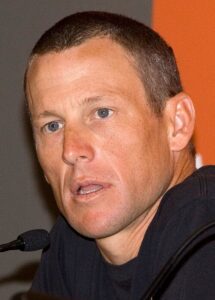
Lance Armstrong
Lance Armstrong - Born 1971
- Won seven consecutive Tour de France titles from 1999 to 2005 — no rider before or since has won more than five — returning from stage-three testicular cancer that had spread to his lungs and brain to become the dominant figure in professional cycling for a decade and the most recognisable cancer-survivor athlete in the history of sport, founding the Livestrong Foundation whose yellow silicone bracelet became a global cultural symbol of resilience and hope sold to more than 80 million people worldwide.1Wikipedia — Lance Armstrong ↗
- Was stripped of all seven Tour de France titles in October 2012 following a USADA investigation — a 1,000-page report supported by sworn testimony from twenty-six witnesses including eleven former teammates — that described his US Postal Service team's doping programme as 'the most sophisticated, professionalized and successful doping program that sport has ever seen,' in which Armstrong was the ringleader who used banned substances including EPO, human growth hormone and testosterone, conducted blood transfusions, paid over one million dollars to a doping physician, and pressured teammates to dope or face removal from the team.2Wikipedia — Armstrong Doping Case ↗
- Admitted the full extent of his doping in a televised interview with Oprah Winfrey in January 2013, following more than a decade of vehement denial that included lawsuits against journalists and whistleblowers, bullying and intimidation of former teammates who attempted to speak out, and public statements that he had never tested positive and was the most tested athlete in the world — a systematic, sustained and personally directed programme of deception that the equations record as a Congruence failure of the same analytical order as Madoff: the stated values were the exact inverse of the actual conduct.3Britannica — Lance Armstrong ↗
Lance Edward Armstrong was born on 18 September 1971 in Plano, Texas, a competitive swimmer and triathlete from early childhood, turned professional cyclist in 1992, won the 1993 World Championship road race, and was diagnosed with stage-three testicular cancer in October 1996 — a cancer that had spread to his lungs, abdomen and brain, giving him a survival probability that his physicians later described as significantly below fifty per cent.4Biography.com — Lance Armstrong ↗ He underwent chemotherapy and surgery, was declared cancer-free in 1997, returned to professional cycling in 1998, and won his first Tour de France in 1999. The dual-profile structure applied to Armstrong's career follows the same analytical framework as Bernie Madoff: the PERCEIVED and ACTUAL variable configurations are entirely different, the gap between them is the analytical story, and the equations must render both honestly. The PERCEIVED profile during the Tour de France years (1999-2005) presented one of the most compelling sporting narratives in modern history: a cancer survivor who had defied death to achieve the greatest sustained achievement in professional cycling, winning seven consecutive Tours while simultaneously building a cancer awareness organisation that gave hope to millions of patients globally. The PERCEIVED Congruence scored at its ceiling — a man whose public values (resilience, determination, fighting spirit, dedication to cancer survivors) were apparently demonstrated daily in his athletic performance. The PERCEIVED Value was unambiguously positive: the Livestrong Foundation, the inspiration to cancer patients, the elevation of cycling's global profile. The ACTUAL profile during the same period is the analytical inverse. Armstrong was not merely doping — every serious competitor in the 1999-2005 Tour de France era was implicated in doping to varying degrees. He was the ringleader of an organised programme. He paid over one million dollars to a doping physician. He pressured teammates who did not dope to dope, or removed them from the team. He sued journalists who reported accurately on his doping, destroying their professional reputations and costing them financially.2Wikipedia — Armstrong Doping Case ↗ He testified under oath that he had never doped. The ACTUAL Congruence scores at its analytical floor: his stated values — integrity, fairness, the inspiration of cancer survivors — were systematically and deliberately contradicted by his actual conduct across a decade. The ACTUAL Intent variable scores at its floor because the audience — the millions of cancer patients who wore yellow bracelets, the public who believed the comeback narrative — did not understand that they were being deceived. The deception was not incidental to the performance but structural to it: without the doping programme, there would have been no seven Tour victories, no comeback narrative, no Livestrong Foundation with the cultural authority it carried. The post-USADA snapshot reflects a leader whose Effective Power has collapsed entirely. Stripped of his titles, banned for life from professional sport, facing a civil lawsuit from the US Department of Justice for defrauding the US Postal Service (settled in 2018 for $5 million), dropped by every major sponsor, removed as chairman of his own foundation. The Visibility variable remains high — he continues to host a podcast and provide media commentary — but the authority that underpinned his leadership has been permanently removed by the disclosure of what the authority was actually based on.
Score Comparison
Add up to 10 leaders. Click a name to visit their profile.
The 13 Equations
Scores for: PERCEIVED — Tour de France DominanceThe 22 Variables
Canonical scoresSources & Bibliography
The scores assigned to this leader are derived from publicly available sources. Variable inputs reflect documented behaviour, structural conditions, and historical record at the time of each snapshot.