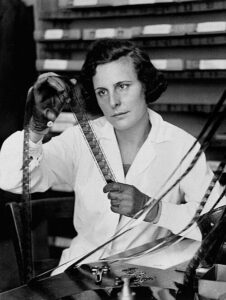
Leni Riefenstahl
Leni Riefenstahl (1902-2003)
- Commanded crews of over 170 cameramen and technicians to document the 1936 Berlin Olympics in Olympia — inventing tracking shots mounted on rails, underwater photography, slow-motion analysis of athletic movement, and editing techniques that remain foundational to sports cinematography — producing a four-hour film widely regarded as the most technically accomplished documentary of the twentieth century, financed by Goebbels' Ministry of Propaganda and designed to glorify Nazi racial ideology.1USHMM — Leni Riefenstahl ↗
- Directed Triumph of the Will in 1934 — deploying 125 camera placements, a camera mounted on an elevator ascending a flagpole, mobile cameras tracking Hitler through crowds, and innovative use of real sound and close-up — creating the most technically masterful propaganda film ever produced, which film scholar Mark Cousins placed alongside Orson Welles and Hitchcock as one of the three most technically talented Western filmmakers of the era.2Wikipedia — Leni Riefenstahl ↗
- Tried four times by post-war denazification courts, designated a 'fellow traveller' rather than a war criminal, spent the next two decades in isolation before reinventing herself as a photographer of the Nuba people of Sudan and subsequently as an underwater cinematographer — continuing to work until she was in her nineties, dying on 8 September 2003 aged 101, having won over fifty libel cases against those who accused her of complicity in Nazi crimes while the evidence of her direct involvement with the regime continued to accumulate in the historical record.3Britannica — Leni Riefenstahl ↗
Helene Bertha Amalie Riefenstahl was born on 22 August 1902 in Berlin, the daughter of a plumbing engineer, and spent her youth as a dancer — touring Europe in solo programmes she choreographed herself, earning six hundred to seven hundred marks a performance — before a knee injury forced surgery and redirected her toward film.4EBSCO — Leni Riefenstahl ↗ She saw a promotional poster for Arnold Fanck's mountain film, sought him out, was cast in his next seven productions, and by 1932 had directed her first feature film, The Blue Light, which she wrote, directed, produced and starred in — an extraordinarily unusual combination for a woman in the German film industry of the Weimar era. The analytical framework for Riefenstahl requires a structure analogous to the Madoff dual-profile, because her leadership variables operate across two entirely distinct registers: the technical-cinematic and the political-moral. The technical variables are unambiguous. Her Ability scores at the ceiling for any filmmaker in the dataset. The tracking shot, the telephoto lens for foreshortening effects, the close-up as a tool of emotional manipulation, the hidden camera during the 1936 Olympics, the camera mounted underwater — these were not refinements of existing technique but genuine inventions.1USHMM — Leni Riefenstahl ↗ Steven Spielberg, George Lucas and Francis Ford Coppola have all cited her work as a direct influence. The film techniques she invented for Olympia are now standard practice in sports broadcasting. Her Process and Defined Output variables reflect a filmmaker who understood with total precision what she was making and how to make it. The political-moral variables are equally unambiguous and point in the opposite direction. The Congruence variable scores low because the gap between her stated position — that she was an artist, not a propagandist; that Triumph of the Will was a documentary, not a political instrument; that she was unaware of the Holocaust — and her actual behaviour is extensively documented.2Wikipedia — Leni Riefenstahl ↗ She filmed Polish civilians being executed by German troops in September 1939 and has been photographed at the scene. She used Romani prisoners from internment camps as extras on Tiefland, and after filming was complete they were sent to Auschwitz. She maintained a close personal relationship with Hitler throughout the period of his most significant crimes. Her post-war claim that she was a naive artist who simply made films and did not understand their political context is contradicted by the evidence assembled by six documentary filmmakers across her lifetime. The Intent variable is where the most analytically precise judgment must be made. Within her own framework — the framework of aesthetic achievement and technical mastery — her intent was transparent, consistent and delivered with extraordinary effect. Within the framework of the society she was serving — the Third Reich, its ideology, its programme — her intent must be judged by what her films actually did, which was to make Hitler appear as a descending god and to represent the mass rallies of the Nazi Party as a mythological force of nature.5Nuremberg Documentation Centre — Triumph of the Will ↗ The Value variable is negative throughout the Triumph of the Will and Olympia snapshots. Both scores are correct. She died on 8 September 2003, aged 101, one month after the release of Underwater Impressions, her final documentary, which she had filmed while scuba diving in her nineties. She was the most gifted filmmaker of the Nazi era. She was a knowing participant in the culture that produced the Holocaust. Both statements are true. The equations render both.
Score Comparison
Add up to 10 leaders. Click a name to visit their profile.
The 13 Equations
Scores for: Olympia — Berlin OlympicsThe 22 Variables
Canonical scoresWhat changed: Triumph of the Will → Olympia — Berlin Olympics
Sources & Bibliography
The scores assigned to this leader are derived from publicly available sources. Variable inputs reflect documented behaviour, structural conditions, and historical record at the time of each snapshot.