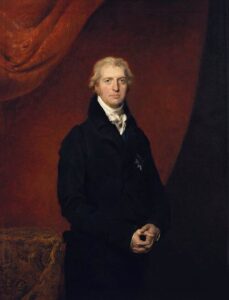
Lord Liverpool
- Robert Banks Jenkinson, second Earl of Liverpool — son of Charles Jenkinson, first Earl of Liverpool and political confidant of George III, Charterhouse and Christ Church Oxford, MP from 1790, Master of the Mint, Foreign Secretary, Home Secretary, Secretary for War and the Colonies, and Prime Minister from June 1812 to February 1827 — served as Prime Minister for nearly fifteen years, the longest continuous premiership in British history after Walpole, governing Britain through the final phase of the Napoleonic Wars, the Congress of Vienna settlement, the post-war economic depression, the Peterloo Massacre, the Queen Caroline affair, and the beginnings of the liberal Tory reform programme that his successors extended into the Reform Act era — a record of institutional management across the most turbulent fifteen years in modern British history that his historical reputation has consistently undersold.1Britannica — Lord Liverpool
- His premiership produced the defeat of Napoleon, the Congress of Vienna settlement that shaped European diplomacy for a generation, the management of the post-war economic crisis without the revolutionary convulsion that equivalent conditions produced in France, Spain, and Italy, the repeal of the income tax, the resumption of cash payments, the liberalisation of trade under Huskisson, the reform of the criminal law under Peel, and the Catholic emancipation question that his personal opposition kept unresolved and that destroyed his successor's government within two years of his incapacitation — making Liverpool the pivot figure of British political history between Pitt and the Reform Act, holding the centre against pressures from both directions for longer than any comparable leader in the dataset.2Oxford DNB — Lord Liverpool
- The man Canning called the Arch-Mediocrity — a characterisation that reflects Canning's frustrated ambition more accurately than Liverpool's actual capability — was in analytical terms one of the most effective coalition managers in the British Political domain, a leader whose Vision was not transformational but whose Process, People, and Resilience variables sustained a governing coalition through conditions that destroyed every comparable European government of his era, producing by institutional survival alone a Value output that the label mediocrity entirely fails to capture.3Britannica — Lord Liverpool
Lord Liverpool is the most underrated profile in the British Political domain and the one whose analytical reassessment has moved most dramatically as historians have shifted from measuring leadership by rhetorical brilliance to measuring it by institutional output under adverse conditions. The Arch-Mediocrity label has obscured for two centuries a premiership of extraordinary durability whose variable profile — high Process, high People, high Resilience, moderate Vision, managed Ego and Pride — is precisely the combination that fifteen years of continuous crisis management required.
The formation period establishes the political baseline with unusual institutional density. Liverpool grew up in the orbit of George III's court through his father's position, entered Parliament at twenty, and served in a sequence of senior ministerial roles — Foreign Secretary at twenty-six, Home Secretary, Secretary for War — that gave him direct operational experience of every major department of government before he reached the premiership.1Britannica — Lord Liverpool The Process variable in the formation period is the highest of any Prime Minister in the British dataset at the point of taking office — Liverpool had managed the Foreign Office during the Amiens negotiations, the Home Office during the early industrial unrest, and the War Office during the Peninsular campaign, producing an institutional knowledge of government machinery that most Prime Ministers acquire in office rather than before it.
The early premiership from 1812 to 1815 is where the Conviction and Resilience variables are established under maximum pressure. Liverpool took office in June 1812 — the month of Napoleon's invasion of Russia — with a minority government, a Commons majority dependent on independent MPs, the American war beginning, and Wellington's Peninsular campaign at a critical juncture.1Britannica — Lord Liverpool The management of the coalition through the final phase of the Napoleonic Wars — sustaining the subsidy system that kept allied armies in the field, managing the Prince Regent's political interventions, holding together a cabinet that included Castlereagh and Canning who had fought a duel three years earlier — reflects the People variable operating at its most demanding expression. Liverpool's specific capability was not the identification of brilliant individuals — though Castlereagh, Canning, Peel, and Huskisson are collectively the strongest cabinet of the early nineteenth century — but the management of those individuals' competing ambitions within a single governmental framework without the coalition fragmenting.
The Congress of Vienna period is analytically significant primarily through Castlereagh, whose Foreign Office management Liverpool sustained against domestic political pressure that would have recalled a less secure Prime Minister's foreign secretary.4US State Department — Congress of Vienna Liverpool's willingness to give Castlereagh the institutional space to construct the Vienna settlement — absorbing the parliamentary criticism that Castlereagh's absence and the settlement's terms generated — reflects the People variable operating in its most institutionally generous form: a leader who understood that the most valuable thing he could give his most capable minister was freedom from domestic political interference. The resulting settlement — which produced the longest period of great power peace in European history — is Value output that Liverpool generated by institutional protection rather than personal diplomatic action.
The post-war period from 1815 to 1820 is the most analytically difficult phase of the premiership and the one that most directly tests the Congruence variable. The economic depression that followed the Napoleonic Wars — demobilisation unemployment, agricultural price collapse, the Corn Laws maintaining bread prices, and industrial unrest producing the machine-breaking campaigns and political agitation that culminated in Peterloo — required a government response that Liverpool's instincts and his parliamentary coalition's interests pulled in the direction of repression rather than reform.5Britannica — Peterloo Massacre The Peterloo Massacre of August 1819 — in which cavalry charged a peaceful reform meeting at St Peter's Field in Manchester, killing eighteen and injuring hundreds — and the Six Acts that followed, restricting public meetings and the radical press, are the Value variable at its most contested in the profile. By the new Value framing — leadership effectiveness for the defined constituency — the repression maintained the parliamentary coalition and prevented the revolutionary convulsion that equivalent conditions had produced in France. By the broader measure of what the repression cost those it was applied to, the score is lower. Both are recorded.
The Queen Caroline affair of 1820 is the most analytically unusual crisis of the premiership. George IV's attempt to divorce his estranged wife Caroline of Brunswick — through a Bill of Pains and Penalties introduced in the Lords — produced a public mobilisation in Caroline's support that made the government's position untenable, and Liverpool eventually persuaded George IV to abandon the bill after it passed the Lords by only nine votes.6Britannica — Queen Caroline The Adaptability variable at this snapshot is among the highest in the profile — Liverpool identified the point at which the political cost of proceeding outweighed the benefit, persuaded a king who was not accustomed to being persuaded, and extricated the government from a crisis it had not created without the constitutional damage that continuation would have produced.
The liberal Tory period from 1822 onwards — following the reconstruction of the cabinet that brought Canning to the Foreign Office, Peel to the Home Office, and Huskisson to the Board of Trade — is the canonical snapshot and the most analytically productive phase of the premiership.2Oxford DNB — Lord Liverpool The People variable at this snapshot is the highest in the profile — Liverpool had identified that the post-war political landscape required a different kind of Conservative governance, had recruited the individuals capable of delivering it, and had given them the institutional space to operate. Peel's reform of the criminal law — reducing the number of capital offences, humanising prison conditions, and beginning the systematic rationalisation of English criminal procedure — and Huskisson's trade liberalisation reflect a Vision variable operating through subordinates with greater domain expertise than Liverpool himself possessed. That is the People variable producing its highest Value output — a leader who understood what was needed, found the people who could deliver it, and got out of their way.
The Catholic emancipation question is the most significant strategic failure of the premiership and the one that most precisely captures the limits of the coalition management approach. Liverpool personally opposed Catholic emancipation — the extension of full political rights to Roman Catholics — and managed his cabinet's divided views on the question by treating it as an open question on which ministers could hold and express personal views without it becoming a government position.1Britannica — Lord Liverpool The management of the division preserved the coalition for fifteen years — but at the cost of leaving the most consequential constitutional question of the era unresolved. When Liverpool was incapacitated by a stroke in February 1827, the coalition held together by his personal management immediately began to fracture over precisely this question, producing the Canning premiership, the Goderich government, and the Wellington administration that eventually passed Catholic emancipation in 1829 under conditions of political crisis that Liverpool's continued management might have avoided.
The stroke of February 1827 — from which Liverpool never recovered, dying in December 1828 — is the terminal variable expression and the one that most precisely illustrates the structural limitation of a leadership model built around personal coalition management rather than institutional design. Liverpool had held the centre by being present at the centre — by knowing each member of his coalition, understanding their positions, and managing the relationships between them with a continuous personal attention that no institutional mechanism could replicate.3Britannica — Lord Liverpool When the personal management ceased, the coalition ceased. That is the Process variable recording its most significant single failure — a leader who built a system that required him to function, rather than a system that functioned without him.
The number that matters most across all four snapshots is Resilience — sustained at a consistently high level across fifteen years of continuous crisis that eliminated every comparable European government of the era. Liverpool governed through the final phase of the Napoleonic Wars, the post-war depression, Peterloo, the Queen Caroline affair, and the liberal Tory reconstruction without losing a general election, without the government collapsing, and without the revolutionary convulsion that France, Spain, Italy, and Greece all experienced in the same period. That sustained institutional survival — unglamorous, unquoted, and analytically precise — is the Leaderment signature of Lord Liverpool, and it is the reason the Arch-Mediocrity label is the most analytically inaccurate characterisation in the British Political domain.
Score Comparison
Add up to 10 leaders. Click a name to visit their profile.
The 13 Equations
Scores for: Stroke and Coalition CollapseThe 22 Variables
Canonical scoresWhat changed: Liberal Tory Peak — Peel, Canning and Huskisson → Stroke and Coalition Collapse
Sources & Bibliography
The scores assigned to this leader are derived from publicly available sources. Variable inputs reflect documented behaviour, structural conditions, and historical record at the time of each snapshot.