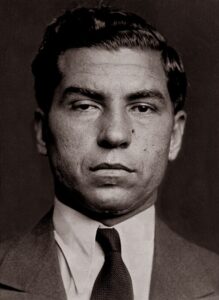
Lucky Luciano
Lucky Luciano (1897–1962)
- Born Salvatore Lucania in Lercara Friddi, Sicily, on 24 November 1897 — emigrated with his family to the Lower East Side of New York in 1906, dropped out of school, was arrested for shoplifting at ten, and by fifteen was running a protection racket on his schoolmates: a penny a week or a beating1Britannica — Lucky Luciano — spent six months in jail for heroin possession in 1916, was not convicted of another crime for twenty years, aligned himself with Meyer Lansky, Frank Costello and Bugsy Siegel to build one of the most profitable bootlegging operations in New York, survived a near-fatal beating — throat cut, eye damaged, left for dead on Staten Island in 1929 — that earned him the scar tissue and the nickname that stuck.
- In April 1931 lured his boss Joe Masseria to a Coney Island restaurant and had him shot by four loyalists, then six months later had his new boss Salvatore Maranzano killed by four gunmen borrowed from Meyer Lansky2Wikipedia — Lucky Luciano — eliminating in one year both of the old-world Sicilian bosses whose dynastic warfare was destroying profitability — before convening the leaders of organised crime from across the country and proposing the Commission: a governing body with no boss of all bosses, distributed power, institutionalised dispute resolution, and a hard rule that prosecutors were not to be harmed, which he enforced immediately by ordering the murder of Dutch Schultz when Schultz refused to abandon his plan to kill Thomas Dewey.
- Was convicted on prostitution racketeering charges in June 1936 and sentenced to thirty to fifty years — continued to govern from prison, helped naval intelligence secure the New York waterfront in 1942, had his sentence commuted in 1946 on condition of deportation to Italy3Mob Museum — Lucky Luciano — spent his final sixteen years in Naples under police surveillance, meeting syndicate heads in Havana in 1947 before being expelled from Cuba, and died of a heart attack at Capodichino Airport on 26 January 1962, having gone to meet a Hollywood producer interested in his life story.
Lucky Luciano is the dataset's most analytically unusual entry. He operated in a domain with no legitimate institutional framework, no legal protection, no external accountability, and no exit mechanism. The equations do not adjudicate the morality of what he built. They record what he built, how he built it, and whether the variables that drove it were internally consistent — and they are.
The rise period is the formation of a leader who understood, earlier than almost anyone in his milieu, that the primary obstacle to organisational effectiveness in organised crime was organised crime itself. The gang wars of the 1920s — bloody, expensive, disruptive to every revenue stream — were the problem his career was designed to solve. The Prohibition boom had made the opportunity large enough to justify the solution. What Luciano brought was the diagnosis and the architecture.4EBSCO Research Starters — Lucky Luciano
The Castellammarese War of 1930–31 is the canonical inflection point. Luciano had spent years cultivating relationships across ethnic lines — with Lansky and Siegel among the Jewish gangs, with Costello and Genovese within the Italian structure — while the old-world bosses Masseria and Maranzano conducted a war that was costing everyone money and generating law enforcement attention. His solution was sequential and precise: engineer Masseria's death through loyalists, accept Maranzano's patronage briefly, then eliminate Maranzano before Maranzano could eliminate him. Within six months he had become, without claiming the title, the most powerful figure in American organised crime.
What he then did with that power is the analytical observation the Codex is designed to capture. He did not attempt to consolidate all authority in himself — the opposite. He designed and convened the Commission: a distributed governance structure that suppressed inter-family Competition, institutionalised dispute resolution, protected the system from the most self-destructive impulses of its members (the Schultz decision), and sustained profitable operations across multiple families simultaneously.2Wikipedia — Lucky Luciano The FBI later described this as the watershed event in the history of organised crime. The Management variable at this snapshot is the highest in the Criminal domain dataset — not because the output was legitimate, but because the architecture was genuinely innovative, systematically deployed, and durably effective.
The Congruence score is, counterintuitively, relatively high. Luciano's stated operating principle — that gang warfare was bad for business and that the system should prioritise collective stability over individual dominance — was the principle he consistently enacted. The Commission rule against killing prosecutors was not rhetorical; he enforced it at real cost, ordering a murder to prevent a murder that would have served his short-term interests. The say-do gap that runs through almost every profile in the dataset is narrower here than in most. The Virtue score is a different matter entirely — it sits at floor, because the system he managed with such discipline generated revenue through prostitution, narcotics, extortion and murder. The equations record both observations simultaneously, and do not resolve the tension between them.
The prison and exile snapshot captures the most analytically unusual feature of his career: that Autonomy, while reduced, never reached zero. He continued to govern from Clinton Correctional. He secured a commutation by making himself useful to the state he had spent his career operating against. He convened the Havana conference within months of deportation. The system he had built was robust enough to function without his physical presence in it — which is the clearest measure of how well-designed the architecture was.5Mob Museum — Luciano traded prison for exile
He died at sixty-four at an airport, on his way to a meeting about a film of his life. The empire he built is still operating. That is an unusual legacy score by any measure.
Score Comparison
Add up to 10 leaders. Click a name to visit their profile.
The 13 Equations
Scores for: Rising Through Masseria — ProhibitionThe 22 Variables
Canonical scoresSources & Bibliography
The scores assigned to this leader are derived from publicly available sources. Variable inputs reflect documented behaviour, structural conditions, and historical record at the time of each snapshot.