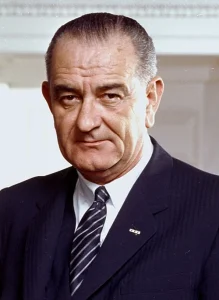
Lyndon B. Johnson
Lyndon B. Johnson (1908–1973)
- Lyndon Baines Johnson — son of a Texas Hill Country farmer and state legislator, NYA director, six-term congressman, decorated naval observer in the Pacific, Senate Minority Leader, Senate Majority Leader — the most effective legislative operator in the history of the United States Congress — and Vice President under Kennedy, assumed the presidency on 22 November 1963 in circumstances of national trauma and proceeded to translate grief into the most concentrated burst of domestic legislation since the New Deal.1Britannica — Lyndon B. Johnson
- His presidency from 1963 to 1969 produced the Civil Rights Act of 1964, the Voting Rights Act of 1965, Medicare, Medicaid, the Elementary and Secondary Education Act, the Immigration and Nationality Act, the Fair Housing Act, the creation of the Department of Housing and Urban Development, the Public Broadcasting Act, and the National Endowment for the Arts — the greatest legislative output of any American presidency since Roosevelt — while simultaneously prosecuting a war in Vietnam that consumed his presidency, destroyed his political coalition, and forced him from office.2Miller Center — Lyndon Johnson Key Events
- The central analytical paradox of the Johnson presidency — a man whose Vision of the Great Society was the most ambitious domestic programme in American history, whose legislative capability to execute that Vision was without parallel, and whose management of the Vietnam War reflected the opposite of every variable that made the domestic programme succeed — is not a contradiction the equations resolve but a contradiction they precisely record, driven by the same Ego and Pride variables operating in different environments with different consequences.3History.com — Lyndon B. Johnson
Lyndon Johnson is the most tragic profile in the American Political domain — not because he failed, but because the variables that produced his greatest achievements and his most catastrophic failure were identical, operating simultaneously, and he could not separate them. The equations do not resolve the paradox. They explain it.
The formation period is analytically essential in a way that is true of no other president in the dataset. Johnson grew up in genuine poverty in the Texas Hill Country — a specific, grinding poverty that shaped his relationship with government, power, and the people government could either help or ignore.4LBJ Library — Biography His year teaching Mexican-American children in Cotulla, Texas — where he was simultaneously principal, teacher, janitor, and coach of a school with no resources — is the experiential foundation of every education and poverty programme he subsequently enacted. The Vision variable in every Johnson snapshot is not abstract political philosophy. It is direct personal knowledge of what deprivation looks like and what institutional intervention can do about it.
The Senate years established the operational baseline that made everything else possible. As Senate Majority Leader from 1955 to 1961 Johnson developed what became known as the Treatment — an overwhelming, physically proximate, individually calibrated campaign of persuasion, pressure, flattery, threat, and dealmaking that he applied to individual senators until they moved in the direction he required.2Miller Center — Lyndon Johnson Key Events The People variable in this period is the highest in the American dataset — not because Johnson selected good people but because he understood people with a granularity that no other political leader in the record approaches. He knew what each senator wanted, what they feared, what they owed, and what they could be made to do. That capability translated directly into the legislative achievements of the presidency.
The transition period following Kennedy's assassination is the most analytically precise expression of Johnson's legislative capability operating under maximum emotional and political constraint. He used the national grief, Kennedy's unfinished legislative agenda, and his own unmatched congressional relationships to pass the Civil Rights Act of 1964 — legislation that Kennedy had submitted but could not move through Congress — within seven months of taking office.5Our Documents — Civil Rights Act 1964 The Process and Defined Output variables at this snapshot are at their ceiling. The Intent variable reflects a man who understood precisely what the moment required and had spent thirty years building the capability to deliver it.
The 1964 landslide election produced the congressional majority that made the Great Society possible — and Johnson understood that the window would close.2Miller Center — Lyndon Johnson Key Events The eighty-ninth Congress of 1965 to 1967 passed more significant legislation than any Congress since 1933 to 1935. Medicare and Medicaid, which had been blocked for twenty years by the American Medical Association and conservative Democrats, passed within months. The Voting Rights Act — which Johnson introduced to a joint session of Congress using the words of the civil rights movement, "We shall overcome" — dismantled the systematic disenfranchisement of Black Americans in the South with a directness that no previous president had attempted.6Our Documents — Voting Rights Act 1965 The Vision and Value variables at this snapshot are the highest in the profile and among the highest in the American Political domain.
Vietnam is where the same variable profile produces the opposite outcome. Johnson inherited a commitment of sixteen thousand military advisers in Vietnam from Kennedy and escalated it to five hundred and forty thousand combat troops by 1968 — driven by the same Conviction that refused to compromise on the Civil Rights Act, the same Pride that could not accept the humiliation of American defeat, and the same People capability that, applied to domestic legislation, was transformative but applied to military strategy was catastrophic because Johnson's understanding of individual human motivation did not extend to understanding the institutional dynamics of military escalation or the political dynamics of Vietnamese nationalism.2Miller Center — Lyndon Johnson Key Events
The credibility gap is the central Congruence failure of the Vietnam period. Johnson's public statements about the war's progress were systematically inconsistent with the intelligence assessments his administration was receiving — not occasionally, but as a sustained pattern across four years.7History.com — Vietnam War The Pentagon Papers, published in 1971 after his presidency, documented the gap in detail. The Congruence variable at the Vietnam snapshots is the lowest in the profile — not because Johnson was uniquely dishonest but because the gap between what he said and what he knew was structural rather than occasional, driven by a Pride variable that could not admit the scale of the miscalculation publicly without collapsing the political support the war required.
The Tet Offensive of January 1968 is the analytical turning point. The North Vietnamese and Viet Cong assault on over one hundred South Vietnamese cities and towns — coordinated, sustained, and launched at the moment Johnson's administration had been publicly claiming the war was being won — destroyed the credibility gap beyond repair.2Miller Center — Lyndon Johnson Key Events Walter Cronkite's editorial broadcast of February 1968 — in which the most trusted man in America declared the war a stalemate — is recorded in the Communication variable from a different direction: when the most effective communicator in the political domain loses control of the dominant narrative, the institutional consequences are immediate and irreversible. Johnson's announcement on 31 March 1968 that he would not seek re-election is the Humility variable finally operating — too late to save the presidency, but genuine.
The number that matters most across all four snapshots is the People variable — specifically its domain specificity. Johnson's People score in the legislative domain is the highest in the American dataset. His People score in the military and foreign policy domain is among the lowest — he surrounded himself with advisers who told him what he wanted to hear about Vietnam, excluded sceptics, and applied the same pressure tactics that moved senators to the positions he required but that produced only false optimism from generals who understood that pessimism was unwelcome. The same variable, differently applied, produced the Great Society and the Vietnam War simultaneously. That is the Leaderment profile of Lyndon Baines Johnson.
Score Comparison
Add up to 10 leaders. Click a name to visit their profile.
The 13 Equations
Scores for: Civil Rights Act and Great Society — Peak Legislative PowerThe 22 Variables
Canonical scoresWhat changed: Senate Majority Leader — The Treatment → Civil Rights Act and Great Society — Peak Legislative Power
Sources & Bibliography
The scores assigned to this leader are derived from publicly available sources. Variable inputs reflect documented behaviour, structural conditions, and historical record at the time of each snapshot.