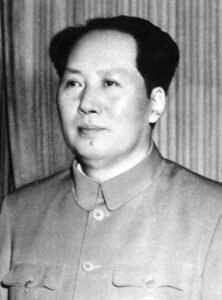
Mao Zedong (1893–1976)
Mao Zedong (1893–1976)
- Founded the People's Republic of China on 1 October 1949, unifying a country fractured by civil war, warlordism and Japanese occupation for decades — having led the Chinese Communist Party through the Long March of 1934–35, emerging from a force of 85,000 reduced to approximately 7,000 as the undisputed leader of the CCP.1Wikipedia — Mao Zedong
- Oversaw one of the fastest industrialisation programmes in recorded history during the First Five Year Plan, dramatically expanding literacy and healthcare and nearly doubling life expectancy1Wikipedia — Mao Zedong — then launched the Great Leap Forward in 1958, whose failure produced the worst famine in recorded human history, with an estimated thirty million people dying of starvation between 1959 and 1962 while cadres falsified production figures to avoid punishment and Mao purged the minister who told him the truth.2Association for Asian Studies — China's Great Leap Forward
- Responsible for the deaths of an estimated 30 to 70 million people through the famine caused by the Great Leap Forward and the violence of the Cultural Revolution (1966–1976)1Wikipedia — Mao Zedong — with the CCP's own post-death verdict of seventy percent right and thirty percent wrong applied to a record the Codex cannot compress into a single number.
Born into a peasant family in Hunan province, Mao rose through a combination of genuine intellectual ability, extraordinary Conviction, and a strategic instinct for guerrilla warfare that his contemporaries — and his enemies — consistently underestimated. He was a founding member of the Chinese Communist Party in 1921, but it was the Long March of 1934–35 that defined him.1Wikipedia — Mao Zedong Leading 85,000 soldiers out of encirclement, losing all but approximately 7,000 to combat, starvation and disease, he emerged from Yan'an as the undisputed leader of the CCP. The equations record this period accurately: Conviction at maximum, Congruence high — he believed what he preached — and Chaos still contained. Resources were scarce, but Autonomy within his domain was absolute and the operational moment — Japanese invasion, KMT overstretch, Soviet backing — created conditions that amplified every variable in his numerator.
The founding of the People's Republic in 1949 produced his peak score. With the state apparatus under his control, Resources maximised, and Autonomy absolute, the First Five Year Plan delivered what the historical record describes as an enormous success. China industrialised rapidly. Life expectancy nearly doubled. Literacy expanded.1Wikipedia — Mao Zedong The equations capture this correctly — when the numerator variables are strong and the denominators are suppressed, Effective Power compounds. This is the canonical snapshot: the period in which Mao converted his revolutionary Effective Power into state-level output.
The Great Leap Forward destroyed it. From 1958, Pride and Ego reached their ceiling. The framework predicts precisely what the historical record shows: the feedback loop broke. Cadres falsified grain production figures to avoid punishment. Each layer of the party exaggerated upward. Nobody told Mao the truth — and when Peng Dehuai did, Mao purged him and intensified the policies.3Wikipedia — Great Leap Forward An estimated thirty million people died of starvation. The say-do gap between "building a workers' paradise" and the documented outcome is one of the largest in the Codex. Congruence collapses not because Mao stopped believing — he may have continued to believe — but because the behaviour of the system he controlled produced the precise opposite of its stated intent. That is what the equations measure.
The Cultural Revolution completed the collapse. Trust reached its practical floor. Liu Shaoqi, his designated successor, was imprisoned and died in custody. Lin Biao, his chosen replacement, died fleeing the country.4Columbia — Mao Zedong Biographical Profile Peng Dehuai was dead. The people around Mao were terrified, not loyal. Recognition — in the framework's sense of stakeholder acknowledgement that a leader's authority is warranted — had been replaced entirely by fear. Fear produces compliance, not Effective Power. The score records the result.
The CCP's own verdict — seventy percent right, thirty percent wrong — is analytically incoherent when applied across his full career. The equations do not produce a single verdict. They produce four: a revolutionary genius, a state-builder of historic scale, the architect of one of the worst man-made famines in recorded history, and a leader whose final decade was characterised by a system consuming itself. All four are true simultaneously. The framework does not resolve the contradiction. It measures it.
Score Comparison
Add up to 10 leaders. Click a name to visit their profile.
The 13 Equations
Scores for: Cultural Revolution — The WreckageThe 22 Variables
Canonical scoresWhat changed: Great Leap Forward — The Catastrophe → Cultural Revolution — The Wreckage
Sources & Bibliography
The scores assigned to this leader are derived from publicly available sources. Variable inputs reflect documented behaviour, structural conditions, and historical record at the time of each snapshot.