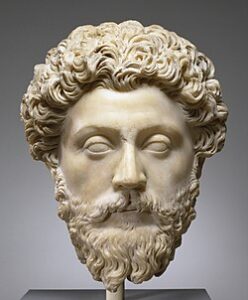
Marcus Aurelius
Marcus Aurelius (121–180 CE)
- Born on 26 April 121 CE in Rome into a prominent senatorial family with Hispano-Roman ancestry — spotted at seven by the Emperor Hadrian, who arranged his adoption by the future Emperor Antoninus Pius and his preparation for the principate1Britannica — Marcus Aurelius — then on 7 March 161 CE, when Antoninus Pius died, declined the Senate's offer to confirm him alone and refused to take office unless his adoptive brother Lucius Verus received equal powers: the first time in Roman history two emperors had shared formally equal constitutional status, for a position he had never sought and would spend nineteen years enduring.
- Governed the Roman Empire from 161 to 180 CE through the Antonine Plague — probably smallpox, killing between five and ten million people, perhaps a quarter of the empire's population2Wikipedia — Marcus Aurelius — and the Marcomannic Wars on the Danube frontier against the Marcomanni, Quadi and Sarmatian Iazyges, personally commanding on campaign for fourteen of his nineteen years as emperor, writing private notes to himself in Greek during those campaigns that were never intended for publication, never published in his lifetime, and became the Meditations.
- Named his son Commodus as heir — breaking the adoptive tradition of the Five Good Emperors and the most consequential leadership error in this dataset by historical consequence — died on 17 March 180 CE, probably of plague, near Vindobona (modern Vienna)3Acclaimed Figures — Marcus Aurelius — whereupon Cassius Dio wrote that Roman history descended from gold to iron and rust, and the Meditations remained in private hands for nearly four centuries before publication, selling 100,000 copies in 2019 alone.
Marcus Aurelius did not want to be emperor. This is not a rhetorical claim. The Meditations — written for no audience, discovered only after his death — record a man in daily negotiation with a position he regarded as a burden rather than a reward. He reminded himself not to be seduced by the purple, not to mistake recognition for virtue, not to confuse the imperial palace with his actual self. In the Codex, this produces something extraordinary: a leader with minimal Ambition, Ego and Pride who nonetheless governed the Roman Empire for nineteen years at the height of its power. The equations reward him accordingly — not because he sought power, but because the variables that destroy most leaders were simply absent.
The Congruence score is the number that defines him — among the highest in the dataset. The say-do gap that runs through almost every other profile — Blair's Iraq, Nixon's tapes, HW Bush's tax pledge, Reagan's Iran-Contra — is structurally absent in Marcus Aurelius. The Meditations are private notes. They were never intended for publication, political effect, or posterity. They read identically to his public conduct.4Philopedia — Marcus Aurelius When he wrote that a man should do his duty without complaint, accept criticism without defensiveness, and treat his position as a service rather than a privilege, he was describing precisely what he did. That alignment between private thought and public action is what the Congruence variable is designed to measure, and Marcus Aurelius represents its ceiling.
The Humility score is unique in the dataset — no other leader matches it. The Meditations contain repeated exercises in epistemic humility — instructions to himself to question his own judgements, acknowledge his errors, and remember that his opinions might be wrong. This is not performed modesty. It is a man who understood, in a way most leaders never do, that the greatest risk of high office is the corruption of the capacity for self-correction. The Codex uses Humility as the safety valve against systemic God Complexes. Marcus Aurelius wrote the manual.
His reign was not peaceful. The Antonine Plague killed between five and ten million people — perhaps a quarter of the empire's population — and shadowed his entire principate. The Marcomannic Wars required him to spend years personally commanding on the Danube frontier, far from the philosophical life he preferred.2Wikipedia — Marcus Aurelius He managed a revitalised Parthian Empire in the east, currency debasement, and simultaneous pressures on multiple frontiers. The Environment variable scores accordingly. He inherited the tail end of the Pax Romana and watched it close. The k variable — external conditions outside a leader's control — reflects nineteen years of compounding adverse fortune. That he maintained administrative competence, legal reform, and genuine philosophical output throughout is what the Conviction variable is designed to capture.
The Charisma score deserves direct acknowledgement — it sits among the lowest in the dataset. Low Ego divided by high Humility produces that result mathematically and correctly. Marcus Aurelius was not charismatic. He was not a performer. Herodian wrote that he alone among emperors proved his learning not by words but by blameless character. What he had instead of Charisma was Authority — the product of Conviction, Recognition, and Ability compounding without ego interference. The equestrian statue still standing in Rome captures it: the arm extended not in triumph but in clemency, the face visibly tired. A man doing his duty.1Britannica — Marcus Aurelius
The succession is the single analytical failure of his reign and the most consequential leadership error in this dataset by historical consequence. Marcus named his son Commodus as heir — a catastrophic choice, apparent to contemporaries and undeniable to history. Cassius Dio wrote that with Marcus's death, Roman history descended from gold to iron and rust. The Defined Output variable carries this. The clearest output of any principate is the quality of what follows it. Marcus Aurelius, who understood almost everything about leadership, did not solve the one problem that mattered most.
The Meditations sold 100,000 copies in 2019. Frederick the Great kept them at his bedside. John Stuart Mill read them. They have been in continuous print for nearly five centuries. This is what high Value looks like when the denominator is two thousand years.
Score Comparison
Add up to 10 leaders. Click a name to visit their profile.
The 13 Equations
Scores for: Marcomannic WarsThe 22 Variables
Canonical scoresWhat changed: Early Reign 161–169 → Marcomannic Wars
Sources & Bibliography
The scores assigned to this leader are derived from publicly available sources. Variable inputs reflect documented behaviour, structural conditions, and historical record at the time of each snapshot.