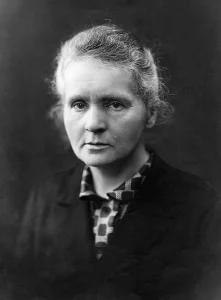
Marie Curie
Marie Curie 1867-1934
- Appointed director of the Curie Laboratory at the Radium Institute of the University of Paris in 1914 — the first woman to hold a director-level position in French science — and directed the institute until her death in 1934, supervising 483 scientific publications and the award of 34 doctoral degrees, while simultaneously being the first woman to win a Nobel Prize, the first person to win it twice, and the only person to win it in two different scientific fields.1Wikipedia — Marie Curie ↗
- During the First World War, recognised that battlefield surgeons needed X-ray capability at the front rather than in distant urban hospitals, self-taught radiology, anatomy and automotive mechanics in weeks, procured vehicles and X-ray equipment by personal advocacy to manufacturers and wealthy donors, developed the mobile radiography units known as petites Curies, trained more than 150 radiologists in courses she ran at the Radium Institute, and deployed over 200 radiological units treating an estimated one million soldiers — a deployment operation of genuine institutional complexity, managed by a woman operating outside every institutional framework available to her.2IEEE Spectrum — Marie Curie WWI ↗
- Became the first woman to hold a professorship at the University of Paris (the Sorbonne) in 1906, following her husband Pierre's death, and held it for twenty-eight years — working in an institutional environment that had denied her access to the Académie des Sciences, refused her application to join it despite her Nobel Prize, and consistently treated her as exceptional rather than equal, a condition the Environment variable records and the equations correct by measuring what she achieved within it rather than rating the institution.3Nobel Prize — Marie Curie ↗
Maria Sklodowska was born on 7 November 1867 in Warsaw, then part of the Russian Empire, the youngest of five children of two teachers whose employment was precarious under a Russian regime suppressing Polish culture.1Wikipedia — Marie Curie ↗ University education for women was not available in Russia, so she left Warsaw for Paris in 1891, attended the Sorbonne, obtained licences in physics and mathematical sciences, met Pierre Curie in his laboratory in 1894, married him in 1895, and began the collaboration that would produce the discoveries of polonium and radium — isolated through four years of back-breaking work refining several tonnes of pitchblende ore in a shed — and the 1903 Nobel Prize in Physics shared with Pierre and Henri Becquerel. The analytical profile of Marie Curie within the Scientific domain requires three distinct institutional contributions to be scored in sequence: the research leadership at the Radium Institute, the wartime radiological deployment, and the institutional legacy she built. The Radium Institute directorship is the clearest expression of the Defined Output variable: she established an institution dedicated to radioactivity research and medical application, directed it for twenty years, and it produced, under her leadership, results that continue today as the Institut Curie — one of the leading cancer research centres in Europe. The People variable reflects a director who attracted researchers from across Europe, supervised dozens of doctoral students, and maintained a productive research programme while conducting her own experimental work simultaneously.4PMC — Marie Curie and Radiobiology ↗ The WWI mobile radiography operation is the most precisely documented leadership achievement outside the laboratory. She arrived at this challenge with no relevant operational experience — she had never worked clinically with X-ray equipment — and within weeks had taught herself what she needed, sourced the equipment, sourced the vehicles, organised the training programme, and deployed a fleet that served a million patients.2IEEE Spectrum — Marie Curie ↗ The Process variable in this snapshot reflects a leader who, when confronted with a problem she had not previously encountered, designed and implemented a solution of operational scale — not as an administrator but as the initiating, organising, personally executing agent of a public health intervention. The Environment variable is analytically crucial throughout her career. She operated in an institutional environment that systematically excluded women: the Académie des Sciences rejected her candidacy by one vote despite her two Nobel Prizes; she was denied the formal recognition routinely extended to male scientists of comparable achievement; and her relationship with the physicist Paul Langevin in 1911 — exposed by the press during the weeks surrounding her second Nobel Prize — was used to attempt to prevent her from attending the Stockholm ceremony. She attended. She received the prize. She died on 4 July 1934 of aplastic anaemia caused by decades of radiation exposure. She and Pierre were reinterred in the Paris Panthéon in 1995 — she was the first woman to be honoured there on her own scientific merit.
Score Comparison
Add up to 10 leaders. Click a name to visit their profile.
The 13 Equations
Scores for: Radium Institute — DirectorThe 22 Variables
Canonical scoresWhat changed: WWI Mobile Radiography — Operational Leadership → Radium Institute — Director
Sources & Bibliography
The scores assigned to this leader are derived from publicly available sources. Variable inputs reflect documented behaviour, structural conditions, and historical record at the time of each snapshot.