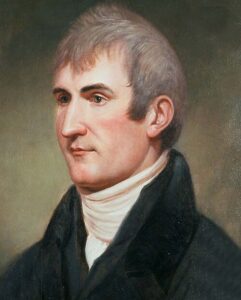
Meriwether Lewis
Meriwether Lewis (1774-1809)
- Commanded the Corps of Discovery from May 1804 to September 1806 alongside William Clark, leading thirty-three men 8,000 miles from St Louis to the Pacific Ocean and back — documenting over a hundred previously unknown animal species, hundreds of plants, and the geography of the American West in more than a million words of journals, losing only one man to illness across twenty-eight months in conditions of extreme physical hardship.1Britannica — Meriwether Lewis ↗
- Prepared for the expedition under the direct instruction of Thomas Jefferson with months of scientific training in Philadelphia — botany, zoology, astronomy, medicine and navigation — representing the most systematically prepared scientific explorer in American history to that point, handpicking Clark as co-commander and recruiting a group of soldiers and frontiersmen whose cohesion across nearly three years in the field was itself a leadership achievement.2Oregon Encyclopedia — Meriwether Lewis ↗
- Died on 11 October 1809 from gunshot wounds at Grinder's Inn on the Natchez Trace, aged 35 — whether by his own hand or another's remains disputed — having spent the two years since returning as a national hero in deepening financial difficulty, administrative conflict, depression and alcoholism as Governor of Louisiana Territory, never completing the published account of the expedition that Jefferson and the country expected of him.1Britannica — Meriwether Lewis ↗
Meriwether Lewis was born on 18 August 1774 on Locust Hill Plantation in Albemarle County, Virginia, the son of a Continental Army officer who died when Lewis was five, and a mother who taught him amateur botany and herbology during the years the family spent in Georgia.3American Battlefield Trust — Meriwether Lewis ↗ He grew up as a frontiersman before any formal military training, spending his early years hunting at night in the forests, developing the physical endurance and woodcraft that Thomas Jefferson would later describe as essential to the expedition he had in mind. By 1795 he was a soldier; by 1801 he was Jefferson's personal secretary, living in the presidential mansion and preparing himself, under Jefferson's direction, for the mission that would define his life. The Corps of Discovery expedition of 1804–06 is the canonical snapshot and the most analytically well-documented exploration in American history. Lewis's preparation was exceptional — months of scientific training in Philadelphia with the country's leading botanists, zoologists and physicians, followed by the methodical selection of Clark as co-commander and the careful assembly of a group of soldiers and volunteers who would spend twenty-eight months together in conditions designed to destroy group cohesion.2Oregon Encyclopedia — Meriwether Lewis ↗ The Intent variable in Lewis's profile reflects the complete shared understanding of purpose across the Corps — Jefferson had given Lewis multiple objectives simultaneously (scientific documentation, geographical survey, diplomatic relations with indigenous nations, identification of trade routes and resources) and Lewis transmitted all of them to his men with sufficient clarity that the journals they kept collectively constitute one of the great scientific records of the nineteenth century. The leadership of the expedition was genuinely shared with Clark in a way that the equations must handle carefully. Lewis was the nominal commander, the scientist, the writer of the primary journal, and the man Jefferson had chosen. Clark was the cartographer, the logistics commander, the man who managed the day-to-day cohesion of the Corps, and by most accounts the more naturally gifted leader of men in the field. The People variable in Lewis's profile reflects this division — he was not the dominant personality in the group's daily life, but the expedition's conception, preparation and scientific output were his.4Americana Corner — Lewis and Clark ↗ They returned to St Louis on 23 September 1806 having lost one man — Sergeant Charles Floyd, to acute appendicitis — and having produced a body of scientific and geographical work that opened the American West. The post-expedition period is the second analytical story and the one the equations capture most starkly. Jefferson appointed Lewis Governor of Louisiana Territory in 1807. The skills that had made him exceptional in the field — physical endurance, scientific curiosity, the management of a small cohesive unit under shared danger — were precisely the wrong skills for a territorial governorship that required bureaucratic navigation, political diplomacy, financial management, and the sustained production of written documentation.5Missouri Office of Administration — Meriwether Lewis ↗ His Process and Defined Output variables in the second snapshot collapse — he arrived in St Louis fourteen months late, fell into conflict with the territorial secretary Frederick Bates, made financial decisions the federal government refused to reimburse, and never completed the published account of the expedition that Jefferson and the country expected. His mental health deteriorated. He drank heavily. Jefferson, who had known him since boyhood, described his vulnerability to what friends called "melancholy."2Oregon Encyclopedia — Meriwether Lewis ↗ He died at Grinder's Inn on the Natchez Trace on 11 October 1809, aged 35, from gunshot wounds whose precise circumstances remain disputed. Most historians accept suicide; some argue murder. He carried with him the expedition journals he had never published and the financial records he was travelling to Washington to defend. He is buried in Tennessee under a broken column — a monument that Jefferson chose to represent a life cut short.
Score Comparison
Add up to 10 leaders. Click a name to visit their profile.
The 13 Equations
Scores for: Governor of Louisiana and DeathThe 22 Variables
Canonical scoresWhat changed: Corps of Discovery → Governor of Louisiana and Death
Sources & Bibliography
The scores assigned to this leader are derived from publicly available sources. Variable inputs reflect documented behaviour, structural conditions, and historical record at the time of each snapshot.
- Britannica — Meriwether Lewis
- Oregon Encyclopedia — Meriwether Lewis
- American Battlefield Trust — Meriwether Lewis
- Americana Corner — Lewis and Clark
- Missouri Office of Administration — Meriwether Lewis
- Wikipedia — Lewis and Clark Expedition
- Wikipedia — Meriwether Lewis
- National Museum of the US Army — Meriwether Lewis