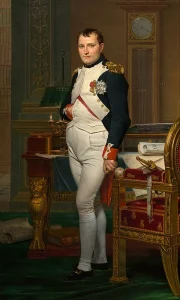
Napoleon Bonaparte
Napoleon Bonaparte (1769–1821)
- Rose from second lieutenant to First Consul in fourteen years through tactical genius, administrative intelligence and precise political calculation — the Italian campaign of 1796 alone producing seventeen actions and eighteen pitched battles in a single season, sweeping Austrian armies from Italy1Liberty, Equality, Fraternity — Napoleon — before crowning himself Emperor in 1804 and enacting the Napoleonic Code, which established equality before the law, religious tolerance and secure property rights across France and its territories.2Wikipedia — Napoleon
- Installed his brother Joseph as King of Spain without adequate assessment of Spanish national resistance, producing a war that consumed 300,000 troops from 1808 to 18143American Battlefield Trust — Napoleon — then invaded Russia with the largest army ever assembled on the continent, won at Borodino, occupied Moscow, and retreated in catastrophe when occupation produced nothing he could use.2Wikipedia — Napoleon
- Declined the Frankfurt proposals of November 1813, which offered France with Belgium, Savoy and the west bank of the Rhine, and fought on to total defeat at Waterloo in June 18154History.com — Napoleon — then spent six years on Saint Helena dictating the Mémorial de Sainte-Hélène, constructing the Napoleonic legend of a liberal, visionary proponent of European unity deposed by reactionary forces.2Wikipedia — Napoleon
Napoleon Bonaparte presents the equations with a profile that spans the full analytical range of the framework across four snapshots separated by fifteen years. The trajectory is not a gradual decline. It is a cliff. The mechanism is not external defeat. It is internal variable inflation consuming the system that produced the peak.
The Revolutionary General and First Consul period is where the profile is built. The Corsican outsider who arrived in mainland France speaking with a marked accent, completed a two-year military course in one year, and rose from second lieutenant to First Consul in fourteen years through a combination of tactical genius, administrative intelligence and precise political calculation.2Wikipedia — Napoleon The Italian campaign of 1796 — seventeen actions and eighteen pitched battles in a single season — established the template. Ability at its maximum, Process and People both operating at documented peak, Defined Output precise and consistently delivered.
What makes this period analytically distinctive is the Humility variable. The historical record supports genuine openness to expertise and correction during this period. He listened to engineers, to scientists — the Egyptian expedition carried 167 scholars — to legal experts drafting the Napoleonic Code, to military specialists advising on artillery deployment. Wellington later said his presence on a battlefield was worth 40,000 soldiers, which is not a description of a leader who ignored professional counsel. The historians who see Napoleon as pragmatic and realistic in his early years are recording a Humility score that the later period would not support.
The Congruence score in this period reflects the honest accounting of the Egyptian expedition — the massacre at Jaffa, the alleged poisoning of plague-stricken men to speed the retreat, the abandonment of his army to return to France when he saw political opportunity. These are documented against a stated mission of liberation and republican values. The gap is real. It sits below maximum because the administrative and legal achievements — the Concordat reconciling revolutionary France with the Catholic Church, the Napoleonic Code establishing equality before the law — were genuine expressions of stated values delivered at scale.4History.com — Napoleon Both things are true simultaneously.
The Emperor at Peak period is the profile's highest score and the point at which the variable inflation becomes analytically visible. Chaos rises as Ego and Pride both move upward following Austerlitz. McLynn's observation that Napoleon lost touch with reality after that victory is the Humility variable declining in the equations' language. He began to describe himself as an heir to the Ancient Romans. He crowned himself. He installed his brothers as kings of satellite states regardless of their competence.2Wikipedia — Napoleon He told his generals "is he lucky?" as though luck were a transferable property of the command structure rather than an environmental variable. These are Pride and Ego operating above their functional level — still contained by genuine Ability and Process at their peak, but the trajectory is established.
The Overreach and Decline period is where the denominator begins to consume the numerators systematically. The Peninsular War — which Napoleon himself called the unlucky war that ruined him — tied up 300,000 troops from 1808 to 1814.3American Battlefield Trust — Napoleon He installed his brother Joseph as King of Spain without adequate assessment of Spanish national resistance. The Russian campaign is Ambition operating at maximum against an Environment declining precisely because the strategic conditions were unfavourable in ways earlier campaigns had not been — scorched earth, extended supply lines, a commander who refused to negotiate, winter.2Wikipedia — Napoleon Victory at Borodino produced occupation of Moscow. Occupation of Moscow produced nothing. The inability to translate tactical success into strategic outcome is the Defined Output variable declining — the mission had expanded beyond what the system could specify and deliver.
Congruence falls further in this period for reasons the historical record makes explicit. The liberation narrative that had justified the Revolutionary campaigns sat alongside the reintroduction of slavery in French colonies, the looting of conquered territories institutionalised as state policy, the censorship and closure of independent newspapers. The French museums contain art stolen by Napoleon's forces from across Europe. These are not incidental to his record. They are the record.
The Hundred Days and Saint Helena snapshot is where Pride becomes the decisive variable. The Frankfurt proposals of November 1813 offered Napoleon France with Belgium, Savoy and the west bank of the Rhine — a significant empire, far beyond France's 1789 borders. He declined and fought on.4History.com — Napoleon The Frankfurt proposals were not militarily unacceptable. They were psychologically unacceptable to a leader whose Pride had reached its ceiling and for whom any reduction of his stated position constituted an identity event rather than a strategic choice. The equations calculated Waterloo before it was fought — not because Napoleon lacked tactical ability, which remained significant even in the final period, but because the structural conditions and the variable profile had together produced an outcome the Chaos score had been predicting for a decade.
He spent six years on Saint Helena dictating memoirs and constructing the Napoleonic legend — Conviction with no operational outlet, Pride requiring that the historical record reflect the self-image his variable profile had generated.5napoleon.org — Waterloo to Saint Helena The Memorial of Saint Helena portrayed him as a liberal, visionary proponent of European unification deposed by reactionary elements. The equations record what the campaign record and the administrative record both show: a leader who was, for a specific period under specific structural conditions, genuinely extraordinary — and who generated the conditions of his own destruction through the same variable trajectory that had produced the peak.
The final snapshot is not a verdict on what Napoleon was. It is a measurement of what was left when Chaos consumed everything else.
Score Comparison
Add up to 10 leaders. Click a name to visit their profile.
The 13 Equations
Scores for: Overreach — DeclineThe 22 Variables
Canonical scoresWhat changed: Emperor — Peak → Overreach — Decline
Sources & Bibliography
The scores assigned to this leader are derived from publicly available sources. Variable inputs reflect documented behaviour, structural conditions, and historical record at the time of each snapshot.