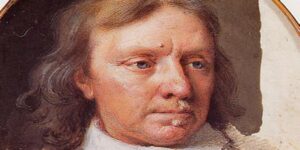
Oliver Cromwell
Oliver Cromwell (1599–1658)
- A farmer and minor MP who entered the Civil War in 1642 with no military experience, Cromwell built the New Model Army from nothing and became Parliament's most effective battlefield commander — winning at Marston Moor, Naseby and Worcester before signing the death warrant of Charles I and establishing the Commonwealth of England.1Wikipedia — Oliver Cromwell
- Named Lord Protector in December 1653, he unified England, Scotland and Ireland under a single executive for the first time — yet dissolved every parliament that challenged him, ruled through major generals answerable only to himself, and spent six weeks agonising over whether to accept the crown before declining it and sitting on King Edward's Chair in purple robes for his reinstallation ceremony.1Wikipedia — Oliver Cromwell
- His Irish campaign opened with massacres at Drogheda and Wexford, where there was widespread slaughter of soldiers and civilians alike.2National Army Museum — Oliver Cromwell After his death in 1658 his body was exhumed, posthumously executed, and his head displayed on a spike outside Westminster Hall1Wikipedia — Oliver Cromwell — a verdict Churchill called the opening of gulfs between nations and creeds that distressed English politics for centuries.
Oliver Cromwell arrived at power by accident, seized it by force, refused its ultimate form, and left it to collapse within two years of his death. The Codex finds him analytically fascinating precisely because of this contradiction: a man of genuine Conviction who nonetheless dissolved every parliament that frustrated him, championed liberty of conscience while massacring Catholics in Ireland, and spent six weeks agonising over whether to accept the crown before declining it — then sat on King Edward's Chair in purple robes for his reinstallation ceremony anyway. The say-do gap is not incidental to Cromwell's story. It is the story.
The Congruence variable is where the contradictions concentrate. The great Stoic leaders of antiquity — men who wrote privately what they practised publicly — represent one end of the Congruence spectrum. Cromwell occupies the other. His public declarations consistently diverged from his actions. He dissolved the Rump Parliament by force after championing parliamentary sovereignty.3World History Encyclopedia — Oliver Cromwell He suppressed the Levellers — who were demanding the democratic principles he had once appeared to share — when they became inconvenient.4Britannica — Oliver Cromwell He declared that government by one man and a parliament was fundamental, then ruled through major generals answerable only to him.1Wikipedia — Oliver Cromwell The Congruence variable records this pattern across all three snapshots, declining steadily as the gap between stated principles and actual conduct widened.
What the equations cannot diminish is the Conviction score, which sits among the highest in the dataset. Cromwell entered the Civil War in 1642 with no real military experience — yet within three years he had created the New Model Army, the first professional fighting force in English history built on ability rather than social rank, and had become its most effective battlefield commander.5Historic Royal Palaces — Oliver Cromwell The victories at Marston Moor, Naseby and Worcester were not inherited. They were built from nothing, through force of will and organisational intelligence that the Ability variable captures directly. His famous instruction — that he would rather have a plain russet-coated captain who knows what he fights for than a gentleman who is nothing else — is the Codex's People variable in a single sentence.2National Army Museum — Oliver Cromwell
The Irish campaign sits unresolved in the historical record and sits equally unresolved in the framework. The massacres at Drogheda and Wexford were not entirely outside the military conventions of a period that had just endured thirty years of continental warfare.2National Army Museum — Oliver Cromwell But Churchill's summary — that Cromwell cut new gulfs between nations and creeds that distressed English politics for centuries — is the consequence that the Value variable must account for. High short-term operational Value against the Irish threat. Long-term Value significantly discounted by the legacy of what was done. The Congruence damage is separate: the man who wrote that soldiers should not wrong or violate country people unless they were actually in arms authorised, or at minimum failed to prevent, the killing of civilians.
The Lord Protector period is where the Chaos equation does its most visible work. Cromwell's Pride and Ego were not negligible. Clarendon called him a brave bad man. The dissolution of every parliament that challenged him, the major generals experiment, the near-acceptance of the crown — these are the behaviours of a man whose self-belief had outrun his stated principles.6History.com — Oliver Cromwell As Pride and Ego rise across the three snapshots, Chaos compounds in the denominator of the Leadership equation, and the scores reflect it. The Charisma score reaches its highest point in the final snapshot — Confidence remaining elevated while Humility has nearly gone. High Charisma, collapsing Trust. The equations separate what conventional biography tends to conflate.
The succession is the final analytical note. Cromwell named his son Richard as successor despite Richard having no power base in either Parliament or the army. Richard resigned within nine months. The Protectorate collapsed. The monarchy was restored.3World History Encyclopedia — Oliver Cromwell The Defined Output variable — which asks whether the outputs of leadership outlasted the leader — records this with appropriate severity.
Edward Hyde's verdict has never been substantially improved upon: a brave bad man. The Codex agrees with both words.
Score Comparison
Add up to 10 leaders. Click a name to visit their profile.
The 13 Equations
Scores for: Commonwealth Peak 1650–1653The 22 Variables
Canonical scoresWhat changed: Civil War 1642–1649 → Commonwealth Peak 1650–1653
Sources & Bibliography
The scores assigned to this leader are derived from publicly available sources. Variable inputs reflect documented behaviour, structural conditions, and historical record at the time of each snapshot.