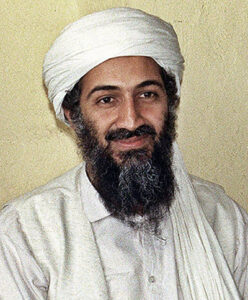
Osama Bin Laden
Osama bin Laden (1957–2011)
- Osama bin Laden — seventeenth of fifty-two children of Mohammed bin Laden, a Yemeni construction billionaire who built his fortune on Saudi infrastructure contracts, educated at King Abdulaziz University in Jeddah where he encountered Abdullah Azzam's jihadist theology, volunteer fighter and logistics coordinator for the Afghan mujahideen against the Soviet occupation from 1979, founder of al-Qaeda in 1988, exiled from Saudi Arabia in 1991, hosted by Sudan and then Afghanistan under the Taliban, and the orchestrator of the September 11 2001 attacks that killed 2,977 people in New York, Washington, and Pennsylvania — was the most consequential non-state actor in the post-Cold War international security dataset and the leader whose single operational output reshaped American foreign policy, international security architecture, and the geopolitics of the Middle East more completely than any comparable act of political violence in the twentieth century.1Britannica — Osama bin Laden
- Al-Qaeda under his leadership from 1988 to 2011 produced the 1998 US Embassy bombings in Nairobi and Dar es Salaam, the 2000 USS Cole attack, the September 11 attacks, the operational training infrastructure in Afghanistan that produced jihadist networks across thirty countries, and a global ideology of violent jihad against American power and its regional allies that survived his death in Abbottabad in May 2011 and continues to generate organisational offshoots whose combined operational reach exceeds al-Qaeda's peak capability — making bin Laden's most durable output not the specific attacks he directed but the ideological and organisational framework that produced organisations he never commanded.2Council on Foreign Relations — Al-Qaeda
- The variable profile that produced this record — a Vision of global jihadist resistance to American power that was coherent, internally consistent, and operationally translatable into specific campaign planning, combined with a Communication capability that operated simultaneously as theological argument, political manifesto, and recruitment instrument across multiple languages and media formats, and a People capability that identified and deployed Khalid Sheikh Mohammed, Mohammed Atta, and the September 11 operational team with a precision that the subsequent intelligence assessment confirmed — is the most analytically complete terrorist leadership profile in the dataset, and the one that most precisely illustrates the relationship between ideological clarity and operational effectiveness in a non-state violent actor context.39/11 Commission Report
Osama bin Laden is the most consequential non-state actor in the dataset and the profile that most precisely tests the model's application of the Value framing established for authoritarian and criminal leaders — leadership effectiveness for the defined constituency and objectives, not moral evaluation of those objectives. The equations record what he built, what it produced, and what it cost the populations that experienced it from the receiving end. The analytical commentary carries the moral weight. The variable scores carry the operational assessment.
The formation period is defined by the specific intersection of inherited wealth, theological formation, and the Afghan jihad that converted a construction heir into a paramilitary organiser of genuine operational capability. Bin Laden's encounter with Abdullah Azzam at King Abdulaziz University — and the subsequent relationship that took both men to Pakistan and Afghanistan in support of the mujahideen — provided the ideological framework and the operational context simultaneously.1Britannica — Osama bin Laden The Afghan period from 1979 to 1989 is the formation snapshot's most analytically significant element — bin Laden's specific contribution was not combat leadership, which he provided in limited quantities, but logistics and financing, which he provided at scale. The construction background — the family business, the project management expertise, the supply chain understanding — translated directly into the construction of training camps, the management of funding flows from Gulf donors, and the logistical coordination of Arab volunteers that made the Maktab al-Khidamat organisation, the precursor to al-Qaeda, operationally effective. The Process variable in this period is being built through direct application of commercial organisational capability to paramilitary logistics, which is the formation condition that most directly explains al-Qaeda's subsequent operational sophistication.
The founding of al-Qaeda in 1988 — at a meeting in Peshawar as the Soviet withdrawal from Afghanistan was becoming clear — is the canonical organisational event of the career and the one that most precisely captures the Vision variable at its most operationally consequential expression.2Council on Foreign Relations — Al-Qaeda Bin Laden understood before most of his contemporaries that the Afghan jihad's conclusion would produce a pool of trained, ideologically committed fighters with no defined subsequent mission, and that an organisational framework was required to direct that capability toward the next objective. The Vision variable at this moment is operating at a level of strategic foresight that the subsequent history confirms — al-Qaeda's founding preceded the Gulf War, the American military presence in Saudi Arabia, and the specific grievances that bin Laden's subsequent ideology cited as justifications, which means the organisational framework was constructed before the specific context that made it operationally relevant had fully developed.
The Sudan period from 1991 to 1996 is the most analytically productive organisational development phase of the career. Bin Laden arrived in Khartoum with construction equipment, financial resources, and a core of experienced Afghan veterans, and proceeded to build an organisation with the same project management discipline that the Afghan logistics operation had developed — constructing roads and infrastructure for the Sudanese government as commercial cover, establishing training facilities, developing the financial network of Gulf donors and front companies that sustained operations, and beginning the ideological production — speeches, fatwas, communiqués — that the Communication variable required to recruit and retain operatives across multiple countries.39/11 Commission Report The Process and Defined Output variables at this snapshot are among the highest in the non-state actor domain — bin Laden was building an organisation with genuine institutional depth, financial resilience, and operational planning capability that most terrorist organisations of the era did not approach.
The 1996 Declaration of War against Americans and the 1998 fatwa — the two foundational ideological documents of al-Qaeda's public phase — are the Communication variable's most analytically significant outputs and the ones that most precisely capture the relationship between theological argument and operational recruitment.4PBS — Bin Laden Fatwa 1998 Both documents were addressed simultaneously to multiple audiences — to existing al-Qaeda members as operational sanction for violence against American targets, to potential recruits as ideological justification for joining, to the broader Muslim world as political argument for the legitimacy of resistance, and to Western governments as strategic communication about al-Qaeda's objectives and resolve. The Intent variable at these moments is among the highest in the profile — each document was calibrated to multiple audiences with a rhetorical precision that the subsequent recruitment and operational response confirmed as effective.
The 1998 Embassy bombings and the 2000 USS Cole attack are the canonical operational outputs of the pre-September 11 period and the ones that most precisely capture the Defined Output variable in its intermediate expression.5Britannica — USS Cole Bombing Both operations reflected a specific operational logic — simultaneous attacks to demonstrate coordination capability, targets selected for symbolic value against American power projection, and timing calibrated to the media cycle that would maximise communication impact. The Process variable at these snapshots reflects an organisation that had developed genuine multi-country operational coordination capability — the Embassy bombings required simultaneous execution in two countries, coordinated logistics, operational security against penetration, and the management of multiple independent cells without direct communication that could be intercepted. That is an organisational Process capability that most state intelligence services would find demanding.
The September 11 attacks are the canonical snapshot and the most analytically significant single operation in the non-state actor domain. The operational planning — conducted over multiple years, involving nineteen operatives across multiple countries, requiring flight training in the United States, financial transfers across multiple jurisdictions, and operational security against the intelligence services of the most capable surveillance state in history — reflects a Process, People, and Defined Output combination operating at the ceiling of what a non-state actor had previously achieved.39/11 Commission Report The 9/11 Commission's assessment confirmed that the operational planning was conducted with a precision and a security discipline that the intelligence community had not anticipated from a non-state actor. Khalid Sheikh Mohammed's operational genius — the specific aircraft-as-weapons concept, the target selection, the cell structure — is the People variable's most consequential single identification in the profile: bin Laden recognised Mohammed's capability, gave him the operational authority to design the attack, and provided the organisational resources to execute it.
The Value variable at the September 11 snapshot requires explicit treatment under the established framing. For bin Laden's defined constituency — the jihadist movement whose objective was the withdrawal of American military power from Muslim-majority countries and the delegitimisation of American-aligned regional governments — the September 11 attacks produced a specific set of outputs: the American invasion of Afghanistan that destroyed al-Qaeda's operational base, the invasion of Iraq that produced the regional instability bin Laden's ideology had predicted American power would generate, and the global jihadist recruitment surge that the attacks' visibility produced. By the strict leadership effectiveness framing, the attacks achieved some of bin Laden's stated objectives while producing consequences — the destruction of the Taliban government, the dismantling of al-Qaeda's Afghan infrastructure, the death or capture of most of his senior operational staff — that his strategic planning had not adequately accounted for. The Value variable records the effectiveness of the output for the defined objectives, not the moral evaluation of those objectives. The score reflects partial strategic effectiveness at catastrophic operational cost.
The post-September 11 period from 2001 to 2011 is the most analytically reduced phase of the career. Bin Laden survived the Tora Bora engagement, evaded the American manhunt for nearly a decade, and continued to produce video and audio communications that maintained his ideological relevance while his operational capability progressively declined.1Britannica — Osama bin Laden The Autonomy variable collapses at this snapshot — bin Laden was living in effective imprisonment in Abbottabad, unable to communicate electronically, dependent on a single trusted courier for contact with the outside world, and operationally disconnected from the al-Qaeda affiliates whose activities were conducted in his name rather than under his direction. The Communication variable maintained its ideological function — the periodic releases sustained the brand — but the Process and Defined Output variables reflect an organisation whose leader had been operationally marginalised by the security environment his own actions had created.
The Abbottabad compound raid of 2 May 2011 — in which US Navy SEALs killed bin Laden and recovered extensive documentary and electronic material documenting al-Qaeda's operational state — produced the terminal snapshot.1Britannica — Osama bin Laden The documentary material confirmed that bin Laden remained intellectually engaged with al-Qaeda's strategic direction but operationally disconnected from its execution — a leader whose Vision variable was functioning at the same level as in the operational peak period, and whose Process and Defined Output variables had been reduced to near zero by a decade of hiding.
The number that matters most across all four snapshots is the relationship between the Vision variable and the Defined Output variable — specifically the gap between what bin Laden intended to produce and what he actually produced. The September 11 attacks achieved their immediate operational objective with precision. The strategic consequences — American military presence in two Muslim-majority countries rather than one, the global counterterrorism architecture that made subsequent al-Qaeda operations progressively more difficult, and the internal Muslim world debate about jihadist violence that the attacks generated — reflected a Vision variable that had accurately diagnosed American vulnerability and inaccurately calculated American response. That gap between operational precision and strategic miscalculation is the analytical signature of Osama bin Laden, and it is the reason that the most consequential single act of non-state violence in the dataset did not produce the strategic outcome its architect designed it to produce.
Score Comparison
Add up to 10 leaders. Click a name to visit their profile.
The 13 Equations
Scores for: Sudan Period — Organisational Development and Embassy BombingsThe 22 Variables
Canonical scoresWhat changed: Afghan Jihad and Al-Qaeda Founding → Sudan Period — Organisational Development and Embassy Bombings
Sources & Bibliography
The scores assigned to this leader are derived from publicly available sources. Variable inputs reflect documented behaviour, structural conditions, and historical record at the time of each snapshot.