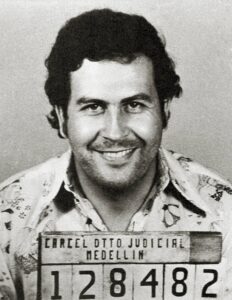
Pablo Escobar
Pablo Escobar (1949–1993)
- Built the Medellín Cartel from small-scale cocaine smuggling in the 1970s into an operation controlling roughly 80% of the global cocaine trade by the late 1980s — smuggling an estimated eighty tonnes monthly into the United States, generating an estimated $420 million a week at peak, and deploying the silver or lead strategy in which every judge, politician and police officer faced a binary choice between a bribe and assassination.1Britannica — Pablo Escobar
- Ordered the assassination of presidential candidate Luis Carlos Galán in August 1989 — a personal grudge, Galán having expelled him from the Liberal Party five years earlier — then bombed Avianca Flight 203 in an attempt to kill Galán's successor, killing all 107 passengers on board, bringing direct US government intervention into the conflict against him.2History Hit — Pablo Escobar
- Negotiated a surrender in 1991 guaranteeing no extradition and housing in a prison of his own construction — La Catedral, containing a football pitch, a bar, a Jacuzzi, a waterfall and enough weaponry for a small army3A&E — Pablo Escobar — escaped in July 1992 when the government attempted to transfer him, evaded three simultaneous adversaries for sixteen months, and was located on 2 December 1993 by Colombian special forces who traced a phone call he made to his family. He was shot on the rooftop attempting to escape, the day after his forty-fourth birthday.4Wikipedia — Death of Pablo Escobar
Pablo Escobar presents the Criminal domain's most extreme variable profile. Where Capone demonstrated that eliminating institutional friction produces high Effective Power outputs, Escobar demonstrates what happens when every variable in that configuration is pushed to its absolute limit — and what happens when the Pride variable eventually overrides every other operational consideration simultaneously.
The early career and cartel foundation period establishes a variable template that the Codex has not encountered elsewhere in the dataset. The silver or lead strategy — bribe or be killed — is the Administrative Impotence equation stated as operational policy.5Wikipedia — Pablo Escobar Every judge, every politician, every police officer faced a binary choice between payment and death. Those who chose death were replaced by someone who chose payment. The result was not low Administrative Impotence. It was the abolition of Administrative Impotence as a concept. The institutional friction that suppresses every legitimate leader in the dataset was not managed or reduced — it was eliminated by lethal force as a structural feature of the operation. By the end of the 1970s the Medellín Cartel had transported thousands of kilograms of cocaine into the United States through smuggling routes that Escobar had personally established. The Autonomy and Resources variables were already approaching levels that no legitimate leader in the dataset reaches.
The peak of power period is the canonical snapshot and the Codex records its highest Criminal domain score because this is where all the structural variables converged at their documented maximum simultaneously. Monthly shipments of seventy to eighty tonnes of cocaine into the United States. An estimated net worth that placed him among the wealthiest individuals on the planet.6EBSCO Research Starters — Pablo Escobar A congressional seat providing parliamentary immunity, obtained through a combination of genuine popular support among Medellín's poor and systematic financial backing of political candidates across both the Conservative and Liberal parties of Colombia. The Hacienda Nápoles — a private estate of twenty square kilometres containing a zoo, a lake, a sculpture garden, a private bullring and a replica of the plane used for his first drug shipment mounted on the gates as a monument to the operation that built everything.7Biography.com — Pablo Escobar Autonomy at its ceiling. Resources at their ceiling. Bureaucracy and Corporate Drag at their floor.
The Congruence variable sits at the floor of the dataset throughout the profile and the Codex records it without qualification. The Robin Hood public image — the housing complexes, the football stadiums, the hospitals and schools built in Medellín's poorest neighbourhoods — existed simultaneously with an operational record that included the systematic murder of judges, the assassination of a Justice Minister, the bombing of a commercial aircraft killing all 107 passengers in an attempt to kill one man who was not on the plane, and the financing of a guerrilla assault on the Colombian Palace of Justice that killed eleven Supreme Court magistrates.8InSight Crime — Pablo Escobar The gap between the public persona of El Patrón as a benefactor of the poor and the operational reality of a narcoterrorist who declared war on the Colombian state is not a Congruence gap. It is a Congruence chasm. The Codex records it at the floor because that is where the evidence places it.
The war with the state period is where Pride reaches its terminal value and the operational consequences become irreversible. The assassination of Luis Carlos Galán in August 1989 was a Pride variable event — Escobar had held a personal grudge against Galán for expelling him from the Liberal Party five years earlier and converted that grievance into a political murder. The Avianca bombing that followed was Pride operating without strategic constraint — an attempt to kill Galán's successor that killed 107 unrelated people and brought the United States government directly into the conflict against him.2History Hit — Pablo Escobar The Colombian and US governments operated simultaneously. The Cali Cartel, his principal domestic rival, provided intelligence to the authorities hunting him. Los Pepes — People Persecuted by Pablo Escobar — operated against his organisation with methods that mirrored his own. The Environment variable at near its minimum records a leader who had converted every institutional, governmental and criminal force in his operational environment into an active adversary simultaneously.
The negotiated surrender and La Catedral period represents the most analytically unusual event in the Criminal domain — a leader whose Autonomy had been near its ceiling voluntarily reduced it to near zero in exchange for a guarantee of no extradition to the United States. The Colombian government agreed to house him in a prison of his own construction, containing a football pitch, a bar, a Jacuzzi and a waterfall. Criminal activity continued from within La Catedral at sufficient scale that the government eventually attempted to transfer him to a standard facility. Escobar's intelligence network learned of the transfer plan in advance and he walked out.1Britannica — Pablo Escobar The prison he had built for himself could not contain him because the silver or lead strategy applied inside it as effectively as outside.
The manhunt and death period records the terminal collapse of all variables simultaneously. Autonomy shrinking as the operational territory was progressively eliminated. Resources depleting as the organisation fragmented under pressure from three simultaneous adversaries. People declining as associates were killed, captured or turned. The Pride variable remaining at its documented maximum throughout — the same Pride that had driven every catastrophic strategic decision from the Galán assassination onward. On 2 December 1993, the day after his forty-fourth birthday, Colombian special forces traced a radio signal to a middle-class residential area of Medellín. The signal came from a call Escobar had made to his family — a connection that the operational discipline of sixteen months of successful evasion could not prevent him from making.4Wikipedia — Death of Pablo Escobar He was shot on the rooftop attempting to escape.
The Codex places Escobar's peak snapshot at the highest point in the Criminal domain because the structural conditions he created — maximum Autonomy, maximum Resources, minimum Administrative Impotence — are the most permissive in the dataset. It places his terminal snapshot at the lowest because the forces those structural conditions eventually generated against him were the most comprehensive in the dataset. The distance between those two readings is the analytical story of what happens when the Criminal domain's structural advantages are pushed to their absolute limit by a Pride variable that could not be contained by any operational consideration — including survival.
Score Comparison
Add up to 10 leaders. Click a name to visit their profile.
The 13 Equations
Scores for: Manhunt — DeathThe 22 Variables
Canonical scoresWhat changed: War with the State → Manhunt — Death
Sources & Bibliography
The scores assigned to this leader are derived from publicly available sources. Variable inputs reflect documented behaviour, structural conditions, and historical record at the time of each snapshot.