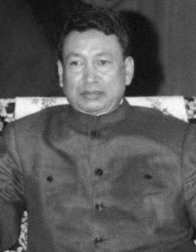
Pol Pot
Pol Pot (1925–1998)
- Saloth Sar — born into a prosperous farming family in Prek Sbauv, educated at a Buddhist monastery, scholarship student in Paris where he encountered Marxist ideology and the French Communist Party, failed student who returned to Cambodia without a degree, schoolteacher, clandestine Communist Party operative, guerrilla leader in the Cambodian jungle, and General Secretary of the Communist Party of Kampuchea from 1963 — emerged from the jungle in April 1975 as Brother Number One of Democratic Kampuchea, the leader of the Khmer Rouge government that in three years and eight months emptied Cambodia's cities, abolished money, closed schools and hospitals, executed the educated and professional classes, and killed between 1.5 and 2 million people — approximately a quarter of Cambodia's entire population — through execution, forced labour, starvation, and disease, making his regime the most intensive single episode of mass killing relative to national population in the twentieth century dataset.1Britannica — Pol Pot
- The Khmer Rouge regime from April 1975 to January 1979 — when Vietnamese forces invaded and drove the government from Phnom Penh — produced the forced evacuation of every Cambodian city within days of taking power, the establishment of agricultural labour camps across the country, the systematic execution of former government officials, military officers, teachers, doctors, lawyers, monks, and anyone wearing glasses or speaking a foreign language as evidence of bourgeois contamination, the destruction of every institution of Cambodian civil society, and a deliberate return to what the regime called Year Zero — the erasure of everything that had preceded the revolution as the foundation for a new agrarian communist utopia that the execution of its own architects progressively consumed.2United States Holocaust Memorial Museum — Khmer Rouge
- The variable profile that produced this record — a Vision of radical agrarian transformation that was ideologically coherent and operationally catastrophic, a Process discipline that executed the evacuation of Phnom Penh's two million inhabitants within three days with military precision, a People capability that identified and deployed cadres of genuine organisational effectiveness in the service of objectives that produced civilisational destruction, and a Congruence variable that was among the highest in the authoritarian domain because Pol Pot did exactly what his ideology required — is the most complete illustration in the dataset of the model's analytical separation between operational effectiveness and Value output, and the clearest case after Hitler of a leader whose variable profile produced its intended outcome and whose intended outcome was catastrophe.3Britannica — Pol Pot
Pol Pot is the most analytically extreme profile in the authoritarian domain and the one that most precisely tests the Value framing established for leaders whose operational effectiveness is in the service of objectives that produce mass human destruction. The equations apply the same logic as Hitler and Mussolini — operational variables are scored on effectiveness, Value reflects output for the defined constituency and objectives — and produce a profile that is analytically honest about both dimensions without requiring either to cancel the other.
The formation period is defined by the specific intersection of Cambodian provincial middle-class background, Buddhist monastic education, and Parisian Marxist formation that produced an ideological framework combining the organisational discipline of communist party structure with the agrarian romanticism of a man who had grown up in rural Cambodia and had processed the experience through the lens of French revolutionary ideology.1Britannica — Pol Pot The Paris period — studying radio electronics on a scholarship he was too distracted by political activity to complete — is analytically significant not for the academic failure but for the specific ideological formation it produced. Pol Pot encountered a French Communist Party at the height of its Stalinist phase, absorbed the organisational discipline and the revolutionary vanguard theory that Leninism provided, and returned to Cambodia with a framework that combined the communist party's operational model with a specifically Cambodian agrarian vision that the French Communist Party had not anticipated and would not have endorsed.
The jungle period from 1963 to 1975 is the most analytically underweighted phase of the career and the one whose variable analysis most directly explains the subsequent regime's operational capability. Pol Pot spent twelve years building the Khmer Rouge from a small urban communist faction into a rural guerrilla movement that eventually fielded sufficient military force to defeat the US-backed Lon Nol government — doing so in the specific conditions of the Vietnam War's spillover into Cambodia, the American bombing campaign that killed between 150,000 and 500,000 Cambodian civilians and drove rural populations toward the Khmer Rouge, and the regional dynamics that gave him Chinese and North Vietnamese support at critical junctures.4History.com — Pol Pot The Process and People variables in this period are analytically high — the jungle formation produced an organisation with genuine military capability, ideological cohesion, and the specific brutality that the subsequent regime deployed at scale. The k variable at this snapshot reflects the American bombing campaign's role in generating the rural recruitment base that the Khmer Rouge required — fortune operating through catastrophe for others.
The April 1975 takeover is the canonical snapshot's opening event and the most analytically precise expression of the Defined Output variable in the profile. The evacuation of Phnom Penh — two million people driven from the capital at gunpoint within three days of the Khmer Rouge's arrival, on the stated justification of an imminent American bombing campaign that did not exist — was executed with a military precision that reflected the twelve years of organisational development the jungle period had produced.2United States Holocaust Memorial Museum — Khmer Rouge The Process variable at this moment is operating at high efficiency — the logistics of moving two million people in three days, however brutal the method, reflect an organisational capability that most states could not have matched. The Value variable records the outcome for the evacuated population without adjudicating the operational effectiveness that produced it.
The Year Zero ideology is the most analytically precise expression of the Vision variable in the profile — and the most complete illustration in the dataset of a Vision that was internally coherent and operationally catastrophic. Pol Pot's conception of the new Cambodia — an agrarian utopia purged of urban contamination, foreign influence, and class distinction, organised around collective rice production and ideological purity — was not improvised in power but had been developed across the jungle years as a specific and detailed programme.3Britannica — Pol Pot The execution of the programme — the abolition of money, the closure of schools and hospitals, the forced labour in the rice paddies, the systematic killing of anyone whose background, education, or physical appearance suggested bourgeois contamination — reflected a Conviction variable operating at its absolute ceiling in the service of a Vision whose agricultural output targets were not achievable with the forced labour methodology the ideology required. The rice production quotas that the regime set — and that the cadres reported as met whether they were or not, because reporting failure was a death sentence — produced the famine that the ideology's internal logic made inevitable and that the Value variable records at the floor.
The People variable in the Khmer Rouge regime is analytically complex in a way that the straightforward authoritarian profile does not fully capture. Pol Pot's inner circle — Nuon Chea, Ieng Sary, Khieu Samphan, Ta Mok — were individuals of genuine organisational capability who had shared the jungle formation and who implemented the regime's programme with an efficiency that the scale of destruction confirms.1Britannica — Pol Pot The cadres who operated the execution sites — S-21 at Tuol Sleng, the killing fields at Choeung Ek — were young, ideologically committed, and operationally effective within the specific and horrific parameters of their role. The People variable records the capability of the human system rather than the objectives it served — which is the same analytical approach applied to Hitler's SS and Mussolini's party apparatus.
The regime's self-destruction through internal purges is the most analytically significant process failure of the canonical period. Pol Pot's response to the agricultural failures — attributing them to sabotage by class enemies and CIA infiltrators rather than to the ideology's operational impossibility — produced a systematic purge of the Khmer Rouge's own cadres, including the Eastern Zone commanders who had the closest relationship with Vietnamese forces and were therefore the most suspect.2United States Holocaust Memorial Museum — Khmer Rouge The Humility variable at this snapshot is at the floor — Pol Pot could not acknowledge that the agrarian programme was producing famine rather than abundance, because acknowledging it would have required acknowledging that the Vision was wrong, and the Pride variable made that acknowledgment structurally impossible. The purges consumed the organisation's most experienced cadres at precisely the moment when the Vietnamese military threat was becoming acute, which is the Ego and Pride variables producing the operational self-destruction that the equations predict.
The Vietnamese invasion of January 1979 — which drove the Khmer Rouge from Phnom Penh within two weeks — is the terminal event of the regime and the most precise expression of the Environment and k variables at their most hostile combined expression.5Britannica — Cambodian-Vietnamese War The Khmer Rouge's Eastern Zone purges had eliminated the commanders most capable of organising effective resistance to a Vietnamese military operation that Pol Pot's ideology had made inevitable — the border raids into Vietnamese territory that the Year Zero nationalism required had guaranteed a Vietnamese military response that the purged military command could not repel.
The post-1979 period — in which Pol Pot continued to lead the Khmer Rouge as a jungle-based insurgency from Thai border camps, received Chinese and American support as a counterweight to Vietnamese-aligned Cambodia, and maintained sufficient organisational cohesion to remain a military presence until the 1991 Paris Peace Accords — is the most analytically disturbing phase of the career.1Britannica — Pol Pot The international community's willingness to maintain the Khmer Rouge's UN seat and provide material support as a geopolitical counter to Vietnamese-Soviet alignment is the k variable operating through the Cold War's strategic logic — fortune sustained by a geopolitical framework that valued anti-Vietnamese positioning above accountability for the killing fields. Pol Pot died under house arrest within the Khmer Rouge in April 1998, having been tried by his own organisation in a jungle court the previous year and found guilty — an ending whose irony the Congruence variable records without resolving.
The number that matters most across all four snapshots is the Vision variable — and the specific characteristic that made it catastrophic rather than merely wrong. Pol Pot's vision was not vague or opportunistic — it was precise, detailed, and operationally committed. The Year Zero programme was implemented with the Process discipline that the jungle years had built. The evacuation was executed with military efficiency. The agricultural programme was pursued with ideological consistency. The purges were conducted with bureaucratic thoroughness. Every operational variable was applied with genuine capability in the service of a Vision whose fundamental premise — that Cambodia's population could be transformed into an agrarian utopia by force — was not achievable by any means available. That combination — high operational capability, coherent Vision, floor Value, and the Pride variable preventing the correction that the agricultural failure required — is the analytical signature of Pol Pot, and it is the reason the equations produce their most disturbing result: a leader who was operationally effective and whose operational effectiveness produced one of the most intensive episodes of mass killing in recorded history.
Score Comparison
Add up to 10 leaders. Click a name to visit their profile.
The 13 Equations
Scores for: Internal Purges and Vietnamese InvasionThe 22 Variables
Canonical scoresWhat changed: Year Zero — Takeover and Regime Peak → Internal Purges and Vietnamese Invasion
Sources & Bibliography
The scores assigned to this leader are derived from publicly available sources. Variable inputs reflect documented behaviour, structural conditions, and historical record at the time of each snapshot.