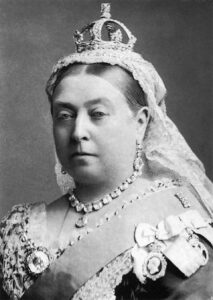
Queen Victoria
Queen Victoria (1819–1901)
- Emerged from the Kensington System — an elaborate programme of isolation and control devised by her mother and Sir John Conroy designed to render her weak and dependent1Britannica — Queen Victoria — to ascend the throne at eighteen, immediately dismissed Conroy, entered the council chamber unaccompanied on her first day, and reigned for sixty-three years across the industrial revolution, democratic reform, and imperial expansion across six continents.2Wikipedia — Queen Victoria
- After Albert's death in December 1861 plunged into deep mourning and withdrew from public appearances for years, during which republican notices were posted on the railings of Buckingham Palace and the monarchy's public standing declined sharply3The Royal Family — Victoria — only for her popularity to recover fully, culminating in the Diamond Jubilee of 1897 when her procession followed a six-mile route through London attended by troops from across the empire, with thanksgiving held outside St Paul's because she could not climb the steps.2Wikipedia — Queen Victoria
- Died at Osborne House on the Isle of Wight in January 1901, having given instructions that her funeral should be white rather than black — in her coffin placed a cast of Albert's hand, a lock of John Brown's hair concealed beneath flowers, and the wedding ring of Brown's mother which he had given her in 1883.
Queen Victoria presents the Codex with its most analytically precise illustration of the gap between the significance of a reign and the score of the leader who occupied it. The Victorian era was one of the most transformative periods in British history — industrial revolution, democratic reform, scientific advancement, imperial expansion across six continents. The Codex does not score the era. It scores the leader. And the constitutional ceiling that constrains every British monarch in the Royalty domain applies to Victoria across sixty-three years with a consistency that the variable profile records honestly.
The accession and early reign period is where the Codex records an eighteen-year-old emerging from the Kensington System — an elaborate programme of isolation and control designed to render her weak and dependent — into one of the most powerful institutional roles in the world.1Britannica — Queen Victoria The record of that first day is analytically significant. She insisted on entering the council chamber unaccompanied. Wellington, present at the meeting, noted that she not merely filled her chair, she filled the room. The Codex records a developing variable profile for this period — Ability and Process still consolidating, Autonomy at its constitutional ceiling, the Melbourne dependency real and documented. What the Codex also records is Conviction and Congruence from the first day of her reign. She paid off her father's debts immediately. She banned Conroy from her presence. She was emotionally volatile, obstinate, honest and straight-talking — four characteristics that her biographers identify consistently and that the Conviction and Congruence variables capture precisely.2Wikipedia — Queen Victoria
The Albert period is the operational peak and the period whose full analytical significance only became clear after her diaries and letters were released decades after her death. Albert replaced Melbourne as the dominant political influence and brought intellectual rigour, administrative discipline and strategic vision to a partnership that the constitutional framework formally denied any official role.3The Royal Family — Victoria The extent to which Victoria was privately attempting to influence government policy, ministerial appointments and foreign affairs throughout this period — through correspondence, through Albert's mediation, through the careful exercise of the rights Bagehot would later define as consulting, encouraging and warning — was systematically underestimated by contemporaries and by historians working before the primary material became available.2Wikipedia — Queen Victoria The Codex records Process and Intent at their peak for this snapshot because the operational engagement was genuine, consistent and documented. Her insistence that the proclamation transferring power in India should breathe feelings of generosity, benevolence and religious toleration — replacing threatening language about native religions with a guarantee of religious freedom — is Congruence operating at its documented level against the institutional momentum of empire.
The widowhood and seclusion period is the profile's most analytically complex. Albert died in December 1861. Victoria entered a state of mourning that lasted the remainder of her life and withdrew from public appearances for years.2Wikipedia — Queen Victoria The Codex records a declining score for this period — not because her Conviction declined, which it did not, nor because her private political activity ceased, which it did not, but because Visibility dropped to near its minimum and Defined Output declined sharply. She continued to write thousands of letters to ministers and foreign dignitaries. She continued to press her views on appointments and policy. But a leader who exercises influence invisibly while the public institution she embodies visibly deteriorates in public confidence is a leader whose variable profile the Codex must record honestly. The republican notice posted on the railings of Buckingham Palace announcing the premises to be let or sold in consequence of the late occupant's declining business is the Visibility variable stated in a single satirical sentence.3The Royal Family — Victoria
The recovery from this period was genuine and the Codex records it. Her son's near-death from typhoid in 1871 — the disease that had killed Albert — and the subsequent thanksgiving service at St Paul's marked the turning point. Visibility recovered. The institutional legitimacy of the monarchy recovered with it. The lesson the Codex draws from this period is not that grief is disqualifying but that constitutional leaders whose primary function is the embodiment of national values cannot perform that function in seclusion. The Value variable requires Visibility to deliver its output.
The Empress of India and later reign period is the profile's canonical snapshot. The Diamond Jubilee of 1897 marked the most complete expression of what the Victorian monarchy had become. A procession six miles through London attended by troops from across the empire. Open-air thanksgiving outside St Paul's because she could not climb the steps. She sat in her carriage and the crowds came to her.2Wikipedia — Queen Victoria That is the Value and Visibility variables at their documented maximum for a constitutional monarch operating within the Autonomy ceiling that the framework imposed on every British sovereign. The empire was larger. The institution was more secure. The Autonomy ceiling had not moved.
She died at Osborne House on the Isle of Wight in January 1901, having given instructions that her funeral should be white rather than black. The Codex records the variable profile of the leader — the Conviction that never declined across sixty-three years, the Congruence that the diaries and letters confirmed, the Autonomy that the constitutional framework imposed, and the Value that the Diamond Jubilee expressed. The era was significant. The reign was consequential. The Codex scores the leader who occupied it — and produces a profile that is more analytically interesting than any single number can express.
Score Comparison
Add up to 10 leaders. Click a name to visit their profile.
The 13 Equations
Scores for: Accession — Early ReignThe 22 Variables
Canonical scoresSources & Bibliography
The scores assigned to this leader are derived from publicly available sources. Variable inputs reflect documented behaviour, structural conditions, and historical record at the time of each snapshot.