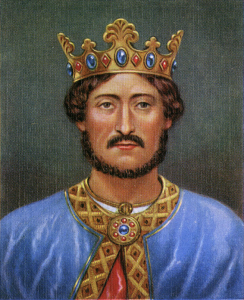
Richard I
Richard I (1157–1199)
- Born on 8 September 1157 in Oxford, the third son of Henry II and Eleanor of Aquitaine — raised at his mother's court in Aquitaine speaking French and Occitan rather than English, made Duke of Aquitaine at fifteen, spent his formative years suppressing rebellious barons in Poitiers and Gascony, and joined his brothers in open revolt against his own father in 11731Wikipedia — Richard I — became King of England on his father's death in July 1189, was crowned at Westminster in September, and within months had mortgaged, sold or auctioned virtually every office, right and privilege the English crown possessed, reportedly declaring "I would have sold London if I could find a buyer," to fund the Crusade he had already vowed to lead.
- Sailed in June 1190, captured Messina, conquered Cyprus, married Berengaria of Navarre, arrived at Acre in June 1191, broke the siege within five weeks through cash incentives to sappers that achieved in five weeks what Guy of Lusignan had failed to do in twenty months — then on 20 August 1191 ordered the execution of 2,500 to 3,000 Muslim prisoners taken at Acre2World History Encyclopedia — Richard I — won the Battle of Arsuf on 7 September by maintaining march discipline under constant attack and choosing the moment to counter-charge — twice approached Jerusalem and twice withdrew on sound strategic grounds — and on 2 September 1192 concluded the Treaty of Jaffa with Saladin, securing Christian control of the coastal strip and pilgrimage access to Jerusalem without ever entering the city.
- Captured by Duke Leopold of Austria on his return journey in December 1192 — handed to Holy Roman Emperor Henry VI, imprisoned for fifteen months while England raised a ransom of 150,000 marks that nearly bankrupted the crown3Britannica — Richard I — returned to England in March 1194, spent six weeks suppressing his brother John's revolt, then left and never returned, dying on 6 April 1199 from an arrow wound taken while besieging the minor castle of Châlus-Chabrol in France for a treasure hoard its lord refused to surrender.
Richard I ruled England for ten years and spent six months of them in England. The country he nominally ruled existed primarily as a revenue source for campaigns conducted elsewhere. By any measure of responsible governance this was a failure. By the military variables of the Codex, the Third Crusade campaign is one of the most technically accomplished performances in the dataset.
The analytical question that makes this profile interesting is not whether Richard was a good king — he was not, by any modern or contemporary administrative standard. It is what the equations show when the military variables are exceptional, the domestic variables are near floor, and the Ego variable is high enough to manufacture the crisis that defined his captivity.
The Crusade accession period reveals the mechanism. Richard had no interest in governance and considerable skill at extraction. He recognised that England was the largest available resource for the project he cared about, and he monetised it with ruthless efficiency — selling offices, rights, lands, royal privileges, and even Scotland's feudal subjugation for 10,000 marks.1Wikipedia — Richard I The Process score at this period is paradoxically high for the wrong reasons: the system he deployed to liquidate the crown's assets was the same systematic capability that later organised the Crusade's logistics. He was not incompetent. He was indifferent to England.
The canonical snapshot — the Third Crusade campaign from Acre to the Treaty of Jaffa — is the Military domain's most technically instructive medieval profile after Hannibal. The Arsuf march is the Process variable at its medieval ceiling: maintaining march discipline over a heavily harassed column for days, feeding cavalry their head at precisely the right moment, coordinating infantry and mounted forces under sustained attack from a superior force. Saladin, who had defeated every European force he faced at Hattin in 1187, could not break Richard's army on open ground. The strategic decision not to assault Jerusalem — twice — is the Humility and Ability variables working correctly: a leader who understood that taking the city without the means to hold it was tactically possible and strategically ruinous.4History Skills — Richard I Crusade
The Congruence variable is the constraint that prevents the canonical score from reaching its mathematical ceiling. The Acre massacre — 2,500 to 3,000 prisoners executed in cold blood after the garrison surrendered — violated the chivalric code he had built his entire identity around. The reasoning offered (Saladin had delayed ransom negotiations) was operationally convenient rather than principled. The same leader who twice declined to assault Jerusalem for sound strategic reasons executed prisoners for impatient tactical ones.2World History Encyclopedia — Richard I
The Pride variable is what produced his captivity, and the captivity is what the Pride variable is designed to predict. He tore down Leopold of Austria's banner at Acre — a deliberate public humiliation of a fellow crusading duke. He quarrelled continuously with Philip II of France throughout the campaign. He insulted, alienated and made enemies of almost every ally he had. When he needed to travel home through Europe, he had no safe passage. Leopold imprisoned him. Henry VI ransomed him. The 150,000 marks England raised to free him — an extraordinary national sacrifice — confirmed that his subjects valued him more than he valued them.
He died from an arrow wound at Châlus-Chabrol, a minor siege he had no strategic reason to conduct personally. The Ego variable at his final snapshot is the number that explains the death: a man who had survived the Third Crusade, survived captivity, survived a king's ransom, rode to the front line of a siege that a competent subordinate could have concluded without him. He declined to wear armour and was struck by a crossbow bolt. He died of the wound's gangrene eleven days later. He was forty-one years old.
His heart was buried in Rouen. His body was buried at Fontevrault beside his father, whom he had spent years trying to destroy. His reputation lasted a thousand years. The equations record both the quality of what he built in the Holy Land and the mechanism by which he systematically undermined everything else.
Score Comparison
Add up to 10 leaders. Click a name to visit their profile.
The 13 Equations
Scores for: Captivity, Return and French Wars — The Last YearsThe 22 Variables
Canonical scoresWhat changed: Third Crusade — Acre to the Treaty of Jaffa → Captivity, Return and French Wars — The Last Years
Sources & Bibliography
The scores assigned to this leader are derived from publicly available sources. Variable inputs reflect documented behaviour, structural conditions, and historical record at the time of each snapshot.