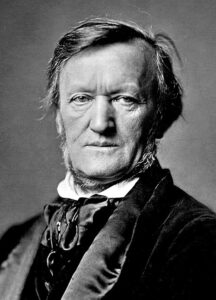
Richard Wagner
Richard Wagner (1813-1883)
- Conceived and built the Bayreuth Festspielhaus from nothing — touring Germany to raise funds, overseeing every architectural detail, inventing the hidden orchestra pit and the practice of darkening the auditorium during performance — creating the first purpose-built venue for a single composer's work, which opened in 1876 with the premiere of the complete Ring cycle and has operated as an annual festival ever since.1Britannica — Wagner Bayreuth ↗
- Developed the concept of the Gesamtkunstwerk — the total work of art, synthesising music, poetry, drama and visual design into a unified whole — and realised it most completely in the four-opera Ring cycle, transforming opera from a vehicle for vocal display into a philosophical and dramatic form whose influence on Western music, theatre, literature and philosophy extended far beyond the concert hall to encompass Nietzsche, Baudelaire, the Symbolists, T.S. Eliot and the development of film music.2Wikipedia — Richard Wagner ↗
- Founded Wagner Societies across Europe and America that functioned as an organised movement of cultural advocacy — wielding political exile, personal bankruptcy, chronic debt, adulterous relationships and virulent antisemitic polemics alongside the most radical musical achievement of the nineteenth century — a combination that generated a cultural force field around his name that outlasted him by a century and whose consequences, through the Nazi appropriation of Bayreuth, remain analytically and morally unresolved.3Smithsonian — Wagner Legacy ↗
Richard Wagner was born on 22 May 1813 in Leipzig, the youngest of nine children of a police actuary who died when Wagner was six months old, and spent his early life in the orbit of his stepfather Ludwig Geyer — an actor, painter and playwright who gave him his first experience of the theatre and, according to some historians, may have been his biological father.2Wikipedia — Richard Wagner ↗ He was drawn to music through Beethoven and to theatre through Shakespeare, and by his early twenties had decided that the form he would work in was opera — specifically, that he would write both the words and the music for each work, a practice essentially unprecedented among major composers of the period. The leadership profile is analytically unusual because the institutional achievement and the artistic achievement are inseparable in a way that does not apply to Diaghilev or Gordy. Wagner did not commission the Ring cycle from others — he wrote it himself, over twenty-six years, while simultaneously running a political exile, managing catastrophic debt, conducting performances, writing philosophical essays and articles, and eventually building the theatre in which it would be performed.4SFCV — Wagner ↗ The Process variable in his profile measures not just the music but the institutional system he built around it: the fund-raising tours, the Wagner Societies, the cultivation of Ludwig II of Bavaria as a patron, the design of the Festspielhaus, the management of the first festival in 1876 which was attended by Kaiser Wilhelm I, the Emperor of Brazil, Tchaikovsky, Bruckner and Saint-Saëns. The Bayreuth Festspielhaus is the analytical anchor of his leadership profile and the reason he belongs in the Cultural domain rather than in the Scientific or Religious domains to which his philosophical ambitions sometimes gesture. He did not merely create works — he built the institution that would perform them, controlled who performed them and under what conditions, and established a cultural franchise that his family has managed for nearly a hundred and fifty years.5Richard Wagner Official — The Man ↗ The Defined Output variable scores at its ceiling: he specified with total precision what he wanted to produce, how it was to be performed, and in what kind of building. The Congruence variable requires the most analytical care in Wagner's profile. His stated values — the Gesamtkunstwerk, the primacy of drama over mere vocal display, the synthesis of the arts — were entirely congruent with his behaviour across a career of sixty years. His antisemitic writings, his political vacillations, his treatment of creditors and patrons, his romantic conduct — none of these constitute Congruence failures in the analytical sense because the values they violated were not his stated values. The Congruence failure in his profile lies elsewhere: between the universalist philosophical ambition of the Ring — a work about greed, power and the redemptive potential of love — and the narrowing nationalist movement that gathered around Bayreuth after his death, in which his widow Cosima and his family became central figures in a cultural politics that fed directly into the Third Reich.6Holocaust Music — Wagner ↗ Wagner did not live to see this. But Bayreuth was his creation, and the institution he built was the vehicle through which it happened. He died in Venice on 13 February 1883, aged 69, at the height of his fame and after completing Parsifal the previous year. His body was returned to Bayreuth by gondola and train and buried in the grounds of Wahnfried, the house whose name translates as 'Peace from Illusion.' The festival has been held every summer since, interrupted only by the two world wars. It remains entirely devoted to staging his mature works.
Score Comparison
The 13 Equations
Scores for: Exile and the Ring — Composition PhaseThe 22 Variables
Canonical scoresSources & Bibliography
The scores assigned to this leader are derived from publicly available sources. Variable inputs reflect documented behaviour, structural conditions, and historical record at the time of each snapshot.