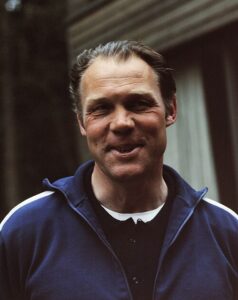
Rinus Michels
Rinus Michels (1928-2005)
- Developed Total Football at Ajax Amsterdam from 1965 — a tactical system in which no outfield player was fixed in a predetermined role, with any player capable of assuming any position and teammates reorganising fluidly to maintain the team's structural shape — leading Ajax to the 1971 European Cup, four Eredivisie titles and three KNVB Cups, ending the defensive era of Catenaccio and establishing the philosophical foundation on which every possession-based, high-pressing tactical system in modern football is built.1Wikipedia — Rinus Michels ↗
- Named FIFA Coach of the Century in 1999 and voted the greatest post-war football coach by The Times in 2007 and the greatest coach in the history of football by France Football in 2019 — achievements that rest not on trophy accumulation alone but on the recognition that his conception of how football should be played fundamentally altered the game's tactical language, with his direct influence traceable through Johan Cruyff, Arrigo Sacchi, Louis van Gaal, Pep Guardiola, Jürgen Klopp and every major possession-based coaching lineage of the past fifty years.1Wikipedia — Rinus Michels ↗
- Led the Netherlands national team to the 1974 World Cup final and the 1988 European Championship — the only major international trophy in Dutch football history — across two entirely different generations of players separated by fourteen years, demonstrating that his tactical philosophy was a transferable system rather than a consequence of the individual genius of Johan Cruyff, and that the principles of Total Football were durable enough to produce championship-level performance with players who had not been part of the original Ajax framework.2Britannica — Rinus Michels ↗
Marinus Jacobus Hendricus Michels was born on 9 February 1928 in Amsterdam, played his entire career as a striker for Ajax — scoring 121 goals in 269 matches and contributing to league titles in 1947 and 1957 — and began his coaching career in 1964 before becoming Ajax manager in 1965.1Wikipedia — Rinus Michels ↗ He inherited a talented but tactically incoherent squad that included a seventeen-year-old Johan Cruyff and began the systematic implementation of a football philosophy that would, within six years, produce the European Cup and, within nine years, reach the World Cup final and come within a single match of becoming what would almost certainly have been the most celebrated national team in the history of the sport. The analytical framework for Michels within the Sports domain requires a Process variable set at its absolute ceiling, but the Process being measured is not game preparation or defensive systems in the conventional coaching sense. It is the design and implementation of a complete tactical philosophy — a system that specified how football should be thought about and played, what the relationship between space, movement and positional fluidity should be, and what kind of player was required to execute it.3These Football Times — Michels ↗ His description of football as resembling war — 'whoever behaves too properly is lost' — is the analytical shorthand for a philosophy that required players to be simultaneously disciplined and unpredictable, physically relentless and tactically intelligent. The Dutch concept of maakbaarheid — the ability and willingness to shape and control a physical environment — is the intellectual foundation of Total Football as Michels conceived it. Where conventional football systems worked within the structure of fixed positions, Michels's system treated the structure of the game itself as a variable that could be consciously shaped by the team with possession.4Football BH — Rinus Michels ↗ When in possession, the team made the pitch as large as possible, spreading opponents and creating space. When possession was lost, it made the pitch as small as possible, pressing immediately to recover the ball before the opponent could reorganise. The fluidity of position that made this possible required players who were physically capable of performing multiple roles and tactically intelligent enough to read the game situation and move accordingly. The Defined Output variable reflects a goal that went beyond winning individual matches or trophies. Michels explicitly articulated his intention to change the way football was played — to defeat Catenaccio not just on the scoreboard but as a tactical paradigm. The 1971 European Cup victory over Panathinaikos, and Ajax's subsequent destruction of Milan 6-0 in the European Super Cup, were described in Dutch newspapers as the 'destruction of Catenaccio.' The tactical ambition was literally the defeat of an entire opposing philosophy, not just the opponent in a specific match.1Wikipedia — Rinus Michels ↗ He died on 3 March 2005 in Aalst, Belgium, following heart surgery. The FIFA Coach of the Century award remains the most precisely matched posthumous recognition in sports coaching: he was the only coach who changed not just his own teams' results but the sport's conception of what was possible.
Score Comparison
The 13 Equations
Scores for: Ajax — European Cup and Total FootballThe 22 Variables
Canonical scoresSources & Bibliography
The scores assigned to this leader are derived from publicly available sources. Variable inputs reflect documented behaviour, structural conditions, and historical record at the time of each snapshot.