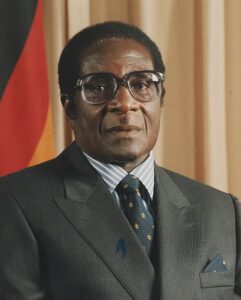
Robert Mugabe
Robert Mugabe (1924–2019)
- Robert Gabriel Mugabe — son of a carpenter in Kutama, Southern Rhodesia, educated by Jesuit missionaries, teacher in Southern Rhodesia and Ghana, fourteen university degrees including a law degree studied in prison, founding member of the Zimbabwe African National Union, political prisoner for ten years under Ian Smith's Rhodesian government, Prime Minister of Zimbabwe from 1980 to 1987, and President from 1987 to 2019 — was the liberation leader who became the liberation's negation: a man whose formation under colonial oppression produced a genuine and analytically high Vision of African self-determination, whose early governance demonstrated real institutional capability, and whose subsequent thirty years in power produced hyperinflation that reached 89.7 sextillion percent, the forced seizure of white-owned farms that destroyed the agricultural economy, systematic political violence against opponents, and a personal accumulation of power that ended only when his own military removed him at ninety-three.1Britannica — Robert Mugabe
- His career encompassed the guerrilla war that produced Zimbabwean independence, the early governance period that produced genuine educational expansion, health system development, and economic growth that made Zimbabwe the most literate and economically developed country in sub-Saharan Africa by the late 1980s, the Gukurahundi massacres in Matabeleland that killed between ten and twenty thousand civilians in the early 1980s, the consolidation of one-party rule, the Congo War intervention, the fast-track land reform programme from 2000 that produced famine and economic collapse, the election violence of 2008, and the November 2017 military coup that ended his thirty-seven-year grip on power — a career arc that moved from liberation to construction to destruction with a variable profile that the equations track with uncomfortable precision.2Human Rights Watch — Robert Mugabe Legacy
- The analytical tension that runs through every snapshot of the Mugabe profile — between the liberation leader whose Conviction and Congruence were among the highest in the African Political domain in the independence period, and the authoritarian whose Ego and Pride consumed the correcting variables that might have produced a different outcome — is the clearest illustration in the dataset of the trajectory from high-scoring liberation leadership to zero-Value authoritarian entrenchment, driven by the same Conviction variable that produced both phases.3Britannica — Robert Mugabe
Robert Mugabe is the most analytically complete arc profile in the African Political domain — complete in the sense that the variable trajectory from formation through peak to collapse is more clearly documented, more precisely traceable to specific variable movements, and more instructive about the relationship between Conviction and Humility than any comparable profile in the dataset. The equations do not require the liberation leader and the authoritarian to be different people. They record how the same variables produced both.
The formation period is defined by the specific combination of Jesuit missionary education, colonial oppression, and prison that produced the most credentialed political prisoner in the twentieth-century African dataset. Mugabe's fourteen university degrees — several studied by correspondence during his ten-year imprisonment — reflect a Learning variable of genuine exceptional quality and a Resilience variable built through the specific conditions of political imprisonment that the colonial state imposed.1Britannica — Robert Mugabe The Conviction variable in this period is at its most analytically precise expression — not the conviction of ideological certainty, which many leaders possess, but the conviction of a man who had directly experienced the system he was opposing, who had spent ten years in prison for opposing it, and who had used that imprisonment to acquire the intellectual formation that the opposition required. The People variable in the liberation period reflects a leader who could build coalitions across the ZANU factions, manage the relationship with the Front Line States that provided operational support, and navigate the Lancaster House negotiations with a diplomatic sophistication that the British government had not anticipated from a Marxist guerrilla leader.
The Lancaster House negotiations of 1979 are the most analytically significant pre-independence event and the one that most precisely captures the Vision and Adaptability variables in combination.4Britannica — Lancaster House Agreement Mugabe entered the negotiations committed to a land redistribution programme that the white Rhodesian farming community and the British government considered non-negotiable. He accepted a ten-year moratorium on compulsory land acquisition in exchange for the independence settlement — a pragmatic concession that his subsequent career suggests cost him more psychologically than it produced politically, because the land question remained unresolved and became the instrument of his later political mobilisation. The Humility variable at this snapshot is analytically the highest in the profile — a leader who accepted a constraint on his core programme in the interest of achieving the primary objective, which is the variable operating correctly.
The early independence period from 1980 to 1987 is the canonical snapshot and the most analytically productive phase of the career. Mugabe's reconciliation speech of April 1980 — in which he told white Zimbabweans that the wrongs of the past must now stand forgiven and forgotten, and invited them to join in building a new Zimbabwe — is the Communication variable at its most strategically sophisticated and the Congruence variable at its most analytically surprising: a man who had spent ten years in prison opposing the white minority government publicly inviting its members to participate in the successor state.5Al Jazeera — Robert Mugabe The Vision variable at this snapshot reflects a genuine and specific programme — universal primary education, health system expansion, racial reconciliation — that the early governance record delivered. Zimbabwe's literacy rate rose from forty percent at independence to over eighty percent within a decade. The health system expanded to reach rural populations that had been excluded from colonial-era provision. The economic management was competent and produced growth. The Value variable at the canonical snapshot reflects these outputs without the moral evaluation of what came later — Mugabe was delivering genuine improvements for his defined constituency in the early independence period.
The Gukurahundi massacres of 1983 to 1987 are the most analytically disturbing element of the early period and the one that most directly challenges the reconciliation narrative.1Britannica — Robert Mugabe The Fifth Brigade — a North Korean-trained military unit that operated outside the normal command structure — killed between ten and twenty thousand civilians in Matabeleland and Midlands provinces in operations directed against ZAPU supporters and the Ndebele population more broadly. The operations were conducted with Mugabe's knowledge and approval. The Congruence variable at this snapshot records the gap between the reconciliation speech and the Fifth Brigade — not hypocrisy in the sense of private views differing from public positions, but the specific application of the reconciliation framework to the Shona political constituency while the Ndebele constituency experienced state violence. The Value variable declines sharply at this snapshot — not because the educational and health outputs disappeared, but because their delivery to one constituency was concurrent with state violence against another.
The Unity Accord of 1987 — in which Mugabe merged ZANU and ZAPU into ZANU-PF and Joshua Nkomo accepted the junior partnership — is the People variable producing its most significant domestic political outcome.3Britannica — Robert Mugabe The merger ended the Matabeleland violence — which was the instrument of its negotiation — and consolidated one-party dominance in a constitutional framework that the Lancaster House settlement had been designed to prevent. The Autonomy variable at this snapshot reaches its highest point in the profile — the constitutional amendment that created the executive presidency, combined with the ZANU-PF dominance, produced an institutional environment in which Mugabe's decision-making was effectively unconstrained by any remaining institutional check.
The post-2000 period is where the variable profile collapses with a speed and completeness that the early record makes analytically disorienting. The fast-track land reform programme — triggered by the 2000 constitutional referendum defeat that Mugabe experienced as a personal repudiation — produced the seizure of white-owned farms, the destruction of Zimbabwe's commercial agricultural sector, and the hyperinflation that reached 89.7 sextillion percent by November 2008.2Human Rights Watch — Robert Mugabe Legacy The Pride variable is the primary analytical explanation for this trajectory — the 2000 referendum defeat, in which the electorate rejected a constitutional amendment that Mugabe had personally championed, was processed not as feedback requiring adjustment but as betrayal requiring punishment. The land seizures were the instrument of that punishment — directed at the white farming community that Mugabe held responsible for funding the opposition — and the economic destruction they produced was not an unintended consequence but a price that the Pride variable made Mugabe willing to pay rather than acknowledge that the referendum result reflected legitimate popular discontent.
The election violence of 2008 — in which the opposition MDC candidate Morgan Tsvangirai won the first round of the presidential election and was then forced to withdraw from the runoff after systematic violence against his supporters produced 200 deaths and 5,000 injuries — is the Congruence variable at its lowest point in the profile.6Human Rights Watch — Zimbabwe 2008 Mugabe had spent his career asserting the legitimacy of African democratic self-determination against colonial and minority rule — and then deployed state violence to prevent the democratic transfer of power that his own electorate had produced. The gap between the liberation narrative and the 2008 election is the largest single Congruence movement in the profile.
The November 2017 military intervention — in which the Zimbabwe Defence Forces placed Mugabe under house arrest, ZANU-PF voted to remove him as party leader, and parliament began impeachment proceedings, producing his resignation on 21 November 2017 — is the terminal variable expression.1Britannica — Robert Mugabe Mugabe was removed not by popular uprising or electoral defeat but by the institution he had built — the party and military that his forty years of patronage had created turned against him when his attempt to position his wife Grace as successor threatened the interests of the military faction that had sustained him. The People variable at this snapshot records its most complete failure — the leader who had managed coalition relationships across thirty years of liberation struggle could not manage the succession question within his own party, which is the most fundamental People failure available to an authoritarian leader.
The number that matters most across all four snapshots is the Humility variable — specifically its trajectory. At Lancaster House it was the highest in the profile, producing the pragmatic concession that made independence possible. In the early independence period it remained sufficient to produce the reconciliation framework and the educational programme. After the 2000 referendum defeat it collapsed entirely — producing a leader who could not accept feedback, could not acknowledge failure, and could not update his programme when the evidence of its consequences was overwhelming. That trajectory — from the highest Humility score in the profile to the floor — is the analytical explanation for the entire Mugabe arc, and it is the reason that the liberation leader who built Zimbabwe's education system and the authoritarian who produced 89.7 sextillion percent inflation are the same person, scored by the same equations, across the same career. That is the Leaderment profile of Robert Mugabe.
Score Comparison
Add up to 10 leaders. Click a name to visit their profile.