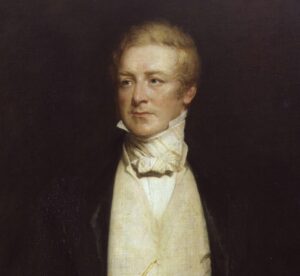
Robert Peel
Robert Peel (1788–1850)
- Robert Peel — son of a cotton manufacturer and MP who purchased his son's political career with the same commercial precision he applied to his mills, Christ Church Oxford double first, MP from 1809 at twenty-one, Under-Secretary for War and the Colonies, Chief Secretary for Ireland, Home Secretary twice, Leader of the Opposition, and Prime Minister twice from 1834 to 1835 and 1841 to 1846 — was the most consequential institutional reformer in British political history between Grey and Gladstone, the founder of the modern police service, the architect of the banking system that financed Victorian prosperity, the author of the Tamworth Manifesto that invented modern Conservative electoral politics, and the man whose repeal of the Corn Laws in 1846 split the Conservative Party, destroyed his own political career, and fed the British working class — achievements whose institutional durability the subsequent century and a half has confirmed at every point.1Britannica — Robert Peel
- His two administrations produced the Metropolitan Police Act of 1829, the Catholic Emancipation Act of the same year, the Bank Charter Act of 1844 that established the framework for modern British monetary policy, the Mines Act, the Factory Act limiting child labour, the income tax restoration as a permanent instrument of fiscal policy, and the Corn Laws repeal of 1846 — a legislative record of institutional construction that restructured the British state's relationship with civil order, religious equality, monetary stability, labour protection, and food supply simultaneously, making Peel the most productive institutional reformer of any nineteenth-century Prime Minister by the criterion of durable legislative output.2Oxford DNB — Robert Peel
- The Corn Laws repeal — which Peel introduced in January 1846 knowing it would split the Conservative Party that he led, having privately concluded that the Irish Famine made continuation of agricultural protection morally indefensible, and having publicly maintained the opposite position for the entirety of his political career — is the most analytically consequential single act of political self-destruction in the British Political domain: a leader who chose the correct policy over his own party's survival, his own electoral position, and his own political future, and whose subsequent reputation has been built on the ruins of the career that choice produced.3UK Parliament — Corn Laws
Robert Peel is the most institutionally consequential profile in the nineteenth-century British Political domain and the one whose variable analysis most precisely captures the relationship between Conviction and political cost. He was not a charismatic leader — his parliamentary style was forensic rather than inspiring, his personal warmth was limited, and his relationship with his own party was consistently difficult. He was a builder of systems — police forces, banking frameworks, fiscal structures, free trade regimes — whose outputs the subsequent history of British institutions has validated at every point. The equations capture the builder rather than the performer.
The formation period is defined by the specific combination of manufacturing wealth, Oxford intellectual formation, and early parliamentary experience that produced an unusual variable profile for its era. Peel's father — Sir Robert Peel the elder, the cotton manufacturer who sat for Tamworth and purchased his son's political education with commercial precision — gave him both the manufacturing perspective that made free trade analytically obvious and the parliamentary position that made enacting it eventually possible.1Britannica — Robert Peel The Oxford double first established the intellectual baseline — Peel's analytical capability in the Commons was consistently recognised by opponents who found his command of detail and his forensic precision difficult to counter. The early parliamentary career — Chief Secretary for Ireland at twenty-four — gave him direct administrative experience of the relationship between institutional design and civil order that the subsequent police and legal reforms directly reflected.
The Irish Chief Secretary period from 1812 to 1818 is the most analytically significant pre-Home Office phase of the career. Peel managed the Irish administration through the post-Napoleonic economic disruption, the agrarian violence of the Rockite and Ribbonmen movements, and the Catholic question that dominated Irish politics — developing in the process both the administrative capability and the specific experience of policing's institutional limitations that directly produced the Peace Preservation Force, the precursor to both the Irish Constabulary and the Metropolitan Police.1Britannica — Robert Peel The Process variable in the Irish period is analytically high — Peel was solving specific administrative problems with institutional design rather than political management, which is the variable combination that the Home Secretary period subsequently amplified.
The Home Secretary period from 1822 to 1827 is the canonical pre-premiership achievement and the one that most directly illustrates the Vision and Process variables in combination. Peel's consolidation of the criminal law — reducing the number of capital offences from over two hundred to fewer than twelve, rationalising the statute book, and establishing the principle that criminal law should be comprehensible and consistently applied — reflected a Vision of institutional design that the existing criminal justice system had not previously been asked to meet.2Oxford DNB — Robert Peel The Metropolitan Police Act of 1829 — establishing the Metropolitan Police Service as a professional, uniformed, and accountable civil police force — is the most durable single institutional output of the career and the one whose global influence has been most consistently underestimated. The Peelian principles — that the police are the public and the public are the police, that the measure of police efficiency is the absence of crime rather than the detection of it — established a framework for democratic policing that every subsequent police service has debated against.
The Catholic Emancipation Act of 1829 is the most analytically significant Congruence event of the pre-premiership career. Peel had spent seventeen years as the foremost parliamentary opponent of Catholic emancipation — his Irish Chief Secretary period had been conducted on the explicit principle that Protestant Ascendancy must be maintained — and then introduced the Catholic Relief Act as Home Secretary, granting full political rights to Catholics in circumstances where he had privately concluded that continued resistance would produce Irish civil war.4Britannica — Catholic Emancipation The Congruence variable at this snapshot records the gap between seventeen years of public opposition and the legislative act that reversed it — not the simple hypocrisy of private views differing from public positions, but the specific and analytically unusual pattern that characterises Peel's career: a leader who maintained a position until the evidence against it became overwhelming, and then reversed it completely regardless of the political cost. That pattern — Catholic emancipation in 1829, Corn Laws in 1846 — is the most analytically distinctive variable signature in the nineteenth-century British Political domain.
The Tamworth Manifesto of 1834 is the Vision variable's most politically consequential single output and the one whose institutional legacy has been most consistently undervalued by historians focused on the Corn Laws repeal.5UK Parliament — Tamworth Manifesto Peel's address to his Tamworth constituents — in which he accepted the Reform Act as a final and irrevocable settlement, committed the Conservative Party to the careful review of institutions and the correction of proven abuses, and distinguished between reform that improved institutions and change that destroyed them — invented the modern Conservative electoral programme. The Communication variable at this moment is operating at its most institutionally consequential register: a document that defined the terms on which the Conservative Party could compete in a reformed electoral landscape, and that established the intellectual framework for Conservative governance that Disraeli subsequently developed into One Nation Toryism.
The second premiership from 1841 to 1846 is the canonical snapshot and the most analytically productive legislative period of the career. The Bank Charter Act of 1844 — establishing the Bank of England's monopoly on note issue, separating the banking and currency departments, and providing the monetary framework that sustained Victorian economic growth — reflects the Process and Defined Output variables operating at their most technically sophisticated expression.6Bank of England — Bank Charter Act The income tax restoration — introduced as a temporary measure to fund the free trade transition and never subsequently removed — is the fiscal innovation whose permanence Peel did not anticipate and whose subsequent governments accepted without designing. The Factory Act and Mines Act — limiting child labour in factories and prohibiting women and children from underground mining — reflect a Vision of the state's relationship to industrial working conditions that the manufacturing background made analytically credible rather than merely sentimental.
The Corn Laws repeal of 1846 is the terminal event of the premiership and the most analytically precise expression of the Conviction variable in the profile — and in the British Political domain. Peel had supported agricultural protection throughout his career, had won the 1841 election on a platform that included Corn Laws maintenance, and had privately concluded by late 1845 — following the Irish potato famine's first appearance — that continuation of the Corn Laws was morally indefensible and that the potato famine made immediate repeal a practical necessity.3UK Parliament — Corn Laws He introduced the repeal in January 1846 knowing that it would split the Conservative Party, that Benjamin Disraeli's parliamentary assault would be devastating, and that his government would fall. It split the Conservative Party for a generation. Disraeli's assault was devastating. The government fell in June 1846 on an Irish Coercion Bill. The Corn Laws were repealed. The Irish continued to starve at a rate that repeal alone could not prevent, but the principle of free trade was established in British economic policy for the subsequent sixty years.
The post-premiership period from 1846 to 1850 is the most analytically unusual phase of the career — Peel led the Peelite faction that had followed him out of the Conservative Party, refused to join the Whigs despite the natural alignment of policy positions, and maintained an independent political position that his death in July 1850 — thrown from his horse on Constitution Hill three days after the fall — resolved rather than the political arithmetic ever did.1Britannica — Robert Peel The Resilience variable in this period is analytically significant — Peel had been destroyed politically by the Corn Laws repeal and continued to function as a parliamentary force of genuine consequence without the institutional position that had previously sustained him. The Pride variable at this snapshot is lower than at any previous point in the profile — a leader who had sacrificed his party and his career for a policy he considered correct, and who did not require vindication to continue operating.
The number that matters most across all four snapshots is the Conviction variable — and the specific characteristic that distinguished it from the Conviction variable of comparable leaders. Peel's Conviction was not ideological but empirical — he held positions until the evidence against them became overwhelming, then changed them regardless of the cost. That pattern produced Catholic emancipation, free trade, and the Metropolitan Police from a man whose starting positions on all three were the opposite of where he ended. The empirical Conviction — update when the evidence requires it, regardless of the political cost of updating — is the rarest variable score in the dataset and the most analytically valuable. It is the signature of Robert Peel, and it is the reason that the Prime Minister who destroyed his own party is ranked by historians as the most consequential institutional reformer of the nineteenth century. The equations agree.
Score Comparison
Add up to 10 leaders. Click a name to visit their profile.
The 13 Equations
Scores for: Corn Laws Repeal and Political Self-DestructionThe 22 Variables
Canonical scoresWhat changed: Second Premiership — Bank Charter Act and Free Trade → Corn Laws Repeal and Political Self-Destruction
Sources & Bibliography
The scores assigned to this leader are derived from publicly available sources. Variable inputs reflect documented behaviour, structural conditions, and historical record at the time of each snapshot.