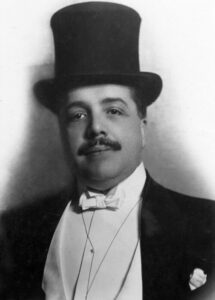
Sergei Diaghilev
Sergei Diaghilev (1872-1929)
- Founded the Ballets Russes in Paris in 1909 and led it for twenty years until his death — commissioning Stravinsky's Firebird, Petrushka and The Rite of Spring, engaging Picasso, Matisse, Coco Chanel, Braque and Miró for sets and costumes, and working with choreographers Fokine, Nijinsky, Massine and Balanchine — making the company the single most influential cultural institution in the performing arts of the twentieth century.1Wikipedia — Ballets Russes ↗
- Personally identified, recruited and developed the careers of the defining artists of early modernism — he was not a composer, dancer, choreographer or designer, but the leader who assembled those who were, holding a vision of total theatrical synthesis so clear that the greatest creative figures of the age competed for access to his commissions.2National Gallery of Art — Diaghilev and the Ballets Russes ↗
- Died in Venice on 19 August 1929 with the Ballets Russes substantially in debt, having never accumulated personal wealth or security — the company disbanded, its dancers scattered globally, and immediately began founding the national ballet companies of France, the United Kingdom and North America that remain the world's major institutions today.1Wikipedia — Ballets Russes ↗
Sergei Diaghilev was born on 31 March 1872 in Novgorod Province, Russia, into a family of vodka distillers who went bankrupt when he was eighteen, and grew up convinced of his vocation as a patron of the arts in the tradition of the Roman Gaius Maecenas — not because he had money, but because he understood what money could do when applied with absolute aesthetic conviction.3Britannica — Diaghilev ↗ He studied law at St Petersburg University, published a journal of visual arts, organised major exhibitions of Russian painting in Western Europe, and arrived at the Ballets Russes not as a man who loved ballet — he was publicly dismissive of it — but as a man who understood that ballet was the form through which the total synthesis of the arts could be achieved. The analytical framework that applies to most leaders in the dataset requires modification for Diaghilev. His Ability variable does not measure compositional or choreographic skill — he had neither. It measures the rarest ability in any creative enterprise: the capacity to identify genius in others, to commission it, to assemble it, to hold it in productive tension, and to impose a unified vision on the result without producing anything himself.4Library of Congress — Ballets Russes ↗ His Vision variable scores at its ceiling because he understood, before almost anyone, that modernism in music, painting, design and movement could be synthesised into a single performance event. His People variable scores high because he managed — through charm, ruthlessness, personal magnetism and genuine aesthetic authority — a roster of artists of such individual ambition and ego that managing any one of them would have been a career in itself. The list of his collaborators is the most remarkable institutional record in twentieth-century cultural history. Stravinsky composed The Firebird, Petrushka and The Rite of Spring on his commissions. Picasso designed sets and costumes for Parade and Pulcinella. Matisse worked on Le Chant du Rossignol. Coco Chanel designed costumes for Le Train Bleu. Braque, Miró, Derain, de Chirico and Dalí all worked for the Ballets Russes.2National Gallery of Art — Diaghilev ↗ Fokine, Nijinsky, Massine, Nijinska and Balanchine were his choreographers. The Library of Congress description of what was required to sustain this enterprise across twenty years of European turbulence is precise: 'wisdom, limitless imagination, shrewdness, and most importantly, the ruthlessness required to nourish an artistic enterprise that revolutionized the course of art, music, and dance.' He was perpetually in debt, dependent on patrons, reliant on the generosity of institutions and individuals who might withdraw support at any point, operating without a permanent home, touring Europe and the Americas with a company that had no legal basis after the Russian Revolution severed its state connections.5Wikipedia — Diaghilev ↗ The Resources variable in his profile reflects this — he operated at or near minimum institutional resource throughout his career. The Value variable scores at its ceiling because the cultural output he produced, and the institutions his alumni immediately founded upon his death, represent the most consequential single contribution to the performing arts in the modern period. He died of diabetes in Venice on 19 August 1929, having told his intimates he feared dying near water. He is buried on the island of San Michele. Stravinsky and Coco Chanel attended the funeral. The Ballets Russes owed substantial debts. Within two years, his former dancers and choreographers had established the companies that became American Ballet Theatre, the New York City Ballet, the Royal Ballet and the Paris Opéra Ballet. He produced nothing himself. Everything that exists in the performing arts today that traces a line to him was made by other people. That is the analytical definition of his leadership.
Score Comparison
Add up to 10 leaders. Click a name to visit their profile.
The 13 Equations
Scores for: Ballets Russes — Early SeasonsThe 22 Variables
Canonical scoresSources & Bibliography
The scores assigned to this leader are derived from publicly available sources. Variable inputs reflect documented behaviour, structural conditions, and historical record at the time of each snapshot.