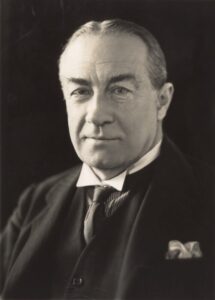
Stanley Baldwin
Stanley Baldwin (1867–1947)
- Stanley Baldwin — son of an ironmaster from Worcestershire, Harrow and Trinity College Cambridge, businessman and managing director of the family ironworks, MP from 1908, Financial Secretary to the Treasury, President of the Board of Trade, Chancellor of the Exchequer, and Prime Minister three times from 1923 to 1924, 1924 to 1929, and 1935 to 1937 — was the dominant figure in British Conservative politics between the wars, winning three general elections, managing the General Strike, navigating the abdication crisis, and overseeing the beginnings of rearmament before handing to Neville Chamberlain a country insufficiently prepared for the war that Baldwin himself had identified as inevitable but had not moved fast enough to prevent — a record whose domestic achievement and strategic failure are so precisely balanced that the historical assessment has oscillated between rehabilitation and condemnation without settling on either.1Britannica — Stanley Baldwin
- His three premierships produced the management of the 1926 General Strike without the revolutionary confrontation that comparable industrial crises had produced in Europe, the first BBC Charter establishing public broadcasting, the Statute of Westminster formalising Dominion autonomy, the abdication of Edward VIII with minimal constitutional damage, the Air Defence Research Committee and the beginning of the radar programme that saved Britain in 1940, and the rearmament programme that Baldwin privately considered essential and publicly managed at a pace that Churchill considered criminally inadequate — a domestic record of considerable institutional consequence whose strategic shadow the Second World War has never allowed to be assessed on its own terms.2Oxford DNB — Stanley Baldwin
- The private record of a man whose public persona — the plain English countryman, the pipe-smoking squire, the voice of honest English common sense — was as carefully constructed a political instrument as any in the twentieth-century British Political domain, whose private correspondence reveals a more sophisticated and more anxious intelligence than the performance suggested, and whose 1936 admission that he had not moved faster on rearmament because he feared the electorate would punish him for it — made to the Commons in terms that Churchill subsequently weaponised to devastating effect — is the most damaging single act of political honesty in the interwar British dataset, a Congruence moment that destroyed his reputation precisely because it was true.3Britannica — Stanley Baldwin
Stanley Baldwin is the most analytically ambivalent profile in the interwar British Political domain — ambivalent in the specific sense that the same variable profile produced both the domestic achievements that stabilised British democracy through the most turbulent decade in European political history and the strategic failures that left Britain insufficiently prepared for the war those achievements had deferred. The equations do not resolve the ambivalence. They record it with precision.
The formation period is defined by the specific combination of manufacturing background and literary sensibility that made Baldwin analytically unusual among Conservative leaders of his era. The ironworks management — he ran the family business for fifteen years before entering Parliament — gave him a direct knowledge of industrial relations, labour management, and the specific texture of working-class life in the West Midlands that most Conservative politicians of his generation had encountered at a much greater distance.1Britannica — Stanley Baldwin The literary formation — Baldwin was a genuinely accomplished essayist whose speeches and broadcasts contain passages of considerable prose quality — gave him a Communication variable built on a register of plain English authenticity that the interwar mass democracy rewarded in ways that the previous generation's parliamentary oratory had not anticipated. The combination of manufacturing experience and literary sensibility produced a People variable that could read working-class opinion with unusual precision for a Conservative leader, which is the foundation of both the General Strike management and the three election victories.
The chancellorship under Bonar Law in 1922 to 1923 is analytically significant primarily for the American debt settlement — in which Baldwin negotiated the funding of Britain's First World War debt to the United States at terms that Bonar Law considered too onerous but that Baldwin accepted on the calculation that American financial goodwill was worth more than the specific debt terms.2Oxford DNB — Stanley Baldwin The Decisiveness variable at this snapshot is operating against the institutional pressure of his own Prime Minister's opposition — Baldwin accepted terms that Bonar Law publicly disowned, and was vindicated by the subsequent financial relationship. The Learning variable records something important: the American debt negotiation gave Baldwin a direct understanding of the relationship between financial credibility and foreign policy capacity that the rearmament debate subsequently required and that his public positioning on defence spending inadequately reflected.
The first premiership of 1923 to 1924 — the shortest in the profile and the one initiated by Baldwin's unexpected elevation following Bonar Law's resignation — is analytically significant for the general election that ended it. Baldwin called an election on the question of tariff reform, lost his majority, and handed the government to the first Labour administration under Ramsay MacDonald — a sequence that the Adaptability variable records as correct in principle and mistimed in execution.1Britannica — Stanley Baldwin Baldwin's calculation — that the tariff reform question needed an electoral mandate or should be abandoned — was constitutionally correct. The timing — calling an election when his parliamentary position was still adequate — reflected a Conviction about democratic legitimacy that cost him the government without being wrong.
The General Strike of May 1926 is the canonical snapshot's most analytically significant single event and the one that most precisely captures the Communication and People variables in combination. Baldwin's management of the nine-day strike — maintaining a public register of calm reasonableness against a Labour movement he privately considered to be threatening constitutional government, using the BBC as the primary instrument of government communication, and offering terms to the TUC that allowed the strike to end without either side claiming total victory — reflected a Communication capability operating at its most politically sophisticated domestic register.4Britannica — General Strike 1926 The People variable at this snapshot is the highest in the profile — Baldwin read the TUC leadership's desire for a face-saving exit with sufficient accuracy to provide one, which is the variable producing the outcome the constitutional situation required. The alternative — a complete union defeat that produced lasting industrial bitterness, or a government capitulation that encouraged further industrial action — was avoided through a People assessment that most of Baldwin's cabinet colleagues had not made.
The second premiership from 1924 to 1929 is the canonical snapshot and the most sustained productive period of the career. The BBC Charter, the Electricity Supply Act establishing the National Grid, the Widows, Orphans and Old Age Contributory Pensions Act, the extension of the franchise to women on equal terms with men — all passed within this period — reflect a Process and Defined Output variable combination operating at moderate but consistent efficiency across a range of institutional domains.1Britannica — Stanley Baldwin The Communication variable at this period is at its highest domestic expression — Baldwin's radio broadcasts established a personal relationship with the mass electorate that the medium of broadcasting made newly possible, and his plain English register was calibrated to an audience that the previous generation's parliamentary oratory had not directly addressed. The Visibility variable at this snapshot reflects a leader who had understood the relationship between mass media and democratic legitimacy before most of his contemporaries had processed it.
The abdication crisis of December 1936 is the most analytically precise expression of the Decisiveness and People variables in the final premiership. Baldwin managed the constitutional crisis produced by Edward VIII's determination to marry Wallis Simpson — a twice-divorced American — with a combination of personal directness, institutional patience, and political timing that produced the abdication without a constitutional rupture, without a parliamentary crisis, and without the kind of public division that a less carefully managed process might have generated.5Britannica — Abdication Crisis The People variable at this snapshot reflects a precise reading of Edward VIII's psychology — Baldwin understood that the King would choose the woman over the throne if the choice was made explicit, and made the choice explicit at precisely the moment when the constitutional and political conditions for a managed abdication were in place. The Process variable records the institutional management — the dominion governments consulted, the cabinet kept informed, the public narrative controlled — with a thoroughness that the subsequent absence of any serious constitutional aftermath confirms.
The rearmament question is the strategic failure that the abdication crisis's institutional success cannot offset. Baldwin had privately concluded by the early 1930s that German rearmament under Hitler made British rearmament essential — he told the Cabinet as early as 1934 that war was inevitable — and had publicly managed the rearmament programme at a pace constrained by his reading of electoral opinion.2Oxford DNB — Stanley Baldwin The 1936 Commons statement — in which he acknowledged that he had not moved faster on rearmament because he feared the electorate would not support it — is the Congruence variable producing its most politically destructive single output: an honest statement that the political management of a security threat had been subordinated to electoral calculation. The statement was accurate. Churchill's subsequent use of it — to argue that Baldwin had prioritised votes over national survival — was the Communication variable weaponised against the Congruence variable with a precision that the historical record has not subsequently reversed.
The Air Defence Research Committee and the radar programme — both initiated under Baldwin's government, both decisive in the Battle of Britain — represent the Vision variable operating at its most consequential in the rearmament record. Baldwin authorised the research that produced the Chain Home radar network that gave Fighter Command the early warning capability that the Battle of Britain required. The Defined Output variable at this snapshot records the radar programme without the public credit that the secrecy of the programme prevented Baldwin from claiming. That gap between the secret output and the public accountability is the analytical explanation for the most damaging aspect of the rearmament reputation — Baldwin was doing more than he could say, and what he was doing was less than the situation required.
The number that matters most across all four snapshots is the Communication variable — and the specific gap between its domestic effectiveness and its strategic inadequacy. Baldwin could communicate with the British electorate — through radio, through press conferences, through parliamentary speeches of considerable literary quality — with a facility that no interwar British politician matched. He could not communicate the strategic reality of German rearmament to that electorate in terms that would have produced the public support for the accelerated British rearmament that the situation required. The same Communication variable that managed the General Strike and the abdication crisis was the constraint on the rearmament programme — Baldwin understood his audience too well to tell them what they did not want to hear at the speed the situation required. That is the analytical signature of Stanley Baldwin, and it is the reason that the most electorally successful Conservative leader of the interwar period is remembered primarily for what he did not do fast enough.
Score Comparison
Add up to 10 leaders. Click a name to visit their profile.
The 13 Equations
Scores for: Resignation and Rearmament LegacyThe 22 Variables
Canonical scoresWhat changed: Third Premiership — Abdication, Rearmament and Radar → Resignation and Rearmament Legacy
Sources & Bibliography
The scores assigned to this leader are derived from publicly available sources. Variable inputs reflect documented behaviour, structural conditions, and historical record at the time of each snapshot.