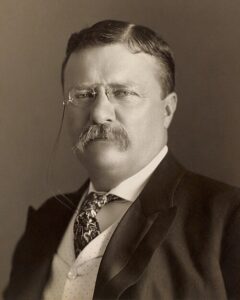
Theodore Roosevelt
Theodore Roosevelt (1858–1919)
- Theodore Roosevelt — sickly child who rebuilt himself through physical discipline, Harvard graduate, New York assemblyman, Dakota rancher, US Civil Service Commissioner, New York Police Commissioner, Assistant Secretary of the Navy, Rough Rider at San Juan Hill, Governor of New York, and Vice President — ascended to the presidency at forty-two on McKinley's assassination in 1901, the youngest man ever to hold the office, having already lived several complete careers.1Britannica — Theodore Roosevelt
- His presidency from 1901 to 1909 produced the Square Deal domestic programme, the dissolution of over forty corporate monopolies under the Sherman Antitrust Act, the Pure Food and Drug Act, the creation of five national parks and eighteen national monuments, the Panama Canal negotiation, and the Portsmouth Treaty ending the Russo-Japanese War — for which he received the Nobel Peace Prize in 1906 — making him the most legislatively productive peacetime president between Lincoln and Franklin Roosevelt.2Miller Center — Theodore Roosevelt Key Events
- The post-presidential period — African safari, European tour, failed Bull Moose third-party candidacy in 1912 that split the Republican vote and handed the presidency to Wilson, near-fatal Amazon expedition, and relentless public output until his death in 1919 — reflects a leader constitutionally incapable of operating below maximum intensity, whose Ego and Pride variables ultimately cost him the one thing his variable profile most required: a return to power.3History.com — Theodore Roosevelt
Theodore Roosevelt is the highest-energy profile in the American Political domain and the most variable-consistent across his entire career. What he was at twenty is what he was at sixty — amplified, accelerated, and applied to progressively larger stages. The equations capture a leader whose strengths and weaknesses were identical in character, differing only in scale.
The formation period is without parallel in the presidential dataset. Roosevelt's deliberate physical reconstruction — the asthmatic child who became the boxer, rancher, and Rough Rider — is the Resilience and Conviction variables being built through conscious effort rather than circumstance.4Theodore Roosevelt Association — Biography The Dakota years following the deaths of his mother and first wife on the same day in 1884 are analytically essential: he withdrew from politics, worked cattle in brutal conditions, and returned with a psychological durability that subsequent crises could not dent. A leader who has already lost everything and rebuilt once is a different instrument from one who has not.
The pre-presidential career established the variable baseline across multiple domains simultaneously. As New York Police Commissioner he demonstrated that Process and Defined Output could be applied to institutional reform against entrenched resistance — walking beats at midnight to catch officers sleeping, introducing competitive examinations, enforcing laws that powerful interests preferred ignored.1Britannica — Theodore Roosevelt As Assistant Secretary of the Navy he prepared the fleet for a war the administration had not yet decided to fight. Both reflect the same variable profile: Vision running ahead of institutional position, Decisiveness operating before authority fully exists, Conviction indifferent to political cost.
The First Term is the canonical snapshot and the most analytically coherent period of the presidency. The trust-busting programme was not anti-capitalist — Roosevelt's Vision distinguished between productive concentration and predatory monopoly — but it required taking on J.P. Morgan, John D. Rockefeller, and James J. Hill simultaneously, which required an Ego and Confidence combination that most leaders cannot sustain under that quality of opposition.2Miller Center — Theodore Roosevelt Key Events The Northern Securities case of 1904, which broke the railroad monopoly, established that the federal government had authority over corporate combinations that restrained trade — a precedent that reshaped American economic governance for the rest of the century.
The conservation programme reflects Vision and Innovation operating in genuine partnership. Roosevelt had read the science, understood the trajectory of industrial extraction, and used the Antiquities Act of 1906 to move faster than Congress could object — designating national monuments by executive order when legislative routes were blocked.5National Park Service — Roosevelt and Conservation The Grand Canyon was protected this way. So was Devils Tower. The method — executive action to preserve what legislative process would have consumed — is Decisiveness and Innovation in combination, and it produced outcomes that are still running.
The Portsmouth Treaty of 1905 is the most underrated achievement of the presidency. Roosevelt mediated the end of the Russo-Japanese War between two powers neither of which he formally represented, through a combination of personal diplomatic pressure, strategic flattery, and a precise understanding of each party's actual versus stated position.6US State Department — Portsmouth Treaty The People variable at this moment reflects a specific capability: the ability to read individuals under pressure and adjust register accordingly. It is the same variable that selected the trust-busting legal team and the same variable that failed him in the Bull Moose period when he could no longer accurately read his own political position.
The Second Term decline is driven by the Ego variable beginning to outrun the Humility corrective. Roosevelt's handpicking of Taft as his successor — and his subsequent fury when Taft governed differently from how Roosevelt would have governed — is the Ego variable made explicit.2Miller Center — Theodore Roosevelt Key Events He had confused his own preferences with objective standards. The 1912 Bull Moose candidacy, which he genuinely believed he could win, reflects Pride at its most operationally destructive: the inability to accept that the moment for his particular variable profile had passed. He split the Republican Party, delivered the presidency to Wilson, and ended his own political career — with full Conviction throughout.
The Amazon expedition of 1913–14 — descending an unmapped tributary of the Amazon that nearly killed him, leaving him with a leg infection that shortened his life — is the post-presidential variable profile in its purest form: Conviction and Resilience operating without institutional constraint, in an environment that did not adjust itself to accommodate him.7National Geographic — Roosevelt's River of Doubt He came back diminished physically but not intellectually. He was still writing, still arguing, still attempting to shape events when he died in his sleep in January 1919.
The number that matters most across all four snapshots is the ratio between Conviction and Humility. Roosevelt's Conviction scores 10 throughout. His Humility scores 5 at peak and declines. When the gap between those two variables is managed — First Term, conservation programme, Portsmouth Treaty — the output is extraordinary. When it is not — Bull Moose, Taft rupture, Amazon — the same energy produces self-inflicted damage. That ratio is the analytical signature of Theodore Roosevelt, and it is the clearest illustration in the dataset of why Humility is the single most important correcting variable in the Leaderment model.
Score Comparison
Add up to 10 leaders. Click a name to visit their profile.
The 13 Equations
Scores for: Pre-Presidential Formation — Police, Navy and San Juan HillThe 22 Variables
Canonical scoresSources & Bibliography
The scores assigned to this leader are derived from publicly available sources. Variable inputs reflect documented behaviour, structural conditions, and historical record at the time of each snapshot.
- Britannica — Theodore Roosevelt biography
- Miller Center — Theodore Roosevelt Key Events
- Theodore Roosevelt Association — Biography
- History.com — Theodore Roosevelt
- National Park Service — Roosevelt and Conservation
- US State Department — Portsmouth Treaty
- National Geographic — Roosevelt's River of Doubt