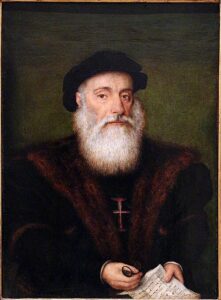
Vasco da Gama
Vasco da Gama (1460-1524)
- Led the first European sea voyage from Europe to India in 1497–99, rounding the Cape of Good Hope and crossing the Indian Ocean to reach Calicut on 20 May 1498 — a journey of over 24,000 miles that took more than two years, cost two of his four ships and over half his crew of 170 men to scurvy and disease, and opened the maritime route that broke the Muslim monopoly on the spice trade and initiated the Portuguese Empire in Asia.1Wikipedia — Vasco da Gama ↗
- Commanded the second Portuguese India expedition of 1502–03 with twenty ships, using systematic terror against Arab and Muslim merchant shipping — including the burning of the Miri, a pilgrim vessel carrying several hundred passengers returning from Mecca — to force submission from East African rulers and impose Portuguese dominance on Indian Ocean trade by violence where diplomacy had failed.2Britannica — Vasco da Gama Second Voyage ↗
- Appointed Viceroy of India by King John III in 1524 and sailed for a third time to Goa, where he immediately set about reforming the extensive administrative corruption that had accumulated under his predecessors — dying of illness at Cochin on 24 December 1524, three months after his arrival, before the work was complete.3World History Encyclopedia — Vasco da Gama ↗
Vasco da Gama was born around 1460 in Sines, a small coastal town on the Alentejo coast of Portugal, the third son of a minor nobleman who commanded the local fortress.4Britannica — Vasco da Gama ↗ Little is known of his early life beyond his naval training and a 1492 mission in which King John II sent him to seize French ships along the Portuguese coast in retaliation for attacks on Portuguese shipping — a task he executed with the speed and effectiveness that brought him to royal attention. When King Manuel I revived the India project in 1495, the command devolved eventually to da Gama, possibly after it was declined by his elder brother Paulo on grounds of ill health. The first voyage of 1497–99 is the canonical snapshot and the most consequential single journey in the Explorers domain in terms of its geopolitical consequences. Da Gama departed Lisbon on 8 July 1497 with four ships and approximately 170 men.1Wikipedia — Vasco da Gama ↗ He made the longest open-ocean voyage yet attempted by a European fleet, veering far into the southern Atlantic to avoid the unfavourable currents of the African coast before rounding the Cape of Good Hope in late November. He worked up the East African coast — Mozambique, Mombasa, Malindi — before acquiring a pilot to guide him across the Indian Ocean. The crossing took 23 days. He reached Calicut on 20 May 1498. The reception at Calicut was the first analytical complication. The Zamorin of Calicut — then the most significant trading port on the Malabar coast — was unimpressed by the gifts da Gama brought, which were adequate for West African trade but plainly inadequate for the sophisticated commercial world of the Indian Ocean.4Britannica — Vasco da Gama ↗ Muslim merchants, whose commercial dominance da Gama had been sent to break, worked against him. He failed to secure a treaty. He left with a small quantity of spices, purchased at inflated prices, and began the return journey. The crossing back took 132 days — five times longer than the outbound leg, as the monsoon had turned against him. Scurvy killed men steadily. He burned the São Rafael because there were not enough surviving crew to sail her. He returned to Lisbon in September 1499 with two ships and approximately 55 men.5The Portuguese Traveler — Vasco da Gama Route ↗ The spices he brought back, even in those small quantities, still turned a profit of three thousand per cent. The second voyage of 1502–03 is where da Gama's Congruence variable records its sharpest analytical drop. He arrived with twenty ships and a mission that was explicitly coercive rather than diplomatic.6History.com — Vasco da Gama ↗ He terrorised East African ports that had been hostile to earlier Portuguese expeditions, extracted forced tribute, and systematically attacked Arab shipping. The burning of the Miri — a vessel carrying several hundred pilgrims returning from Mecca, including women and children, which da Gama is said to have set alight with its passengers locked below decks — is the most extreme act attributed to him and one whose full details are disputed by later historians, though its broad outline is accepted.7Biography.com — Vasco da Gama ↗ Whatever the precise account, the second voyage established Portuguese dominance in the Indian Ocean by methods that made da Gama feared and hated throughout the region in a way the first voyage had not. He returned to Portugal richly rewarded. The People and Congruence variables in the second snapshot reflect what those methods cost. He spent twenty years in semi-retirement in Portugal, advising successive kings on Indian affairs, before King John III sent him back in 1524 as Viceroy — the highest Portuguese position in Asia — to reform an administration that had grown corrupt and ineffective.8EBSCO — Vasco da Gama ↗ He arrived at Goa in September 1524 and immediately began the work. He died at Cochin on 24 December 1524, three months after arrival. His body was returned to Portugal for burial in 1538. The Portuguese national epic, Camões's Os Lusíadas, is built around his first voyage. He is the only explorer in the dataset whose canonical achievement was immediately and consciously recognised by his own state as a world-historical turning point.
Score Comparison
Add up to 10 leaders. Click a name to visit their profile.
The 13 Equations
Scores for: First Voyage to IndiaThe 22 Variables
Canonical scoresSources & Bibliography
The scores assigned to this leader are derived from publicly available sources. Variable inputs reflect documented behaviour, structural conditions, and historical record at the time of each snapshot.