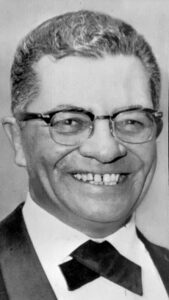
Vince Lombardi
Vince Lombardi (1913-1970)
- Arrived at Green Bay in 1959 to coach a team that had gone 1-10-1 the previous season — the worst record in the franchise's thirty-nine-year history — declared at his first team meeting that he had never been on a losing team and did not intend to start, and led the Packers to five NFL Championships in seven years including the first two Super Bowl victories, producing an 89-29-4 record and transforming professional American football's standard of what coaching excellence meant.1Wikipedia — Vince Lombardi ↗
- Developed the Green Bay sweep — a single play practised to the point of perfect execution regardless of what the opponent knew was coming — as the analytical embodiment of his coaching philosophy: discard the immaterial, refine the few things you do best, practise them with relentless repetition until they become automatic under pressure, and understand that simplicity executed to perfection will defeat complexity executed imperfectly.2Britannica — Vince Lombardi ↗
- Became a national cultural figure beyond football — his speeches and leadership philosophy, particularly the principles of individual sacrifice for collective excellence and the pursuit of perfection as the only justification for settling for excellence, are studied in business schools worldwide and cited by political leaders, military commanders and corporate executives — a consequence of his nine-season coaching record that is analytically inseparable from the moral force of the values he articulated and the degree to which his conduct demonstrated them.3Vince Lombardi Official — Biography ↗
Vincent Thomas Lombardi was born on 11 June 1913 in Brooklyn, New York, the eldest of five children of an Italian immigrant butcher, studied for the priesthood for two years before transferring to a football-playing high school where he became a star fullback, graduated from Fordham University in 1937 where he was one of the 'Seven Blocks of Granite' on the offensive line, and spent the next fifteen years as a high school coach, then assistant coach at Fordham, West Point and the New York Giants before being hired as head coach and general manager of the Green Bay Packers at the age of forty-five.1Wikipedia — Vince Lombardi ↗ At West Point, he worked under Colonel Earl Blaik — widely considered the finest college football coach of his era — and absorbed a philosophy of military-style discipline, precision preparation and the expectation of personal sacrifice for collective achievement that shaped everything he subsequently did as a head coach. He arrived at Green Bay with five years of NFL experience as an assistant, no head-coaching experience at the professional level, and a complete analytical clarity about what he intended to do and how he intended to do it.4Wisconsin Historical Society — Vince Lombardi ↗ The Defined Output variable in Lombardi's profile scores at its ceiling because he was not ambiguous about what he was trying to produce. At his introductory press conference he said he had never been associated with a loser and did not intend to start. He sent sixteen players packing within weeks. He imposed a training regimen that players described as physically and mentally brutal, building in its intensity and its demands until it became, as multiple Hall of Famers recalled, the hardest thing they had ever done and the most valuable. The Conviction variable reflects a man who had spent fifteen years as an assistant coach developing an absolute clarity about what excellent football looked like and what it required from its participants. When he finally had authority over the entire enterprise, there was no hesitation about implementing what he had concluded. The People variable is where Lombardi's profile is most analytically complex. His legendary intensity — the demanding practices, the personal confrontations, the 'mind games' he played with individual players to extract maximum effort — could register as a negative management trait in a conventional assessment. In the Codex framework, the variable measures whether the leader built and sustained the human architecture necessary to deliver the Defined Output. The players who survived his methods and achieved his standards became, by their own testimony, deeply loyal to him, attributing their personal development and their professional achievements directly to what he demanded of them.5Vistage — Lombardi on Leadership ↗ Bart Starr, the Hall of Fame quarterback who played all nine of Lombardi's seasons, credited Lombardi with the formative influence of his professional life. He retired as head coach after the 1967 season but retained the general manager role, found the separation from coaching unendurable, and in 1969 became head coach of the Washington Redskins — who had not had a winning record in fourteen years. In one season he produced one. He was diagnosed with intestinal cancer shortly after the 1969 season and died on 3 September 1970, aged fifty-seven, before the 1970 season began. He was inducted into the Pro Football Hall of Fame in 1971. The Super Bowl trophy is named after him. No other individual in the history of American football has had the championship trophy named in their honour.
Score Comparison
The 13 Equations
Scores for: Washington Redskins — Final SeasonThe 22 Variables
Canonical scoresWhat changed: Green Bay — Dynasty Peak → Washington Redskins — Final Season
Sources & Bibliography
The scores assigned to this leader are derived from publicly available sources. Variable inputs reflect documented behaviour, structural conditions, and historical record at the time of each snapshot.