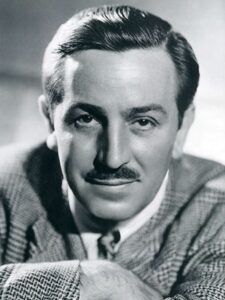
Walt Disney
Walt Disney (1901-1966)
- Founded the Walt Disney Company with his brother Roy in 1923 and built it into the world's first animation studio capable of feature-length production — creating Mickey Mouse, Snow White, Fantasia, Bambi and a library of animated features that established animation as a legitimate artistic form — pioneering technological innovations including synchronised sound, Technicolor, the multiplane camera and widescreen formats that transformed the medium.1Wikipedia — Walt Disney ↗
- Opened Disneyland in Anaheim, California in 1955 — the world's first purpose-built themed entertainment park — conceived as a three-dimensional extension of his storytelling universe, in which every element of the visitor experience from car parking to the smell of Main Street was designed under his personal direction, creating a new form of industrial entertainment that became the template for the global theme park industry.2Britannica — Walt Disney Company ↗
- Led a studio that employed hundreds of animators, composers, writers, engineers and designers across productions of extraordinary technical and narrative complexity — simultaneously demanding absolute creative standards, managing significant labour disputes including the 1941 animators' strike, testifying before the House Un-American Activities Committee, and planning EPCOT, a working city of the future that remained unbuilt at his death on 15 December 1966.1Wikipedia — Walt Disney ↗
Walter Elias Disney was born on 5 December 1901 in Chicago, Illinois, grew up in Missouri, worked as a farm labourer, joined the Red Cross Ambulance Corps at sixteen after being rejected by the Army for being underage, and returned from France in 1919 with a conviction that he would work in animation.3HistoryB — Walt Disney ↗ His first animation studio, Laugh-O-Gram, went bankrupt in 1923. He arrived in Hollywood with his brother Roy and $40 between them and founded the Disney Brothers Studio in a rented space, producing animation on a shoestring for the next five years before creating Mickey Mouse in 1928 — the character who would fund everything that followed. The analytical framework for Disney is that of an industrialist of creative production rather than a pure creative artist. He did not draw the animations himself — in the later years he barely drew at all. What he did was conceive the total product, communicate it to his artists with extraordinary physical and verbal vividness — walking through entire story sequences, performing voices, acting out emotional beats — and then hold every element of the production to a standard of quality that his studio described as having turned the animators around him into over-achievers.4ISU — Walt Disney Leadership ↗ His Process scores high because the industrial systems he built for animation production — the multiplane camera, the story department, the sound synchronisation workflow — were not incidental to the art. They were the means by which the art was produced at scale. Snow White and the Seven Dwarfs, released in 1937, was produced with $1.5 million — an enormous sum during the Depression — against the industry consensus that audiences would not watch a feature-length cartoon. It earned over $8 million in its initial release and changed the landscape of American entertainment.5Wilson Luna — Walt Disney Story ↗ The Defined Output variable in Disney's peak period scores at its ceiling: he knew precisely what he was making, how it should feel, and what standard it needed to meet. The Vision variable reflects a man who consistently saw creative and commercial possibilities that the industry around him considered impossible. The 1941 animators' strike is the most analytically complex event in his leadership profile. Disney's response — firing strikers, testifying as a friendly witness before HUAC, growing increasingly autocratic as the studio expanded — reflects a leader whose Ego and Pride variables were climbing as his success grew, and whose People variable was declining in inverse proportion.6St John's Scholar — Walt Disney ↗ His stated commitment to treating employees with fairness was contradicted by his conduct during and after the strike — a Congruence failure that is analytically significant even if it did not interrupt the creative output. Disneyland opened on 17 July 1955 and was, by every measure, the most ambitious single act of institutional creation in the history of American entertainment. Disney personally supervised every element of its design, from the layout of the park to the height of the buildings on Main Street — scaled to make adults feel slightly taller than life. He was planning the Experimental Prototype Community of Tomorrow — EPCOT — a functional city built on the principles of American corporate innovation — when he died of lung cancer on 15 December 1966, aged 65. Roy Disney deferred his retirement to complete Walt Disney World in Florida, which opened in 1971 and was dedicated to his brother.
Score Comparison
The 13 Equations
Scores for: Disneyland and ExpansionThe 22 Variables
Canonical scoresWhat changed: Snow White to Fantasia — Creative Peak → Disneyland and Expansion
Sources & Bibliography
The scores assigned to this leader are derived from publicly available sources. Variable inputs reflect documented behaviour, structural conditions, and historical record at the time of each snapshot.