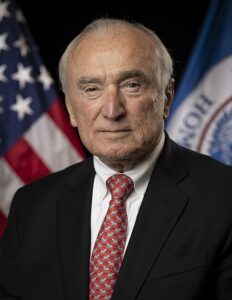
William Bratton
William Bratton (Born 1947)
- As NYPD Commissioner from 1994 to 1996, publicly committed to a ten per cent crime reduction target in his first year — a goal criminologists called career suicide — then beat it with a twelve per cent decline, followed the next year by sixteen per cent against a target of fifteen, reducing homicides by fifty per cent across twenty-seven months and establishing that police leadership could be held to measurable, published outcome targets for the first time in the history of American policing.1Governing — William Bratton ↗
- Invented CompStat — the computerised crime statistics management system that required precinct commanders to know their crime data in real time, attend weekly accountability sessions, and explain patterns and responses to senior leadership — creating the first systematic accountability framework in large-scale urban policing, subsequently adopted by departments across the United States and described by one observer as the most significant public sector management innovation of the late twentieth century.2EBSCO — William Bratton ↗
- Served as Chief of the LAPD from 2002 to 2009 — inheriting a department under federal consent decree following the Rampart corruption scandal, with a history of brutal relations with minority communities — and reduced serious crime by thirty per cent and homicides by forty-one per cent while simultaneously increasing ethnic diversity and eliminating the mass-arrest tactics that had fuelled public hostility, becoming the first person ever to have led the police departments of both New York and Los Angeles.3Wikipedia — William Bratton ↗
William Joseph Bratton was born on 6 October 1947 in Dorchester, Boston, served in the Military Police Corps, and joined the Boston Police Department in 1970 as a beat officer.3Wikipedia — William Bratton ↗ He rose through the BPD ranks over two decades — becoming its youngest Executive Superintendent at thirty-two — before moving to the New York City Transit Police in 1990, where he applied broken windows theory to the subway system and reduced crime significantly before being appointed NYPD Commissioner in 1994. The Transit Police experience is analytically significant: it was his first full implementation of the accountability framework he would later systematise as CompStat. The Defined Output variable in Bratton's profile scores at its ceiling across every appointment. Before taking the NYPD role, he presented Mayor Giuliani with a plan committing to a forty per cent crime reduction in three years — a target criminologists publicly described as impossible.1Governing — William Bratton ↗ The commitment was not rhetorical. CompStat required precinct commanders to present crime data in real time at weekly meetings, to account for patterns in their area, and to explain what they were doing about them. Commanders who could not answer were replaced. The system made crime reduction a measurable, published leadership responsibility for the first time in American policing history — a fundamental shift in the accountability architecture of a major public institution. The Process variable is where Bratton's profile distinguishes itself most sharply within the Law Enforcement domain. He did not simply produce results — he built the systems that produced results and ensured those systems could be operated without him.2EBSCO — William Bratton ↗ CompStat spread from the NYPD to departments in Philadelphia, Baltimore, Providence, Miami and eventually internationally. The analytical test of a Process innovation is whether it survives its inventor: CompStat did, and continues to operate in adapted forms in police departments globally. This is the distinguishing characteristic of his profile compared to a leader who produces outcomes through personal charisma or authority alone. The People variable carries the most analytical complexity. His methods — broken windows enforcement, stop-and-frisk at elevated levels during his first NYPD tenure — generated documented friction with minority communities and contributed to tensions that his own later analysis acknowledges as a foreseeable consequence of well-intentioned policies applied without sufficient regard for community relationships.4Bratton — The Profession ↗ His second NYPD tenure, 2014 to 2016, was partly characterised by the reversal of mass stop-and-frisk — an acknowledgement that the policy had caused harm disproportionate to its crime-reduction benefit. The People variable in his profile reflects both the organisational development of his departments and the community relations record that his own retrospective analysis does not shy away from. He resigned from the NYPD for the first time in 1996, reportedly forced out by Mayor Giuliani's view that Bratton's public profile was eclipsing the Mayor's own. The personal dynamic between a leader who builds institutional results and a political principal who owns the credit is itself an analytically instructive leadership case. Bratton's Congruence scores high because his stated commitment to measurable crime reduction was consistent across every appointment. His Ego scores high because he understood his own capability precisely and operated accordingly.
Score Comparison
The 13 Equations
Scores for: LAPD — Reform and RebuildingThe 22 Variables
Canonical scoresWhat changed: NYPD — First Term CompStat Revolution → LAPD — Reform and Rebuilding
Sources & Bibliography
The scores assigned to this leader are derived from publicly available sources. Variable inputs reflect documented behaviour, structural conditions, and historical record at the time of each snapshot.