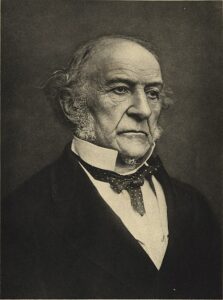
William Gladstone
- William Ewart Gladstone — son of a Liverpool merchant and slave owner, Eton and Christ Church Oxford double first, MP from 1832, Junior Lord of the Treasury, Under-Secretary for the Colonies, President of the Board of Trade, Secretary of State for War and the Colonies, Chancellor of the Exchequer four times, Leader of the Liberal Party, and Prime Minister four times from 1868 to 1874, 1880 to 1885, 1886, and 1892 to 1894 — served in Parliament for sixty-three years, held the chancellorship for twelve of them, introduced the first Irish Home Rule Bill at seventy-six and the second at eighty-three, and remained a figure of genuine parliamentary force until his resignation at eighty-four, making him the longest-serving and oldest Prime Minister in British history and the one whose career arc most precisely illustrates the relationship between sustained institutional capability and the single transformative issue that ultimately defined it.1Britannica — William Gladstone
- His four administrations produced the disestablishment of the Irish Church, the Irish Land Act, the Education Act of 1870, the Ballot Act introducing secret voting, the Army reforms under Cardwell, the University Tests Act, the Judicature Act reorganising the court system, the Third Reform Act extending the franchise to agricultural labourers, the Irish Land League reforms, and two Irish Home Rule Bills that split the Liberal Party and failed to pass — a legislative record of institutional transformation across religious, educational, electoral, military, judicial, and constitutional domains that no other Victorian Prime Minister approaches in breadth, and whose Irish dimension consumed the final twenty years of a career that the preceding forty had built.2Oxford DNB — William Gladstone
- The private record of a man whose religious faith was the organising principle of his entire public career — whose nightly walks rescuing prostitutes from London streets were conducted in full knowledge of the political risk they represented, whose diaries record a psychological and spiritual self-examination of extraordinary intensity across sixty years, and whose Congruence variable between private conviction and public position was among the highest in the Victorian Political domain — is the most analytically complete portrait of a leader for whom the relationship between personal morality and political action was not a rhetorical device but the actual mechanism of decision-making.3Britannica — William Gladstone
William Gladstone is the most analytically complex profile in the Victorian Political domain and the one whose variable arc most precisely illustrates the relationship between sustained institutional capability and the single transformative commitment that eventually consumed it. He was the most productive legislative Prime Minister of the nineteenth century across the first three administrations. He was the most consequential political failure of the same century in the fourth. The equations record both without requiring either to cancel the other.
The formation period is defined by the specific combination of evangelical Christianity, classical scholarship, and the Canning Toryism that Gladstone absorbed at Eton and Oxford, and from which he spent the subsequent thirty years progressively departing in the direction that the evidence of his own experience and the moral logic of his own faith required.1Britannica — William Gladstone The early parliamentary career — which began with the defence of his father's slave-owning interests, continued through the Tory administrations of the 1830s and 1840s, and gradually converted through the Italian nationalism question, the fiscal reform at the Board of Trade, and the Irish Church question into the Liberalism that the 1868 election confirmed — is the Learning variable producing the most sustained single ideological evolution in the Victorian Political domain. Gladstone did not change his mind for political convenience. He changed it because the evidence, processed through the moral framework of his evangelical faith, required him to.
The Chancellor of the Exchequer period — four separate terms totalling twelve years, the most productive fiscal record of any Victorian minister — is where the Process and Defined Output variables reach their highest pre-premiership expression. Gladstone's budgets — reducing tariffs from over a thousand items to fewer than fifty, balancing the budget through income tax rather than borrowing, and establishing the principle that government expenditure required demonstrable justification — produced the fiscal framework of Victorian prosperity and the doctrine of financial accountability that subsequent chancellors inherited.2Oxford DNB — William Gladstone The Communication variable in the parliamentary period is analytically distinct from Palmerston's or Disraeli's — Gladstone's oratory was not witty or theatrical but forensic and morally urgent, operating in a register that the Victorian Commons found simultaneously exhausting and irresistible. A four-hour budget speech that kept the Commons engaged through detailed fiscal argument is a Communication variable operating at a completely different register from the civis Romanus sum, but the Defined Output it produced was more durable.
The first administration from 1868 to 1874 is the canonical snapshot and the most analytically coherent legislative period of the career. Gladstone had told the Queen that his mission was to pacify Ireland — and he arrived at the specific legislative programme that mission required with the same analytical precision that the budget speeches reflected.4UK Parliament — Ballot Act 1872 The Irish Church Disestablishment Act removed the Church of England's privileged position in Ireland — a reform that Gladstone had reached through the moral logic of religious equality rather than political calculation, and that the Nonconformist vote subsequently rewarded without having been calculated in advance. The Irish Land Act provided tenant protections that the existing landlord-tenant relationship had systematically denied. The Education Act created the framework of elementary education that the subsequent century built upon. The Army reforms under Cardwell abolished the purchase of commissions — ending a system that had been militarily inefficient and socially unjust simultaneously for two centuries. The Ballot Act introduced secret voting — removing the coercive power of landlords and employers over their tenants' and workers' votes. Each reform addressed a specific institutional injustice through a specific legislative mechanism — the Defined Output variable at this snapshot is the highest in the profile and among the highest in the Victorian Political domain.
The People variable in the first administration is analytically significant for a specific reason that the legislative output tends to obscure. Gladstone's cabinet — including Granville, Bright, Lowe, Cardwell, and Forster — was the strongest collective Liberal capability of the Victorian era, and each appointment reflected a precise matching of individual capability to departmental requirement. The Cardwell appointment to the War Office is the most consequential single People decision of the period — the subsequent abolition of purchase and the reorganisation of the army on a short-service territorial basis reflected Cardwell's specific expertise applied to a specific institutional problem with the autonomy that Gladstone's cabinet management provided. That is the People variable operating at its most institutionally productive expression.
The Midlothian Campaign of 1879 to 1880 is the most analytically significant single Communication event of the career and the one that most directly anticipates the subsequent development of mass democratic politics. Gladstone conducted a speaking tour of Midlothian in Scotland — addressing mass audiences at railway stations, town halls, and outdoor meetings — in which he made the detailed moral and strategic case against Disraeli's Beaconsfield foreign policy with a sustained forensic intensity that the emerging popular press amplified to a national audience.1Britannica — William Gladstone The Communication variable at this moment is operating in a register that Gladstone had developed over fifty years of parliamentary oratory, now applied to a mass audience context that the reformed franchise and the popular press had created. The Vision variable at this snapshot reflects a leader who had identified the specific political opportunity that Disraeli's foreign policy failures had created, and the specific communicative instrument that the mass democratic context made available.
The Irish Home Rule commitment from 1885 is the most analytically significant single Conviction event of the career and the one whose consequences most precisely illustrate the relationship between moral commitment and political sustainability. Gladstone had reached the conclusion that Irish self-government was both morally required and practically necessary through a process of reasoning from evidence and moral principle that the diaries document with unusual completeness.5UK Parliament — Gladstone and Home Rule The Conviction variable at this moment is at its absolute ceiling — Gladstone introduced the first Home Rule Bill in 1886 knowing that it would split the Liberal Party, that Joseph Chamberlain and the Liberal Unionists would defect, and that the bill would almost certainly fail. It split the Liberal Party. Chamberlain defected. The bill failed. The Congruence variable at this snapshot is equally high — Gladstone's public conversion to Home Rule was complete, his private conviction was identical to his public position, and the political cost he accepted was the most complete in the profile.
The second Home Rule Bill of 1893 — introduced at eighty-three, passed by the Commons, defeated in the Lords — is the terminal legislative event of the career and the most analytically unusual parliamentary achievement in the Victorian Political domain.2Britannica — William Gladstone Gladstone shepherded a bill of constitutional transformation through the House of Commons at an age when most politicians had retired, with a parliamentary majority dependent on Irish Nationalist votes, against a unified Conservative and Liberal Unionist opposition, and a Lords veto that the Parliament Act of 1911 — eighteen years later — eventually provided the mechanism to overcome. The Resilience variable at this snapshot is the highest in the profile — a leader who had absorbed the failure of the first Home Rule Bill, the loss of the Liberal majority, and seven years in opposition, and returned to introduce the second bill with the same conviction and the same analytical precision.
The resignation in March 1894 — over the naval estimates, which Gladstone considered excessive and his cabinet considered essential — is the final Congruence act of the career. Gladstone resigned rather than accept a naval policy he considered morally and fiscally wrong, at eighty-four, from a position of sufficient authority that the cabinet's unanimous opposition to his resignation could not change his mind.1Britannica — William Gladstone The Pride variable at this snapshot is lower than at any point in the profile — a leader who resigned on a matter of principle without requiring the principle to be vindicated, and who accepted the political consequences without attempting to manage them. That is the Congruence variable at its most complete expression, operating at the end of a career that had been built on it.
The number that matters most across all four snapshots is the Congruence variable — sustained at its highest consistent level across sixty years of public life, through the evolution from Tory to Liberal, from opponent of Irish reform to champion of Irish Home Rule, from defender of his father's slave-owning interests to author of the moral foreign policy that the Midlothian Campaign embodied. Gladstone's public positions and private convictions were not always the same — the early career contains specific gaps that the Learning variable subsequently closed — but the direction of travel was always from private conviction toward public position, not from political calculation toward publicly adopted principle. That directional consistency — updating public positions when private conviction required it rather than when political advantage suggested it — is the analytical signature of William Gladstone, and it is the reason that the four-times Prime Minister who failed to pass Irish Home Rule is ranked by historians as the greatest reforming Prime Minister of the Victorian era. The equations agree.
Score Comparison
Add up to 10 leaders. Click a name to visit their profile.
The 13 Equations
Scores for: First Administration — Irish Church, Education and Ballot ActThe 22 Variables
Canonical scoresWhat changed: Chancellor Peak — Fiscal Reform and Free Trade → First Administration — Irish Church, Education and Ballot Act
Sources & Bibliography
The scores assigned to this leader are derived from publicly available sources. Variable inputs reflect documented behaviour, structural conditions, and historical record at the time of each snapshot.