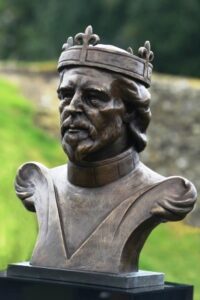
William the Conqueror
William I (c.1028–1087)
- Born illegitimate in Falaise around 1028 — the son of Duke Robert I of Normandy and Herleva, daughter of a tanner — became Duke of Normandy at eight on his father's death, survived the murder of his tutor and the attempted assassinations of his early years through the protection of loyal retainers and the occasional intervention of the French king Henry I who knighted him in his teens1The Royal Family — William I — and by 1060, after thirty years of baronial revolt, French invasion and internal conspiracy, had consolidated Normandy into the most militarily coherent and administratively sophisticated duchy in France, acquired Maine and Brittany by conquest and marriage, and received what he interpreted as a promise of the English throne from Edward the Confessor.
- Crossed the Channel with a fleet of hundreds of ships and several thousand men on 28 September 1066, defeated and killed Harold Godwinson at Hastings on 14 October in a battle decided by the combination of Norman cavalry, archers and Harold's strategic error of attacking rather than waiting2Wikipedia — Norman Conquest — was crowned on Christmas Day in Westminster Abbey where the guards outside, hearing the acclamation inside, assumed a riot and began burning the surrounding buildings — and spent the next nine years suppressing revolt after revolt, including the Harrying of the North in the winter of 1069–70 which destroyed the agricultural capacity of Yorkshire and Durham so comprehensively that the Domesday Book, compiled sixteen years later, still records hundreds of villages as waste.
- Commissioned the Domesday survey in December 1085 — the most comprehensive administrative record of any medieval European kingdom, listing every landholding, its pre-Conquest and current holder, its value and its taxable resources, described by contemporaries as recording England "to the last hide and the last ox"3Wikipedia — William the Conqueror — and died on 9 September 1087 at Rouen from injuries sustained when his horse threw him against a saddle pommel during the sacking of Mantes, dividing England and Normandy between his sons William Rufus and Robert Curthose, his corpse so swollen by the time of burial that it burst open during the funeral ceremony in Caen.
William I ruled England from 1066 to 1087 and transformed it more completely than any ruler before or since. He replaced an entire aristocracy, reorganised the church, introduced a new legal and feudal system, built a network of castles across the kingdom, created the most comprehensive administrative record in medieval Europe, and in the process killed or dispossessed most of the people who had governed England before he arrived. The equations record both the extraordinary operational achievement and the mechanism of its human cost.
The formation period in Normandy is the most undervalued phase of his career and the one that produced the operating method that made 1066 possible. A child duke who survived three decades of baronial revolt, assassination attempts and French invasion did not do so through luck. He did so through the combination of Conviction at 9 (unwavering in his claim to the ducal title despite every challenge), Process at 8 (systematic military consolidation, castle-building, and alliance management), and a Humility that expressed itself as tactical adaptability — he learned, adjusted, and preserved what worked rather than destroying institutions that functioned. The ducal administration he inherited from his predecessors was more sophisticated than many of his baronial rivals understood, and he used it rather than replacing it.4Britannica — Wellington
The canonical snapshot — the conquest and its immediate consolidation — is where every variable reaches its operational peak simultaneously. The planning of the invasion was Process at its ceiling: the diplomatic groundwork (papal blessing, Norman nobility bought in, alliances secured), the logistics (hundreds of ships, pre-positioned supplies, timed crossing), the tactical execution at Hastings (cavalry, archers and infantry deployed in combination against a shield wall, the feigned retreat that broke Harold's line), and the political management afterwards (Christmas Day coronation in Westminster, deliberate use of English ceremonial forms, selective retention of Anglo-Saxon officials).1The Royal Family — William I
The Harrying of the North in 1069–70 is the Congruence variable at its most analytically precise. William's stated policy toward rebellion was absolute: rebellion would be met with destruction sufficient to prevent its recurrence. The Harrying was not a departure from stated policy — it was its most extreme expression. He destroyed the agricultural base of northern England so thoroughly that the region did not recover for a generation. The Domesday Book records the evidence: village after village marked waste where productive estates had stood. The Value variable cannot record the administrative achievements of the Domesday survey without recording the Harrying that produced the landscape it surveyed.3Wikipedia — William the Conqueror
The late period — after 1075 when the last significant English revolt was crushed — is where William's attention turned from military consolidation to administrative architecture. The Domesday survey of 1085–86 is the Process variable at its most ambitious: a complete inventory of every landholding in England, its value before and after the Conquest, its taxable capacity, and its current holder. Nothing approaching this in scope or detail was attempted anywhere in Europe until centuries later. It was commissioned for fiscal and legal purposes — William needed to know what he owned and what it was worth — but it produced as a by-product the most detailed snapshot of medieval society in European history. That is the Process variable producing output far beyond its immediate operational purpose.5Western Civilization — William's Rule
He died from a riding accident during a campaign he had no strategic reason to conduct personally. The swollen corpse that burst during the funeral ceremony at Caen — described in graphic detail by contemporary chroniclers — became the dominant image of his death in popular memory. It is an analytically unimportant detail for the equations and a humanly important one: the man who had remade England so completely died ignominiously, divided his achievement between sons who would spend the next decades fighting each other for it, and left a kingdom still in the process of becoming something he could not have fully predicted.
His descendants still reign. His language is embedded in English at every level of abstraction and governance. His administrative frameworks became the foundation of the common law tradition Henry II codified a century later. The k variable of the Norman Conquest, operating across a thousand years, is without parallel in this dataset.
Score Comparison
Add up to 10 leaders. Click a name to visit their profile.
The 13 Equations
Scores for: Consolidating Normandy — Survival and FormationThe 22 Variables
Canonical scoresSources & Bibliography
The scores assigned to this leader are derived from publicly available sources. Variable inputs reflect documented behaviour, structural conditions, and historical record at the time of each snapshot.