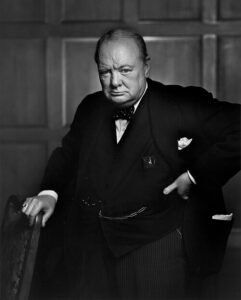
Winston Churchill
Winston Churchill (1874–1965)
- Born at Blenheim Palace on 30 November 1874, the descendant of the Duke of Marlborough, served as First Lord of the Admiralty before overseeing the disastrous Gallipoli campaign in 1915, resigned from government and commanded a battalion on the Western Front, returned to office under Lloyd George, then as Chancellor of the Exchequer in 1925 returned sterling to the gold standard at pre-war parity against the explicit advice of John Maynard Keynes — depressing the British economy and confirming a decade-long pattern in which the same Conviction that drove his most significant achievements drove his most significant errors.1Wikipedia — Winston Churchill
- Spent the Wilderness Years from 1930 to 1939 out of office, commanding no resources and leading no organisation, holding the correct analysis of the Nazi threat against the entire political establishment for a decade and paying the full political price for it2Museum of the Prime Minister — Winston Churchill — then became Prime Minister on 10 May 1940, refused Lord Halifax's proposal to explore a negotiated settlement when France was falling and invasion was imminent, and rallied a coalition government and a nation to a war that the preceding decade had made him the only credible leader to prosecute.
- Won the war, lost the 1945 general election to Clement Attlee while attending the Potsdam Conference, returned to Downing Street in 1951 in what Roy Jenkins described as being "gloriously unfit for office"3GOV.UK — Winston Churchill — kept Eden waiting for years, produced no significant domestic outputs in his second premiership beyond housebuilding, and resigned in 1955 through ill health — dying on 24 January 1965 and receiving a state funeral attended by six sovereigns and fifteen heads of state, the first such funeral since the Duke of Wellington's in 1852.
Winston Churchill presents the Codex with its most dramatic arc. Years of political irrelevance, a period that changed the course of history, and a long decline that ended in the lowest band — scored by the same equations that produced the finest hour. The framework does not adjust for legacy. It scores what the variables produced in each period. The result is uncomfortable, accurate, and more analytically interesting than the hagiographic account.
The conventional narrative compresses Churchill into the wartime years and treats everything else as prologue or epilogue. The Codex does not. The Early Career snapshot records Gallipoli, the gold standard, two party defections, and a Congruence score that reflects a man whose stated principles and actual conduct were in persistent tension.4Britannica — Winston Churchill The same Conviction that drove the social reforms of the Board of Trade period drove the catastrophic naval assault on the Dardanelles. The same Confidence that made him the most compelling advocate for rearmament made him certain the gold standard could be restored at pre-war parity against the explicit advice of Keynes. Conviction is not a guarantee of good outcomes. It is a guarantee of held positions — and the context determines whether those positions are right.
The Wilderness Years snapshot is the most analytically instructive period in his profile and one of the most instructive in the entire dataset. From 1930 to 1939 he held no office, commanded no resources, led no organisation, and had no formal power. The Autonomy and Resources variables sit at their lowest points. And yet the Conviction variable sits at its maximum — because he held the correct analysis of the Nazi threat against the entire political establishment for a decade, paid the full political price for it, and was ultimately vindicated.2Museum of the Prime Minister — Winston Churchill The Congruence score is its highest of any snapshot precisely because there was no incentive to maintain the position. He said Hitler was dangerous. He acted on that belief consistently. The say-do gap that characterises most of his career is absent in this period.
What the Wilderness Years also reveal is the mechanism by which the Wartime Peak became possible. Churchill did not arrive in Downing Street on 10 May 1940 as a surprise. He arrived as the inevitable conclusion of a decade in which the rest of the political establishment had been comprehensively wrong and he had been comprehensively right. The Conviction variable had been compounding in the public mind for ten years. When the moment required someone who had never wavered, there was only one candidate.
The Wartime Peak snapshot produces the highest scores of his profile for reasons the equations identify clearly. Congruence rises to its highest level — he had spent a decade saying Hitler must be fought and he fought. Conviction holds at its maximum — refusing Halifax's peace negotiation proposal when France was falling and invasion was imminent is the most consequential single act of Conviction in modern political history.2Museum of the Prime Minister — Winston Churchill Bureaucracy and Corporate Drag drop significantly — he designed the war cabinet specifically to eliminate institutional friction, created the Minister of Defence role to concentrate authority, and issued minutes marked Action This Day to cut through procedural delay. The war cabinet was a leadership machine built around his specific operating style. The Value variable reaches its ceiling — the only score in this profile that cannot be credibly challenged. He saved liberal democracy from fascism. No other assessment is analytically honest.
What suppresses the Wartime Peak score below what the Conviction and Congruence variables alone would produce is Chaos — Pride × Ego — which remains elevated even in his finest hour. He created the Minister of Defence role for himself. He positioned himself as the indispensable man. He was writing his own legend through the speeches in real time. These are not the behaviours of a leader who had fully subordinated self to mission. They are the behaviours of a man who had partially suppressed his natural Ego in service of a larger purpose — but only partially. Environment further suppresses Progress — Britain alone with France fallen and invasion imminent is not a favourable external landscape regardless of what the leader does. The score reflects both the quality of the leadership and the severity of the conditions.
The Late Career snapshot records what the equations produce when the variables that made the Wartime Peak possible are reversed. Ego and Pride rise to their highest points of his career. The mission that had partially suppressed both variables is gone. What remains is a man of enormous historical self-consciousness protecting his legacy, refusing to stand down despite clear incapacity, and keeping Eden waiting for years.3GOV.UK — Winston Churchill The second premiership produced no significant domestic outputs beyond housebuilding. The score and the band assigned to this period are not a verdict on his historical significance. They are a verdict on his performance as a leader in that specific period.
The Codex identifies the mechanism of the arc: a leader whose natural variables — Conviction, Confidence, Ambition — required a specific context to produce their highest expression, and whose Chaos variable ensured that context could only be temporary. The same Pride and Ego that made him impossible to ignore in the wilderness made him impossible to work with in peacetime. The finest hour was not despite these variables. It was only possible because of them — and because of the decade of isolation that preceded it.
Score Comparison
Add up to 10 leaders. Click a name to visit their profile.
The 13 Equations
Scores for: Wilderness Years 1930–1939The 22 Variables
Canonical scoresWhat changed: Early Career 1900–1929 → Wilderness Years 1930–1939
Sources & Bibliography
The scores assigned to this leader are derived from publicly available sources. Variable inputs reflect documented behaviour, structural conditions, and historical record at the time of each snapshot.