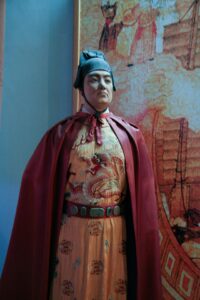
Zheng He
Zheng He (1371-1433)
- Commanded seven treasure voyages across the Indian Ocean between 1405 and 1433 on behalf of the Ming Dynasty, leading fleets of up to 317 ships and 28,000 men to Southeast Asia, India, Arabia and the east coast of Africa — operating at a scale that dwarfed every contemporary European expedition and would not be matched until the twentieth century.1Britannica — Zheng He ↗
- Secured diplomatic tribute from more than thirty states across Asia and Africa through a combination of overwhelming naval power and skilled personal diplomacy — establishing Chinese imperial influence across the Indian Ocean world nearly a century before Portuguese ships rounded the Cape of Good Hope, and bringing back ambassadors, exotic animals and commercial intelligence that expanded the Ming court's knowledge of the world.2World History Encyclopedia — Zheng He ↗
- Died at Calicut in 1433 during his seventh voyage, reportedly buried at sea — after which the Ming court destroyed the official records of his expeditions, banned ocean-going ship construction, and retreated into isolationism, ending a maritime programme that had briefly made China the dominant naval power in the world and would not be resumed for five centuries.3Wikipedia — Zheng He ↗
Zheng He was born Ma He around 1371 in Yunnan Province, into a Muslim family whose father and grandfather had both made the pilgrimage to Mecca — a heritage that would prove significant when he later navigated the Islamic trading world of the Indian Ocean.4National Geographic — Zheng He ↗ In 1381, when he was approximately ten years old, Ming forces invaded Yunnan, killed his father, captured him, and had him castrated. He was sent to serve as a court eunuch under Prince Zhu Di. He grew into what contemporary sources described as an imposing figure of exceptional intelligence, distinguished himself as a soldier and tactician when Zhu Di seized the imperial throne in 1402, and was rewarded with the surname Zheng and ultimately with command of the greatest naval expedition in human history to that point. The analytical framework identifies Zheng He as an Explorers domain profile but the equations that govern his canonical snapshot are as much Military and Political as they are the pure exploration variables that govern Shackleton or Amundsen.5EBSCO — Zheng He ↗ His Defined Output was not to find new lands — the routes he sailed were already known to Chinese and Arab merchants. His Defined Output was to display the power of the Ming Dynasty to every significant ruler in the Indian Ocean world, to bring them into the tributary system, and to return to the Yongle Emperor with evidence that China was the supreme authority in the maritime world. He delivered this output seven times across twenty-eight years. The scale of the enterprise defies easy contextualisation. His largest treasure ships were the biggest wooden vessels ever built — estimated at between 250 and 440 feet in length, depending on which sources are accepted — crewed by specialists including navigators, translators, doctors, soldiers and diplomats.2World History Encyclopedia — Zheng He ↗ Christopher Columbus's Santa María was less than 80 feet long. The fleet that departed for the first voyage in July 1405 consisted of approximately 317 ships and 28,000 men — a force comparable in scale to a significant military campaign, deployed for diplomatic projection. The People variable in Zheng He's profile reflects the management of that population across voyages lasting two years at sea: provisioning, health, discipline, motivation, and the constant management of relationships between Chinese officers, Muslim crew members, and the peoples of dozens of foreign courts. Zheng He's Muslim identity was not incidental to his effectiveness. His family's hajj tradition gave him credibility in the Islamic ports of India, Arabia and East Africa that a Han Chinese admiral could not have established. He built mosques, visited shrines, and sent sailors to Mecca on his final voyage.3Wikipedia — Zheng He ↗ The Congruence variable in his profile reflects a man whose personal identity, professional role and operating method were in genuine alignment — he was not performing Islamic credentials, he was deploying them as a genuine asset within a mission he believed in. The destruction of the official records after his death is the most analytically significant fact about Zheng He's legacy. The same imperial system that had commissioned and funded seven of the largest expeditions in human history subsequently decided to erase them — burning the records, banning ocean-going ship construction, and retreating into the continental isolation that would leave China without a significant naval presence for five centuries.3Wikipedia — Zheng He ↗ The Ministry of War told the emperor in 1477 that the voyages had "wasted tens of myriads of money and grain" and that the deaths they caused could be "counted in the myriads." Zheng He died at sea in 1433. His tomb stands in Nanjing and is believed to contain his clothes and headgear. His body lies in the Indian Ocean.
Score Comparison
Add up to 10 leaders. Click a name to visit their profile.
The 13 Equations
Scores for: The Great VoyagesThe 22 Variables
Canonical scoresSources & Bibliography
The scores assigned to this leader are derived from publicly available sources. Variable inputs reflect documented behaviour, structural conditions, and historical record at the time of each snapshot.