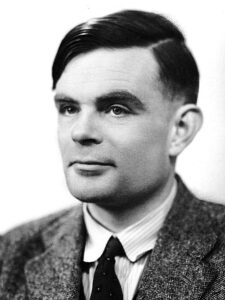
Alan Turing
Alan Turing (1912–1954)
- Led Hut 8 at Bletchley Park from 1939, developing with Gordon Welchman an electromechanical bombe machine that built on foundations laid by Polish mathematicians to break the German Enigma cipher at industrial scale — producing the Ultra intelligence that historians estimate shortened the Second World War by two years, work that remained classified under the Official Secrets Act until the 1970s and was not fully acknowledged until the 1990s.1Imperial War Museums — Alan Turing
- Laid the theoretical foundations of computer science and artificial intelligence before and after the war — the Turing machine, the ACE computer design, the Turing test — work whose full significance could not be explained publicly because its wartime applications remained classified, delaying and distorting its reception.2Wikipedia — Alan Turing
- Prosecuted by the British government in 1952 for homosexual acts, subjected to chemical castration as an alternative to imprisonment, had his security clearance revoked by the institution his work had saved, and died in June 1954 aged 41 — receiving a royal pardon posthumously in 2013, fifty-nine years after his death.3Britannica — Alan Turing
Alan Turing was born in London in June 1912, the son of a civil servant, educated at Sherborne School and King's College Cambridge, and by the time he arrived at Bletchley Park on 4 September 1939 — the day after Britain declared war on Germany — he had already produced the theoretical paper that would eventually be recognised as the founding document of computer science.3Britannica — Alan Turing He had also been working part-time for the Government Code and Cypher School since 1938, which meant that when the war began he understood the Enigma problem more deeply than almost anyone in Britain. He reported to Bletchley and did not leave the problem until it was solved.
The work he produced there is the most consequential act of individual intellectual leadership in the Unsung dataset — and arguably in the history of the Second World War. By early 1942 the cryptanalysts at Bletchley Park were decoding approximately 39,000 intercepted messages each month, a figure that subsequently rose to more than 84,000 — two messages every minute, day and night. Encyclopedia Britannica The bombe machine that made this possible was Turing's design, developed with Gordon Welchman in the autumn of 1939 and spring of 1940, and it was Turing's mathematical insight that had identified the structural vulnerabilities in the German operating procedures that made the machine viable.3Britannica — Alan Turing He led Hut 8, the section responsible for German naval cryptanalysis, and a colleague later wrote that there should be no question in anyone's mind that his work was the biggest factor in Hut 8's success — that in the early days he was the only cryptographer who thought the problem worth tackling.4SpringerLink — Alan Turing at Bletchley Park Experts have estimated that the efforts of Turing and his fellow codebreakers shortened the war by as much as two years. Encyclopedia Britannica
None of this could be spoken of. At the end of the war, a memo was sent to all those who had worked at Bletchley Park reminding them that the code of silence dictated by the Official Secrets Act did not end with the war but would continue indefinitely. The National WWII Museum Turing was awarded an OBE in 1946 — recognition without explanation, a medal that could not be discussed attached to work that could not be described. When he attempted after the war to design the ACE computer at the National Physical Laboratory, the Official Secrets Act made it impossible for him to explain the basis of his thinking, because the thinking had been developed in conditions that remained classified.2Wikipedia — Alan Turing The institution that had used his genius could not allow him to use it freely.
In 1952 he was arrested for homosexual acts — then illegal in Britain — and prosecuted by the same government whose survival his work had helped secure.1Imperial War Museums — Alan Turing He accepted chemical castration as an alternative to imprisonment. His security clearance was revoked. He was placed under surveillance. The Autonomy variable in his final snapshot scores at 2 — the lowest in the Political and Unsung datasets combined — because the state had assumed physical control of his body while simultaneously stripping him of the institutional access his work required. He continued working — his final years produced original research in mathematical biology and morphogenesis — but the conditions the equations describe in that last snapshot are the most extreme concentration of institutional persecution against an individual in the entire Codex.3Britannica — Alan Turing
He died on 7 June 1954, aged 41, from cyanide poisoning. The coroner recorded a verdict of suicide. The work of Bletchley Park and Turing's role in cracking the Enigma code was kept secret until the 1970s, and the full story was not known until the 1990s. Imperial War Museums He received a royal pardon in 2013, fifty-nine years after his death, and his face now appears on the fifty pound note. The arc of his three snapshots — invisible genius, invisible pioneer, visible criminal — is the most precise illustration in the dataset of what happens when a state treats Congruence as a threat rather than an asset. His Congruence variable scores at 10 across all three snapshots. The state's does not.
Score Comparison
Add up to 10 leaders. Click a name to visit their profile.
The 13 Equations
Scores for: Bletchley ParkThe 22 Variables
Canonical scoresSources & Bibliography
The scores assigned to this leader are derived from publicly available sources. Variable inputs reflect documented behaviour, structural conditions, and historical record at the time of each snapshot.
- Imperial War Museums — Alan Turing
- Wikipedia — Alan Turing
- Britannica — Alan Turing
- SpringerLink — Alan Turing at Bletchley Park
- Holocaust Encyclopedia — Bletchley Park
- Bletchley Park Roll of Honour — Alan Turing
- National WWII Museum — Alan Turing and Bletchley Park
- History of Information — Alan Turing cryptanalysis