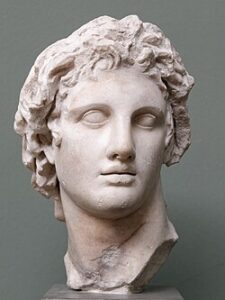
Alexander the Great
Alexander III of Macedon (356–323 BC)
- Crossed the Hellespont at twenty with approximately 48,000 soldiers,1Wikipedia — Alexander the Great destroyed the Persian Achaemenid Empire through decisive victories at Granicus, Issus and Gaugamela, and by thirty had assembled the largest empire the ancient world had seen — stretching from the Adriatic to the Indus, producing the cultural diffusion that established Greek as the lingua franca of the eastern Mediterranean for seven centuries.2Britannica — Alexander the Great
- Killed Cleitus the Black — who had saved his life at Granicus — in a drunken rage when Cleitus accused him of having forgotten Macedonian ways,1Wikipedia — Alexander the Great ordered the massacre of the military-age male population at Tyre and Gaza, marched his army through the Gedrosian Desert killing thousands of soldiers and camp followers,3Britannica — Alexander the Great Timeline and demanded the prostration before the king that Greeks associated with deification.
- Died in Babylon at thirty-two without naming a successor — his reply to the question of who should inherit his empire being "to the strongest" — triggering forty years of war between his generals and the disintegration of everything he had built.4Wikipedia — Wars of Alexander the Great
Alexander III of Macedon presents the equations with their most analytically demanding profile in the ancient world dataset. The historical legacy — the largest empire assembled in the ancient world by the age of thirty, an unbroken battle record, the cultural diffusion that produced Greco-Buddhism and Hellenistic Judaism and established Greek as the lingua franca of the eastern Mediterranean for seven centuries — is not what the equations are measuring. They are measuring the leader at the moment of each snapshot. The gap between the score and the legend is itself the analytical finding.
The accession and consolidation period establishes a variable profile that the Persian campaign would build on and the Central Asian campaign would begin to destroy. Taking the throne at twenty, Alexander moved against every threat simultaneously — eliminating rival claimants, subduing the Thracian tribes, destroying Thebes with sufficient thoroughness that Athens immediately submitted without engagement.5History.com — Alexander the Great: Key Battles The destruction of Thebes is analytically significant not as a military event but as a Defined Output event — a precise calibration of force to achieve a specific political outcome. He needed Greece quiet for a decade. He achieved it in a single demonstration. That is Process and Intent operating at their documented level before the Persian campaign had begun.
The Persian campaign peak is where the personal variable quality operates at its documented maximum. The tactical record across Granicus, Issus and Gaugamela is built on a consistent analytical foundation: the identification of the opponent's psychological and positional vulnerability, the concentration of force at precisely the point where it would be most decisive, and the personal presence at the point of maximum danger that made the outcome irreversible.2Britannica — Alexander the Great At Issus, Alexander personally led the charge at the centre. At Gaugamela, he arranged a double phalanx that opened to absorb the scythed chariots and reformed to break Darius's centre. These are not the same tactical solution applied repeatedly. They are Ability and Humility operating together — a commander who updated his methods to match each opponent rather than imposing a preferred approach on every engagement.
The Humility variable in this period requires specific justification because it sits lower than the tactical record might suggest. Alexander's adaptation of tactics was genuine and documented. His adaptation of self-conception was not. The divine parentage claims, the competitive need to outdo his father that Plutarch records as central to his personality, the reckless personal behaviour in battle that repeatedly endangered his life and therefore the entire campaign — these are Ego and Pride already moving upward in the period of his greatest military achievement. The equations record both the tactical intelligence and the personal inflation simultaneously, because both were present simultaneously.
The Congruence score across the Persian campaign period sits below its ceiling because the historical record cannot be selectively read. The massacre of the military-age population at Tyre, the same at Gaza, the burning of Persepolis1Wikipedia — Alexander the Great — whether deliberate revenge or drunken accident, the latter recorded as an act Alexander immediately regretted — sit alongside the genuinely generous treatment of Darius's family, the restoration of Egyptian temples, the burial of Darius with full royal honours. Both things are in the sources. The equations record both.
The Central Asia and India period is where the variable trajectory reverses and does not recover. The killing of Cleitus the Black — who had saved Alexander's life at Granicus, killed in a drunken rage when Cleitus accused him of having forgotten Macedonian ways — is the Congruence event the equations weight most heavily in this period.1Wikipedia — Alexander the Great Not because it was the most consequential act, but because it was the most precisely documented moment of the gap between stated values and actual behaviour. Alexander spent two days in grief and remorse afterwards. The remorse confirms that he knew what his stated values required. The killing confirms that Ego and Pride at their elevated levels overrode that knowledge in the moment.
The proskynesis demand — requiring the prostration before the king that Greeks associated with deification — cost him the sympathies of his Macedonian companions and was eventually abandoned. The Philotas execution and the subsequent assassination of Parmenion, his most experienced general, removed the institutional memory of the army's leadership in a single sequence of decisions. The inner circle was fracturing under the weight of a leader whose Ego and Pride were consuming the trust that had made the system functional.
The final years and Babylon record Chaos at an elevated ceiling — and the megalomania and paranoia that contemporaries documented with increasing alarm. The Gedrosian Desert march, which killed thousands of soldiers and camp followers through what historians have characterised as either reckless ambition or deliberate parallel to legendary precedents, is Intent operating at maximum against Process that had begun to deteriorate.3Britannica — Alexander the Great Timeline The mass marriage at Susa — Persian and Greek unions designed to cement imperial harmony — produced almost no lasting marriages. The mutiny at Opis was suppressed but not resolved. Hephaestion's death devastated the system at the moment it was most fragile.6The Collector — Alexander the Great
He died in Babylon at thirty-two. His reply to the question of succession — to the strongest — ensured forty years of war between his generals and the eventual disintegration of everything he had built.4Wikipedia — Wars of Alexander the Great That is Defined Output at its terminal value: a leader who had spent thirteen years defining the objective with extraordinary precision, and who produced no mechanism for its continuation.
The trajectory from peak to terminal is the analytical story the biography cannot tell but the equations record precisely. What the equations also record, and what the historical summary tends to obscure, is that the peak was genuine. The equations do not diminish the achievement. They record the mechanism of both the achievement and the collapse — the same Ego and Pride variables that drove a twenty-year-old king across the Hellespont, and that at thirty-two had consumed the Trust and Congruence that had made the system hold.
Score Comparison
Add up to 10 leaders. Click a name to visit their profile.
The 13 Equations
Scores for: Persian Campaign — PeakThe 22 Variables
Canonical scoresWhat changed: Accession — Consolidation → Persian Campaign — Peak
Sources & Bibliography
The scores assigned to this leader are derived from publicly available sources. Variable inputs reflect documented behaviour, structural conditions, and historical record at the time of each snapshot.