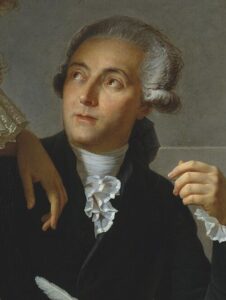
Antoine Lavoisier
Antoine Lavoisier 1743-1794
- As Commissioner of the Royal Gunpowder and Saltpeter Administration from 1775 to 1792, established his laboratory at the Paris Arsenal, attracted young chemists from across Europe who came to learn the Chemical Revolution in progress, transformed French gunpowder from the worst in Europe to the best — a result he achieved by applying the same quantitative chemical methods to production chemistry that he was simultaneously applying to theoretical chemistry — and made France self-sufficient in gunpowder at a moment of acute military necessity.1Science History Institute — Lavoisier ↗
- Chaired the commission that established the metric system — adopted by the National Assembly in March 1791 on the commission's recommendation — serving on the Advisory Committee on Agriculture, the board of the Caisse d'escompte, and multiple other governmental bodies while simultaneously conducting the experimental programme that established the law of conservation of mass, named oxygen and hydrogen as elements, published the Elementary Treatise on Chemistry (1789) and co-authored the systematic Method of Chemical Nomenclature (1787) that produced the naming conventions still used today.2Wikipedia — Antoine Lavoisier ↗
- Was guillotined on 8 May 1794 as a member of the Ferme générale — the private tax-collecting company whose association with the ancien régime made its members targets of the Revolutionary Terror — eighteen months after which he was fully exonerated by the French government, with the mathematician Lagrange observing at his execution that it had taken only a moment to sever that head and that a hundred years might not produce another like it; the most precise expression in the dataset of the Environment variable reaching its absolute destructive floor.3Britannica — Lavoisier and the Revolution ↗
Antoine-Laurent de Lavoisier was born on 26 August 1743 in Paris, the son of a wealthy attorney, inherited a large fortune at five on his mother's death, received a superior classical education at the Collège des Quatre-Nations, obtained a law degree at his father's insistence while simultaneously studying chemistry, botany, astronomy and mathematics, and was elected to the Académie des Sciences at the age of twenty-five — among the youngest ever to receive that honour — on the basis of his earliest geological and chemical work.1Science History Institute — Lavoisier ↗ The analytical profile of Lavoisier in the Scientific domain requires explicit handling of his dual role: he was simultaneously the leader of the Chemical Revolution and an administrator of the French state. The scientific achievement — establishing quantitative experimental chemistry, identifying oxygen and hydrogen as elements, formulating the law of conservation of mass, systematising chemical nomenclature — is not in analytical dispute. The administrative role — tax farmer, Gunpowder Commissioner, agricultural committee member, metric system chairman — provided the funding and the laboratory space that made the science possible. These are not separate lives that happened to occur in the same person; they are analytically connected. The Gunpowder Commission is the most precisely documented institutional leadership achievement. Lavoisier arrived at the Paris Arsenal in 1775, established a laboratory that attracted European chemists, systematically improved the saltpeter production process, improved gunpowder quality, and made France self-sufficient in a strategic military material within a few years. The Process variable in this phase reflects a scientist who understood the difference between laboratory-scale and production-scale chemistry and applied the same quantitative methodology to both.4Britannica — Lavoisier ↗ The metric system commission is the administrative leadership achievement with the largest long-term impact. Lavoisier chaired the committee that designed and recommended a rational, internationally reproducible system of measurement based on physical constants rather than royal feet. The recommendation was adopted. The system it produced is still in use globally. The Congruence variable in Lavoisier's profile requires analytical precision. He was a genuine Enlightenment liberal who believed in the power of reason and science to improve human welfare, who served on multiple government bodies with this intention, and who declined to flee France when the Revolution turned dangerous because he believed he could remain useful. He was right about the science. He was fatally wrong about the politics. The Environment variable in his final snapshot approaches its absolute floor: a political system that had decided the category to which he belonged was condemned, regardless of individual merit. His remains were never identified. The equipment and documents his wife Marie-Anne salvaged after his execution enabled the posthumous publication of his Mémoires de chimie in 1805.
Score Comparison
Add up to 10 leaders. Click a name to visit their profile.
The 13 Equations
Scores for: Revolutionary Terror — Environment at Its FloorThe 22 Variables
Canonical scoresWhat changed: Gunpowder Commission and Chemical Revolution — Peak → Revolutionary Terror — Environment at Its Floor
Sources & Bibliography
The scores assigned to this leader are derived from publicly available sources. Variable inputs reflect documented behaviour, structural conditions, and historical record at the time of each snapshot.