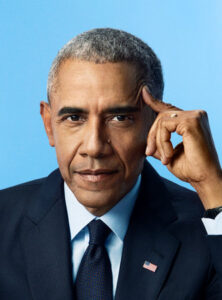
Barack Obama
Barack Obama (born 1961)
- Born in Honolulu, Hawaii, to a Kenyan father and a mother from Kansas, raised in Hawaii and briefly in Indonesia, became the first African American president of the Harvard Law Review, served in the Illinois State Senate before his 2004 keynote address at the Democratic National Convention launched a national political career1Britannica — Barack Obama — then won the presidency in November 2008 with nearly 53 percent of the popular vote, becoming the first African American to hold the office and receiving the Nobel Peace Prize in his first year.
- Signed the Affordable Care Act in March 2010, providing health coverage to over 20 million previously uninsured Americans2Obama Presidential Library — Barack Obama — then watched the 2010 midterm elections produce the Tea Party wave that destroyed his legislative majority, leaving executive orders, coalition diplomacy, and incremental action as the primary instruments of governance for the remaining six years of his presidency.
- Authorised the Special Forces raid that killed Osama bin Laden in May 2011, negotiated the Iran nuclear deal and the Paris Climate Agreement in 2015, and normalised relations with Cuba — before leaving office in January 2017 with an approval rating above 55 percent3Washington Monthly — Obama accomplishments and a successor who spent four years attempting to dismantle everything he had built.
Barack Obama served as the 44th President of the United States from 2009 to 2017, becoming the first African American to hold the office. He arrived with the largest political mandate of any Democrat since Lyndon Johnson, a global wave of goodwill that was historically unprecedented, and a financial crisis that required immediate systemic intervention. He left with the Affordable Care Act, two Supreme Court appointments, the killing of Osama bin Laden, and a legacy that his supporters consider transformational and his critics consider incomplete.
The gap between those two assessments is itself analytically interesting. Obama's personal variables were extraordinary — Charisma, Visibility, Recognition, Confidence, and Congruence all at or near their ceiling in 2009. The problem was not the leader. It was the system around the leader.
The 2010 midterm elections produced the Tea Party wave that destroyed his legislative majority and fundamentally altered the remaining six years of his presidency. From that point forward, Obama was governing by executive order, coalition, and incremental diplomacy rather than by legislative programme.1Britannica — Barack Obama His Autonomy variable collapsed. His Defined Output variable became aspirational rather than achievable. The Republican Congress was not merely opposition — it was a permanent veto on the domestic agenda.
What he did with those constraints is the more interesting question. The Iran nuclear deal, the Paris Climate Agreement, the normalisation of relations with Cuba, and the sustained management of a recovering economy all represent genuine achievement under structurally hostile conditions.2Obama Presidential Library — Barack Obama His k variable improved steadily after the 2008 crisis inheritance. His People variable remained high throughout — the broader team was consistently competent.
The variable that costs him most in the Codex is Defined Output in the second term. Without legislative capacity, the outputs became difficult to define precisely enough to drive the equations. Vision without delivery mechanism is Inspiration, not Leadership — and the equations treat the distinction seriously.
His Congruence remained high throughout — perhaps the most consistent of any modern president. He said what he believed, believed what he said, and the gap between the two was narrow in both directions.3Washington Monthly — Obama accomplishments In an era when that variable is increasingly rare, it is worth noting.
The presidency ended with an approval rating above 55 percent — unusually high for a two-term president — and a successor who spent four years attempting to dismantle everything he had built. The durability of what survived that dismantling is perhaps the most honest measure of what the Defined Output variable actually delivered.
Score Comparison
Add up to 10 leaders. Click a name to visit their profile.
The 13 Equations
Scores for: Final Year 2016The 22 Variables
Canonical scoresWhat changed: Second Term 2013–2016 → Final Year 2016
Sources & Bibliography
The scores assigned to this leader are derived from publicly available sources. Variable inputs reflect documented behaviour, structural conditions, and historical record at the time of each snapshot.