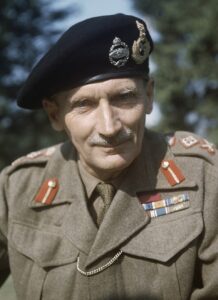
Bernard Montgomery
Bernard Montgomery (1887–1976)
- Took command of the demoralised Eighth Army in August 1942, stabilised the position at Alam Halfa by correctly predicting where Rommel would attack, spent two months rebuilding training, logistics and combined arms coordination, then drove the Afrika Korps to defeat at El Alamein in twelve days — taking over 30,000 prisoners — before pursuing across North Africa to the final Axis surrender in Tunisia in May 1943.1Wikipedia — Bernard Montgomery
- Commanded all Allied ground forces at Normandy on 6 June 1944, adapted when the immediate capture of Caen proved impossible, fixed the bulk of German armour in the eastern sector to free the American breakout west, and accepted the German surrender in northwest Europe at Lüneburg Heath on 4 May 1945.2National Army Museum — Bernard Montgomery
- Published his memoirs in 1958, generating formal demands for retraction from former colleagues across three Allied nations, the threat of legal action from Auchinleck, and the withdrawal of his honorary citizenship of Montgomery, Alabama2National Army Museum — Bernard Montgomery — a man Churchill had called unbeatable and unbearable3US National Park Service — Bernard Montgomery confirming both verdicts simultaneously in a single volume.
Bernard Montgomery presents the Codex with its most analytically contested Military domain profile. The operational record and the personal variable profile run in opposite directions throughout his career — a commander whose Process, Defined Output and Intent were consistently high, whose Ego was consistently elevated, and whose Pride inflated progressively from El Alamein onward until the post-war memoirs produced the most comprehensively damaging act of self-promotion in the dataset. Churchill's verdict — in defeat unbeatable, in victory unbearable — is not a biographical observation. It is the Chaos variable stated in six words.3US National Park Service — Bernard Montgomery
The early career and Western Desert period establishes the operational template with a clarity the sources support consistently. Montgomery took command of the Eighth Army in August 1942 when it was demoralised, tactically uncertain and operating without a coherent combined arms doctrine. Within a fortnight he had stabilised the position at Alam Halfa, correctly predicted where the German attack would come, and prepared the defence accordingly.1Wikipedia — Bernard Montgomery He then spent two months doing something his predecessors had not — rebuilding training, logistics, combined arms coordination and crucially the confidence of an army that had been retreating and improvising for eighteen months. The burning of withdrawal plans was theatre. The substance behind the theatre was genuine.
The Second Battle of El Alamein began October 1942. Twelve days later it was over. Over thirty thousand prisoners taken. The Afrika Korps broken as an offensive force.1Wikipedia — Bernard Montgomery He then pursued across Libya into Tunisia through the winter of 1942, defeated the last German offensive at Medenine in March 1943 — again correctly anticipating the attack and preparing the defence with minimal casualties — and drove the Axis to final surrender in Tunisia in May 1943. Process and Defined Output operating at their documented peak. He said what he would do, prepared meticulously, and delivered precisely the result he had specified.
The Codex records the Autonomy variable at its highest in this period because the Western Desert gave him the cleanest command structure of his career. No coalition friction of consequence, clear operational objectives, sufficient resources assembled before he would commit to battle. The Ego and Pride variables were already elevated — the self-promotion, the personal branding, the black beret and the carefully cultivated public image — but at this stage they were contained within a command environment that rewarded operational output rather than coalition management. The Chaos the equations record in this period was producing the focused, disciplined, methodical approach that broke the Afrika Korps.
The Sicily and Italy period is where Corporate Drag begins its upward movement. The coalition command structure tightened, American commanders took increasing exception to his attitudes and his boastfulness, and the Italian terrain imposed constraints that North Africa had not.2National Army Museum — Bernard Montgomery His description of the Italian campaign as a dog's breakfast was analytically correct — it was a strategic sideshow fought in difficult terrain against a determined opponent — but the language ensured that the commanders whose cooperation he needed heard the criticism as personal rather than strategic. Ability and Process remained high. The Codex records what the variables produced, not what the political narrative required.
The Normandy and Northwest Europe period is the profile's most analytically significant and the most misread. The Caen controversy — whether the failure to take Caen immediately was a deviation from the master plan or always the intended approach — is ultimately the wrong analytical question. The right question is what the Codex measures: did the plan survive contact with the enemy, did the commander adapt correctly when it did not, and did the campaign deliver its stated objective. The answers are no, yes, and yes.
The 21st Panzer Division and the 12th SS Panzer Division Hitlerjugend stopped the immediate capture of Caen. Montgomery adapted — drawing German armour east through a series of operations that fixed the bulk of the Wehrmacht's armoured reserve against the British and Canadian sector, freeing the American forces to break out west. The Falaise Pocket destroyed Army Group B as a fighting force. On 4 May 1945 Montgomery accepted the German surrender in northwest Europe at Lüneburg Heath.4The Famous People — Bernard Montgomery The plan did not survive contact. The mission did. That is Process and Intent operating correctly — local commanders empowered to make decisions as the situation developed, the strategic intent embedded deeply enough to survive the friction of coalition command and the chaos of the Normandy bocage.
The elevated Chaos throughout this period records the personality accurately. He was difficult, self-promoting, tactless with American commanders, nearly sacked after Goodwood, and publicly insufferable after the Battle of the Bulge when he claimed credit in terms that Bradley and Eisenhower found professionally offensive.5Encyclopedia.com — Bernard Montgomery The Corporate Drag variable rises in this period because these behaviours generated real institutional friction. But the Codex does not rate the friction. It rates what the leader produced against his stated objectives. The campaign objectives were achieved.
The post-war and later years period is where Pride reaches its terminal value and the Congruence variable produces its lowest reading. The 1958 memoirs generated formal demands for retraction and apology from former colleagues across three Allied nations. Auchinleck threatened legal action. Montgomery was stripped of his honorary citizenship of Montgomery, Alabama.2National Army Museum — Bernard Montgomery His public support for apartheid after visiting South Africa, his opposition to the legalisation of homosexuality in terms that embarrassed even his supporters, his dismissal of African leaders as complete savages — these are Congruence events that the Codex must record honestly. The operational record was genuine. The post-war record damaged it systematically through a Pride variable that had reached a level where no accommodation of alternative perspectives was possible.
Brooke, his patron and consistent defender throughout the war, wrote in his diary that he had to haul him over the coals repeatedly for his egotistical outlook and lack of tact. Eisenhower valued his military judgement while finding him personally impossible. Churchill, who promoted him to Field Marshal partly to manage the political consequences of removing him from ground forces command, called him unbeatable and unbearable in the same breath.3US National Park Service — Bernard Montgomery The Codex produces a profile that agrees with all three assessments simultaneously — because all three were simultaneously correct, and because the variable framework is capable of holding that analytical complexity in a way that a single biographical verdict cannot.
Score Comparison
Add up to 10 leaders. Click a name to visit their profile.
The 13 Equations
Scores for: Normandy — Northwest EuropeThe 22 Variables
Canonical scoresWhat changed: Sicily — Italy → Normandy — Northwest Europe
Sources & Bibliography
The scores assigned to this leader are derived from publicly available sources. Variable inputs reflect documented behaviour, structural conditions, and historical record at the time of each snapshot.