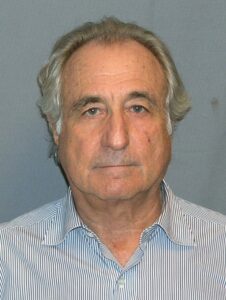
Bernie Madoff
Bernie Madoff (1938-2021)
- Founded Bernard L. Madoff Investment Securities in 1960, built the legitimate brokerage arm into one of Wall Street's largest market makers, served as chairman of the NASDAQ stock exchange, and cultivated an image of such exceptional trustworthiness and exclusivity that investors competed for access to his fund — an image maintained without a single genuine investment in the asset management business for at least twenty years.1Britannica — Bernie Madoff ↗
- Ran the largest Ponzi scheme in history, estimated at $65 billion in paper value and between $17 and $20 billion in actual principal — depositing client funds into a single Chase Manhattan bank account, fabricating trading statements by reading historical editions of the Wall Street Journal to identify past winners, and paying earlier investors with money from later ones for at least two decades while submitting false filings to the SEC.2Wikipedia — Madoff Investment Scandal ↗
- Confessed to his sons Mark and Andrew on 10 December 2008 that his asset management business was 'one big lie' — was arrested by the FBI the following day, pleaded guilty to eleven federal felonies in March 2009, and was sentenced to 150 years in prison, the maximum available — his son Mark died by suicide on the second anniversary of the arrest, and his son Andrew died of cancer in 2014; Madoff died in federal prison on 14 April 2021, aged 82.3Wikipedia — Bernie Madoff ↗
Bernie Madoff was born on 29 April 1938 in Queens, New York, grew up in the predominantly Jewish neighbourhood of Laurelton, worked through college, and founded Bernard L. Madoff Investment Securities in 1960 with $5,000 earned from lifeguarding and installing sprinkler systems.1Britannica — Bernie Madoff ↗ The legitimate brokerage arm of that firm became genuinely significant — a pioneer of electronic trading whose computer systems were eventually adopted by the NASDAQ exchange, and a market maker that at its peak was the sixth-largest in S&P 500 stocks. Madoff served as NASDAQ chairman in 1990. None of that was fiction. The fiction was everything else. This profile uses four snapshots to make the analytical structure explicit: two labelled PERCEIVED, two labelled ACTUAL, across two phases. The perceived snapshots score what the world believed about Madoff at each phase. The actual snapshots score what was really happening. The gap between them is the analytical definition of the faker — not a leader who failed, but a leader who manufactured the appearance of leadership while doing something entirely different underneath it. The perceived face during the rise phase scores extraordinarily high. Madoff cultivated exclusivity as a weapon — investors were told they were privileged to be considered, that not everyone was accepted, that access to his fund was a mark of distinction.2Wikipedia — Madoff Investment Scandal ↗ His clients included the foundation of Holocaust survivor Elie Wiesel, Steven Spielberg, Kevin Bacon, major banks, pension funds and sovereign wealth vehicles. His reported returns of approximately ten per cent annually, in both up and down markets, were the defining perceived variable — Defined Output at its ceiling, Ability at its ceiling, Process at its ceiling. Financial analyst Harry Markopolos presented the SEC with a detailed memo in 2005 titled 'The World's Largest Hedge Fund is a Fraud,' noting that such a return distribution 'simply doesn't exist in finance.' The SEC took no action. Major accounting firms including PricewaterhouseCoopers and KPMG found no irregularities. JPMorgan Chase, where the account sat, ignored signs of money laundering. The perceived profile was impregnable.1Britannica — Bernie Madoff ↗ The actual profile during the same period is its precise mirror image. No investments were made. Client money was deposited into a personal business account at Chase Manhattan Bank. When clients requested withdrawals, they were paid from the same account using newer investors' money. The fabricated trading statements were produced by staff members who read old editions of the Wall Street Journal to select past winners and backdated fictional purchases. Madoff told the SEC Inspector General from his prison cell that he believed the SEC didn't look carefully enough because of his personal reputation — a precise description of how the perceived profile protected the actual one.4TheStreet — Bernie Madoff ↗ The actual Congruence variable is not zero — Madoff's stated values and his actual behaviour were in alignment, in the sense that he consistently behaved as a man who had decided to deceive everyone around him. It is the Intent variable that collapses: the people in his environment did not understand what he was doing or why, because he had constructed a complete alternative reality for them to inhabit. He confessed on the evening of 10 December 2008, the day after the Lehman Brothers collapse had triggered withdrawal requests he could no longer satisfy, to his sons who worked in the legitimate side of the business and had no knowledge of the scheme.5A&E — Bernie Madoff ↗ They reported him to federal authorities. He was arrested the following morning. In his plea allocution he stated that he had always intended to resume legitimate trading activity but it proved 'difficult, and ultimately impossible.' He was sentenced to 150 years. His son Mark died by suicide on the second anniversary of the arrest. His son Andrew died of cancer in 2014. Madoff died in federal prison on 14 April 2021, aged 82, still insisting he had acted alone.
Score Comparison
The 13 Equations
Scores for: PERCEIVED — Rise Phase 1980s–2000The 22 Variables
Canonical scoresSources & Bibliography
The scores assigned to this leader are derived from publicly available sources. Variable inputs reflect documented behaviour, structural conditions, and historical record at the time of each snapshot.